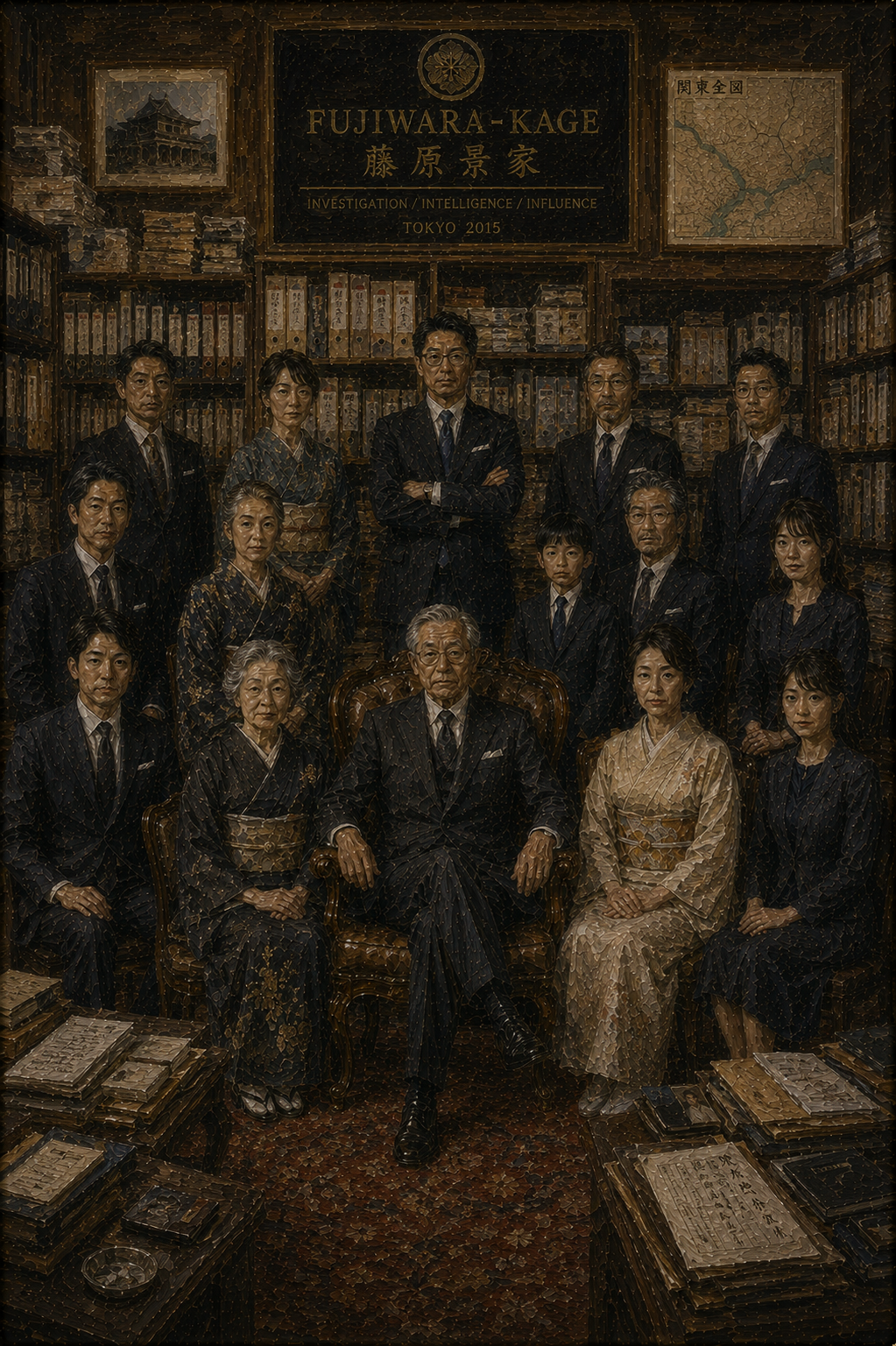
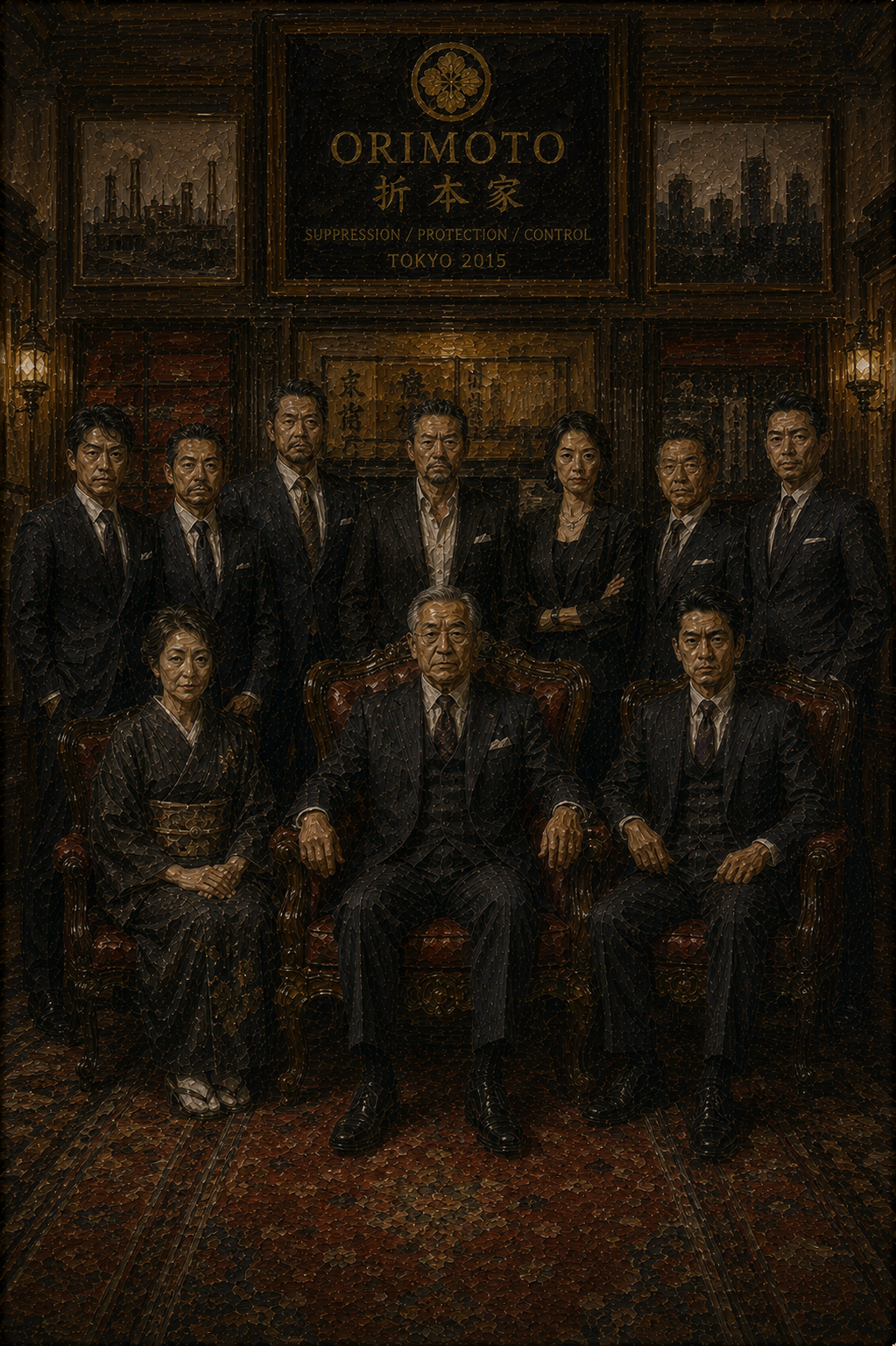
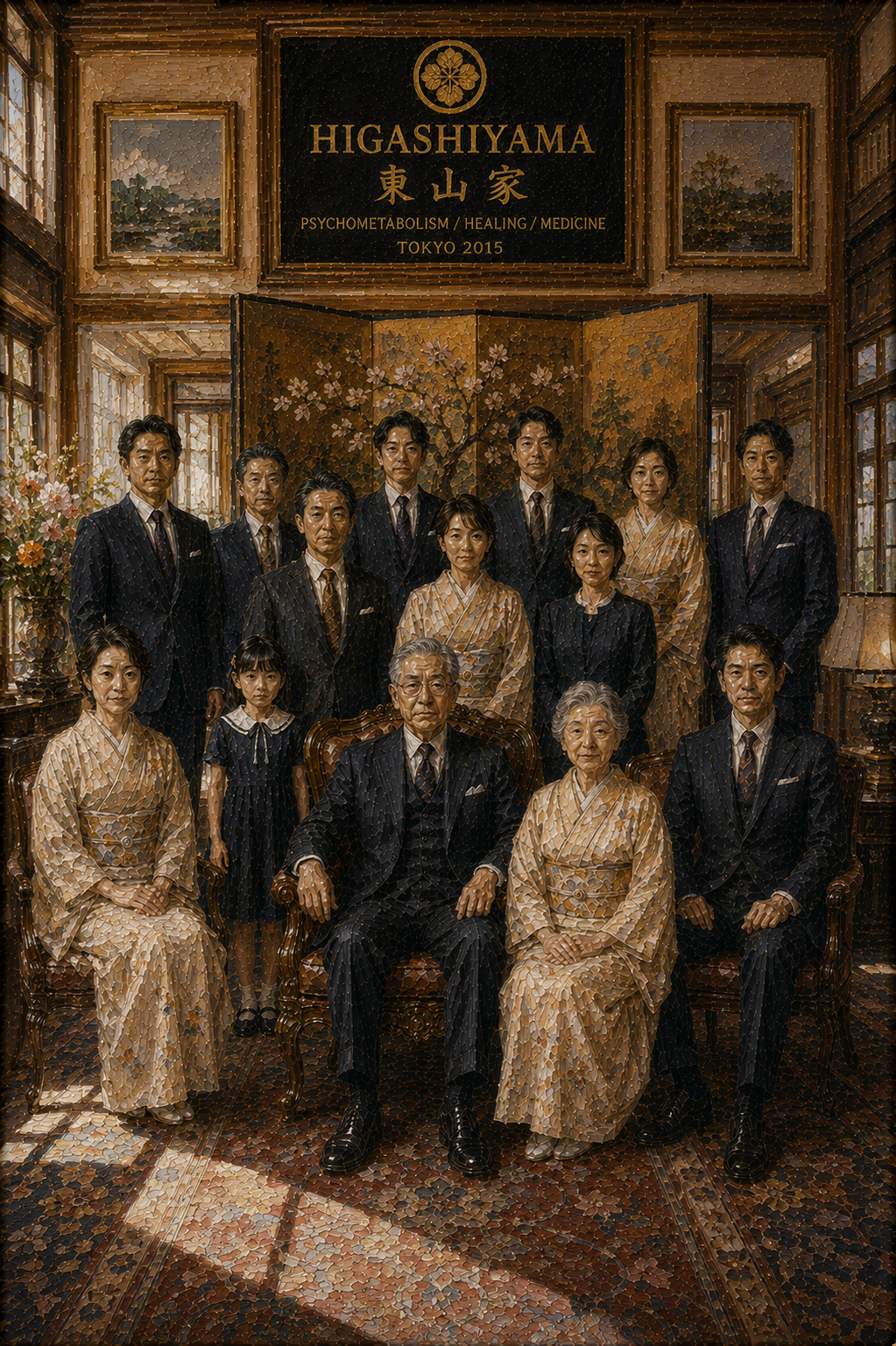
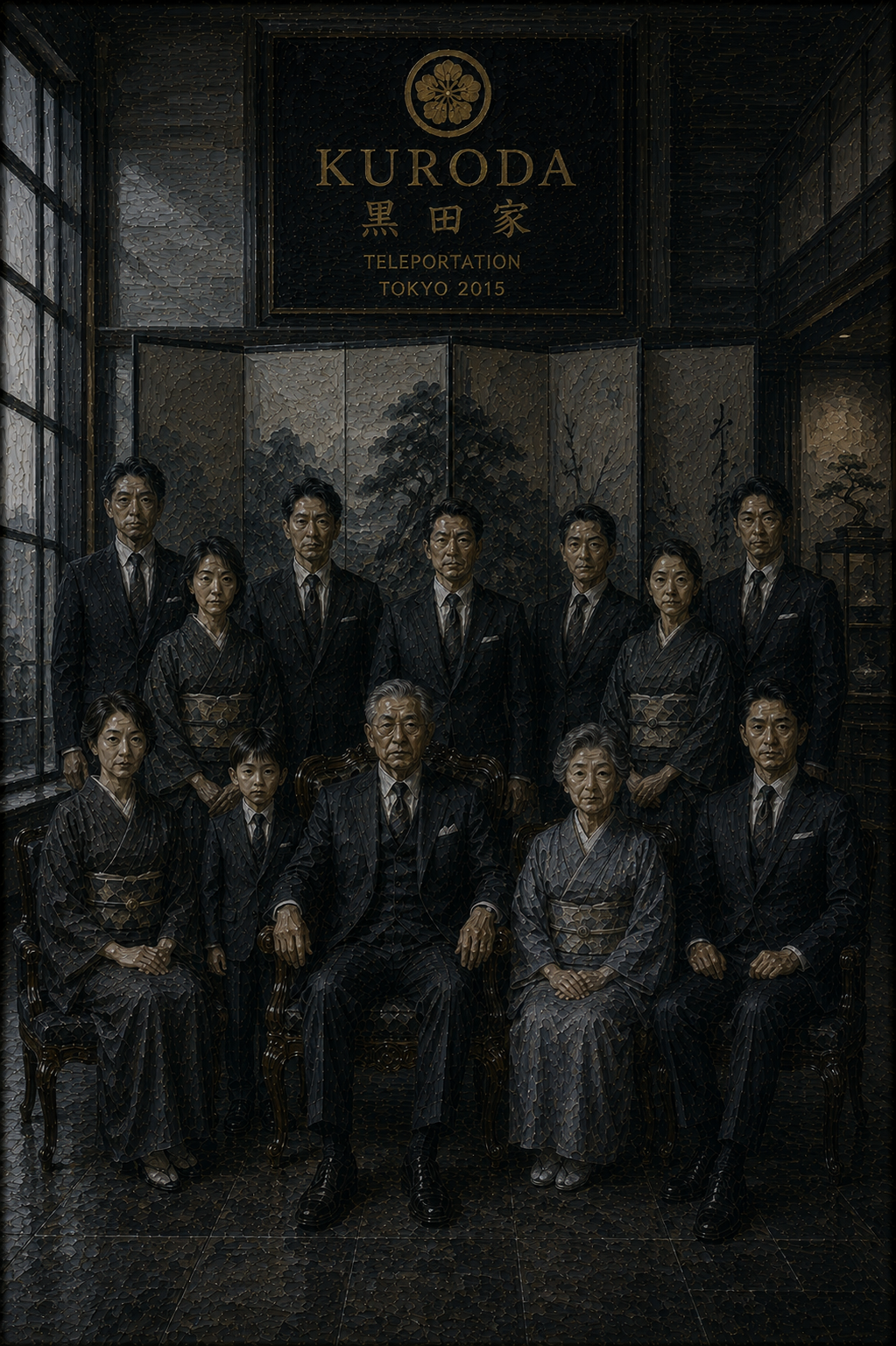
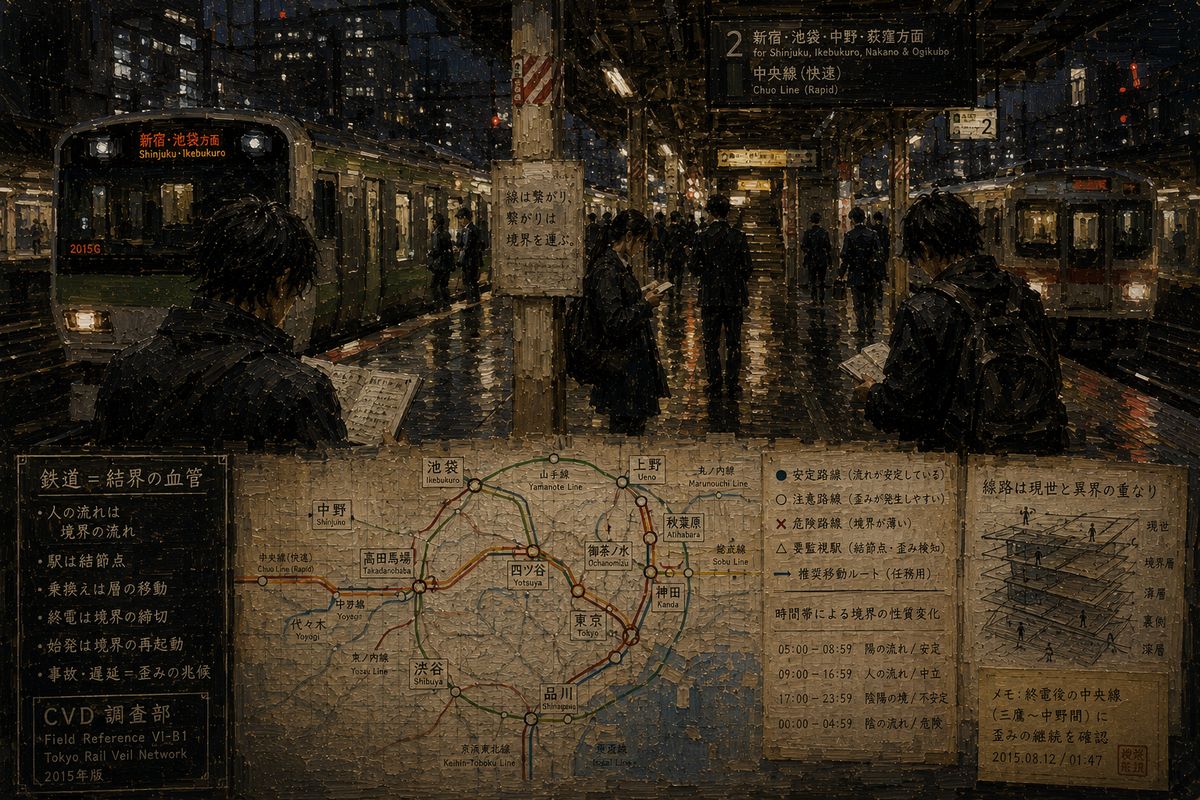
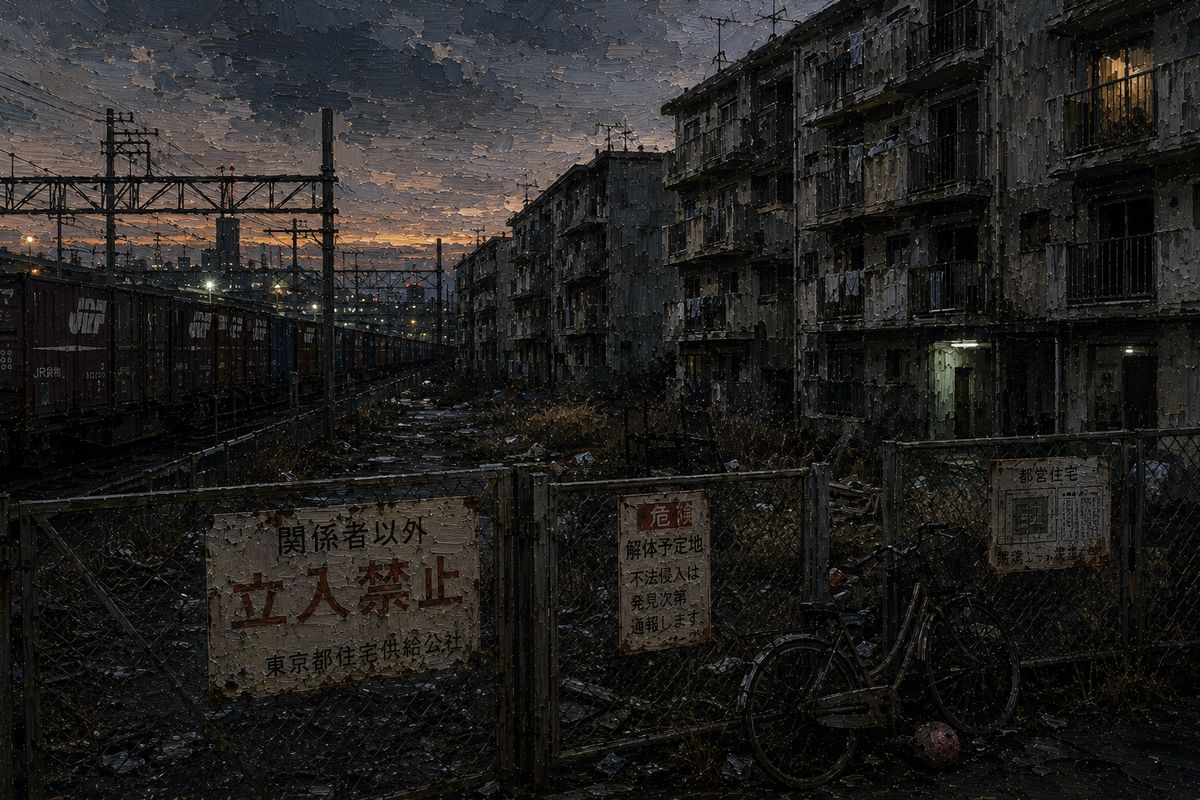
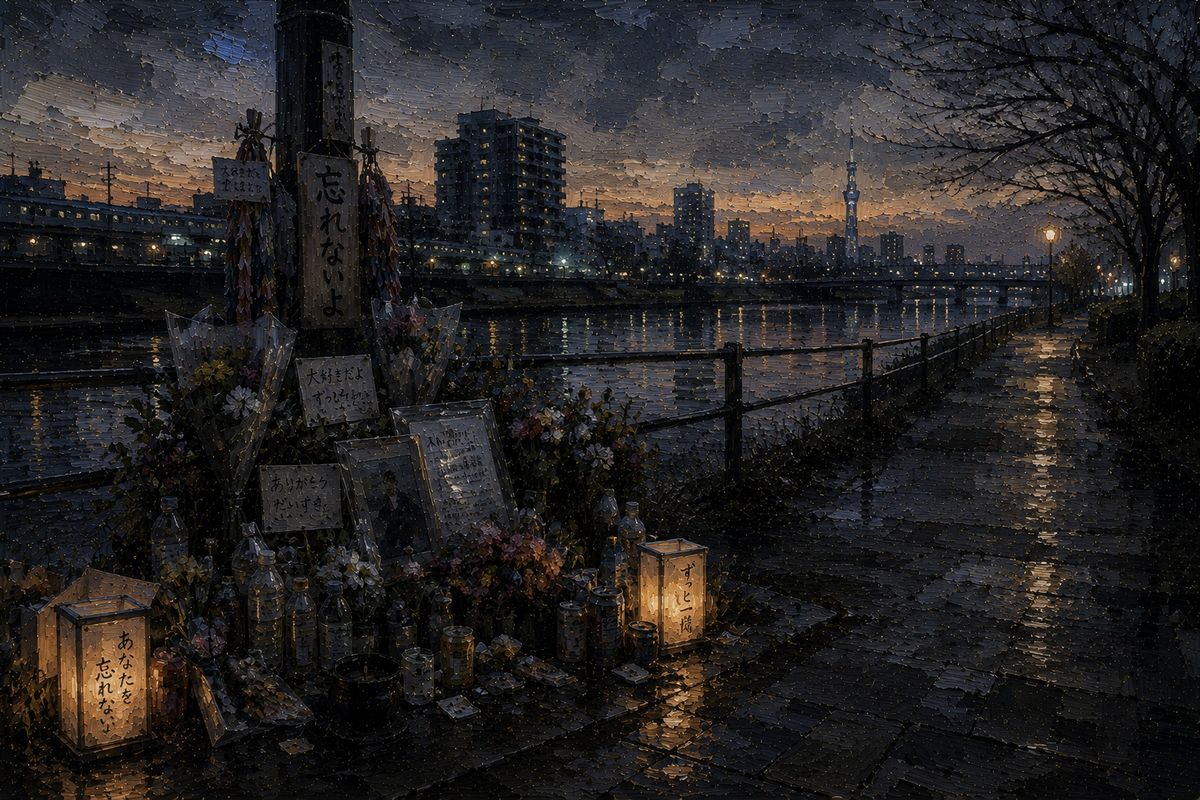
This page is the canon of the world. Every other page of this book follows it.
The world
The veil. The veil never falls. That is the premise of the whole story. If it fell, every being would come to earth, many would take humans, and almost everyone would die. Demons want it to fall or to thin. The more power they use, the thinner it gets, and when two very strong entities fight, the veil is disturbed in that place. The final battle is won because the veil does not fall. It is fought on the human side. On one side are cults, possessed people and demons. On the other are the Thirteen, the CVD and the families. Obon is a great deal of suffering at once, so the veil thins. Some good souls cross and return. Many bad ones cross, do not want to go back, and possess people.
Entering the veil. People go into the veil only to fetch information of extreme importance. Nobody trains there. The work of everyone in this world is to send back what has come through to the human side.
Spirituality, not magic. Clothes keep their colour, objects do not appear from nothing, and time is never stopped or turned back. The tone is raw, painful and real, with deaths, horror and swearing allowed. Problems are solved by people paying a price.
Rats. A demon can borrow a rat's senses. Rats are never possessed and do not speak.
The Font, the Axis and the planes
The Font. The Font is the totality of every force and every domain. It is the origin of creation. It creates and expands, and its nature is expansive and entropic. Balance is not its function. It is neither good nor evil, and it is not a god in the human sense.
The Axis. The Axis is Kuze Kaname, a human being whose consciousness fused with the totality. He is the first instrument of the Font. He keeps the balance between the forces and between the planes, exists in every plane at once, and contains all thirteen domains. He is not God and not the Font, and he did not create anything. He gave up his name when he became the whole, because to become the whole you give up your name and your ego, and nobody remembers him. He is in a trance and has lost access to the human meaning of his Duty.
The planes. Seven planes coexist. Physical, Astral, Mental, Buddhic, Atmic, Monadic and Divine. They are one existence in different conditions, and one place can show different things from different planes. The veil is the structure that lets them coexist. When it is disturbed, the relations between planes become unstable.
The discard plane. The Axis can take something out of accessible space and send it to a plane of discard. How it works is not yet decided and must not be invented.
The Convergence. The place where the Axis fused with the Font to keep the balance. A person reaches it through mediumistic overload, by using their abilities too far, stretching perception past what they can hold, or thinning the veil beyond what they can stabilise. It is dangerous. People come back mad, unable to work, with fragments they can explain, with new or stronger abilities, or with understanding they did not have. Nothing protects anyone completely. "Do not look into God's eyes" is a CVD rule everyone knows, because many have looked and gone mad.
What the Convergence gives. A person asks one question and gets one answer, then is sent back. The answer is always true and always granted, but the person does not know how it will happen, so the intention must be very clear. People come back with a trace of another ability, wild and not their own, for about three days to a week, and their main ability roughly doubles and becomes much easier to train. The Convergence stimulates what was already latent. A trace that is trained in that week stays anchored. Everyone else thinks it is a hangover. The group discovers the truth and uses it like a cheat nobody else knows, which is how Itsuki gains Psychokinesis and Teleportation. Whoever goes alone comes back wrecked, so Rei once proposes they all hold hands and go together. In the end each goes in their own moment, and on their return Rei can tell what each one absorbed.
Rei at the Convergence. Rei knows he cannot look at the totality, so he asks instead. His questions are about the structure. Why there is a demon in the human world, why some people have two abilities, what the domains and the seats are for, why the veil must be kept, and what is missing between humans and the Font. At first he sees no man and no face. Other people cannot see the Axis because they do not have the understanding. Through his questions, much training and real understanding of his own function, Rei comes to see him, a man, and then talks with him as a person and explains the human world to him. The conversation helps the Axis recover the human meaning of Duty, but only Rei taking the seat restores the function.
When the veil falls. The veil falls only if the Axis leaves his post, gives up, abandons humanity, or is attacked, which is almost impossible. Then a dark age of war follows, as it did long ago. In that war one of the Thirteen grows strong enough, feels empathy and love, understands every feeling and forgives, and fuses with the totality as the new Axis. Their identity vanishes for everyone.
The Axis at the end. The Axis has accepted his fate. He will leave only when he dies. He is good, calm and gentle. He tells Rei he is the only one who knows who he is and hopes he will visit.
Other names. The veil is also called the membrane. The Axis is also called the Architect. "Font pull" and "Font return" name the pull of the totality.
Domains, seats and the two Thirteens
Domains. The thirteen domains are Grief, Rage, Love, Fear, Wonder, Despair, Joy, Shame, Hunger, Courage, Longing, Awe and Duty. Each is a pillar of balance. "Register" means the same as domain. A person's domain is the one of these emotions they are anchored in, felt in one life.
Seats. A domain is the emotional force, a seat is the function that makes a connection, and an occupant is whoever takes the seat. Every emotion has two seats. One is among the living, held by a human of the Thirteen at Singularity rank. One is among the dead, held by a demon of the Thirteen of Yomi at Guardian rank. Two seats are vacant, on different sides. Duty is vacant among the living. Among the dead, Duty is Yushiro's seat. Love is vacant among the dead, while Sakuma Kei holds Love among the living.
The Love seat. It connects the Font to the world of the dead. It lets spirits and demons understand the life they had, value it and accept where they are now, so they do not try to come back wrongly. Ren, the Love demon inside Usami, takes this seat. Reincarnation is an unconfirmed hypothesis, a matter of faith.
The Duty seat. It connects the Font to the human world. Its absence is a missing function. Nobody knows since when it has been vacant. Rei must occupy it. His Duty grows from his brother to his companions, the Resistance, the people the CVD ignores, and humanity, and he never stops loving his brother.
Humans and demons in the structure. Humans stabilise their pillar by developing their domain, understanding it, training their abilities, using them without losing their balance, and taking responsibility for the veil and for humanity. Demons connect the domains to the Font.
The human Thirteen. They are Singularity rank and sit beside the Axis. They live their own lives and meet Rei in the street. Mori Takao leads them. Under pressure are Mori Takao, Nakashima Yuna, Inoue Satoru and Park Junho, with Watanabe Jun weakening. Satoru of Hunger sometimes feels a glutton's hunger. Rei meets all of them at one meeting and admires Sakuma Kei of Love, who has a fatherly side. Nobody among the Thirteen is closer to the Axis than the others. Much later Itsuki becomes one of the Thirteen.
The Thirteen of Yomi. The thirteen demons of the thirteen emotions. Their Love seat is empty, which is why the demons are maddened and the world behind the veil is unstable, and nobody knows it. Only five are on the living side. The Healer, Kishin, Courage, Joy (who came only for fun) and Hunger (hungry for anything new, for souls and for strength). The rest stay behind the veil and do not join the war. Joy and Hunger are wandering the living side happily. They do not know that a demon of the Thirteen should not leave its seat, and every day away weakens the world of the dead a little more. Nobody, on either side, knows exactly what the seats are for. Joy and Hunger appear only in the battle. At the end some come to help with Kishin. Courage has been held since the early 1980s in the unnumbered room in Audit. At the end the demons become the thirteen of the world of the dead.
Ranks
The ladder. Null, Sensitive, Postulate, Adept, Ritualist, Arbiter, Vanguard, Guardian, Singularity, Axis. Demons and spirits use the same ranks.
Sensitive. A latent, untrained aperture.
Postulate. A registered initiate who already works. Everyone who enters the CVD already sees entities.
Vanguard. Absurdly strong people who still work. Leaders inside the CVD and heads of families.
Guardian. A Vanguard who kept growing. Every master is a Guardian. A Guardian can act, but every use thins the veil around them and draws the other side, so they act only when nothing else will do. They live isolated and the Director suppresses them in between. A possessed master is one of the most dangerous things in the world. The demons of the Thirteen of Yomi stand at this level, and that is where the name comes from, because they guard the far side of the veil.
Singularity. The human Thirteen. Some were isolated masters, some were born and grew strong, and all earned a place beside the Axis. A Singularity stabilises itself and can act.
Axis. A state, not a rank.
Second paths. Anyone at any rank can open a second path, but nobody knows. The human Thirteen have one path each. The Axis and Rei are the ones who find out, because the Uedera are born with two paths, one latent. People in the Vessel Program have two, their own and the entity's. Everyone believes only the possessed can have more than one, so the Vessels are seen as much stronger than ordinary investigators. A Guardian maximises one path. Six paths cannot be held without losing one's mind. Only the Axis holds all six.
Suppression. Suppression is a secret. Only the Vanguards, the Director, Gin, cult leaders and the strongest people know. The Director suppresses the Guardians. Gin may have suppressed some people.
Abilities and techniques
Abilities. The six abilities are Clairsentience, Telepathy, Biokinesis, Telekinesis, Psychokinesis and Teleportation. Clairsentience and Telepathy are the rarest. Inside each ability there are techniques. Different people can hold different techniques in the same ability. A technique is not exclusive to one person, but the way of carrying it out can be. Two telekinetics can master the same containment, and one spreads the force over wide surfaces while the other concentrates it into tiny points. The domain does not decide which techniques a person has. It decides how they use them. The Axis opened every feeling, and with that every ability and every technique.
Which path a technique belongs to. By what it does. Force on matter is Telekinesis. Energy is Psychokinesis. Changing where something is is Teleportation. Perceiving information is Clairsentience. Acting on a mind is Telepathy. Acting on a body is Biokinesis. Reading a lie by sensing what a person radiates is Clairsentience, and reading it inside their mind is Telepathy. Calming someone through their body is Biokinesis, and calming them by sending a feeling is Telepathy.
Biokinesis. It helps the body and wounds. It can steady another person only very lightly.
Teleportation. It crosses dimensions, which is discovered later. It can redirect an attack (sending a thrown chair or bolt elsewhere), disarm, cancel a fall, swap places with a friend, reach the spirit plane once the teleporter has been there, and send a ghost back to its plane when the ghost is not inside a person, and a strong one comes back. It does not work on possessed people. At high level a teleporter can hold a house, then a whole neighbourhood, in the intermediate dimension for a while.
The mind inside. When a telepath enters a mind there is a place inside and a short journey through it. The place is the person's real life, what they lived, love, hate and fear. It wears the face of whoever controls the body. In possession the owner is alone at the bottom of their own mind, and the demon is in the body. Gin's mind with the Healer inside is not a bad place. Rinka's mind with Kishin is a purgatory. Usami's mind is sweet, full of everything he loves and everyone he knows, even people who dislike him.
Demons, possession and exorcism
Demons. Demons are ancient, and it takes a very long time to become one of the Thirteen of Yomi. They are untrustworthy and impulsive. A demon acts the second it wants something and makes its host do things that are not in the host's nature. In every demon and every possessed host the pupils do not contract in the light. Almost nobody notices. A corrupted emotion becomes its excess. Every emotion has a balance, an excess and a lack.
| Emotion | Balance | Excess | Lack |
|---|---|---|---|
| Grief | honouring the loss and moving on | unable to let go | coldness, no loss hurts |
| Rage | defending one's limits | revenge and destruction | accepting everything |
| Love | caring and letting go free | obsession | indifference |
| Fear | prudence | paranoia, sees enemies everywhere, strikes first | recklessness |
| Wonder | open curiosity | fear of everything, extreme self-preservation | boredom |
| Despair | accepting what has no way out | giving up on everything | denial |
| Joy | simple pleasure | needing fun at all times | nothing gives pleasure |
| Shame | seeing the mistake and fixing it | hiding and self-hatred | no remorse |
| Hunger | wanting to grow and learn | consuming everything, souls and strength | wanting nothing |
| Courage | facing it even afraid | looking for fights | cowardice |
| Longing | remembering with tenderness | living in the past | cutting every tie |
| Awe | humility before what is greater | fanaticism and submission | arrogance |
| Duty | responsibility for others | rigidity, control, blind sacrifice | abandonment |
Wonder and Fear differ by target. Wonder faces the world and the unknown, and its excess hurts the person. Fear faces people and threats, and its excess is dangerous to others.
Contracts. Demons never break a contract or a promise. If one does, it loses part of the souls that make it strong, grows weaker and must compensate the person. That is why they almost never make one. A name does not anchor a demon.
Contract and possession. With a contract, as in the Vessel Program, the host lives, speaks and shares the body (Usami and Ren, Kenji and Abe). In a fight the two can swap places. If the medium panics under stress, the entity, cultivated and trained by the CVD, takes over on its own, locks the medium inside so they neither see nor hear, finishes the mission, and tries to calm them. That is the real strength of the Vessels. Without a contract, the possessed person is trapped inside and does not speak unless the demon opens a gap. Little by little the demon erases the host's identity. A body possessed without a contract lasts one year if the demon will not share it. Two spirits cannot share a body. A spirit without a body needs another way to speak, which is why the radios and the Spirit Capturer exist.
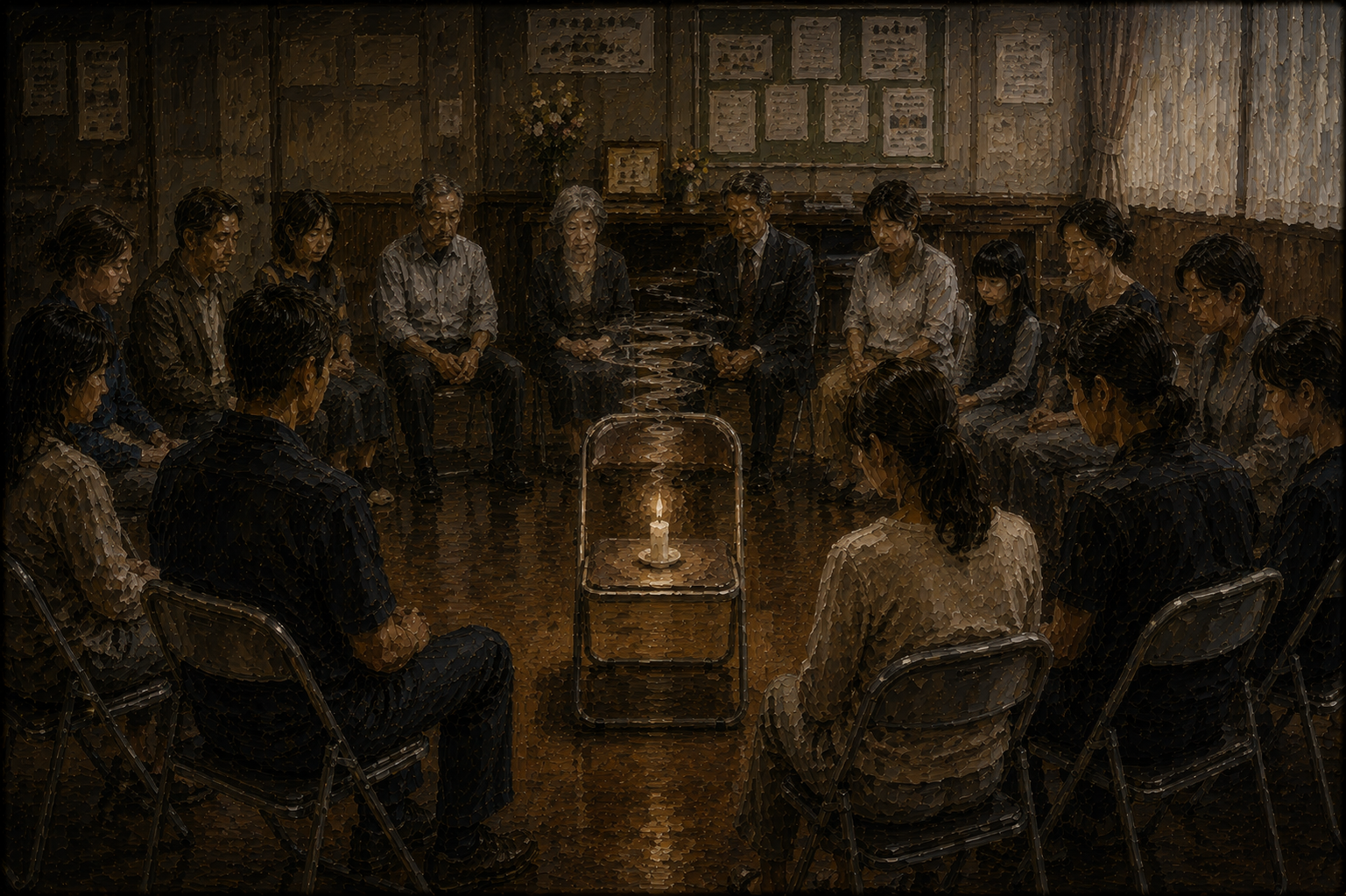
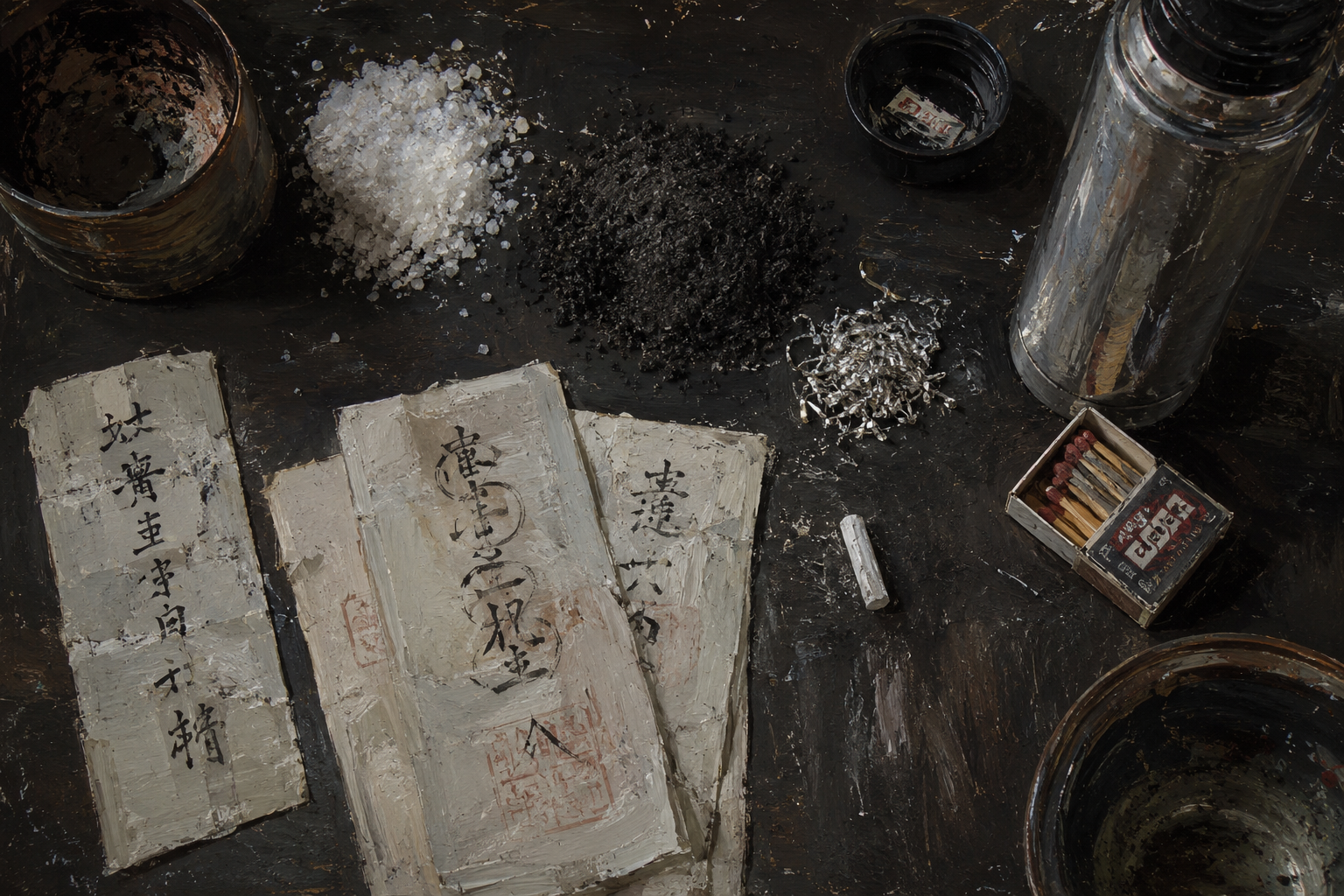
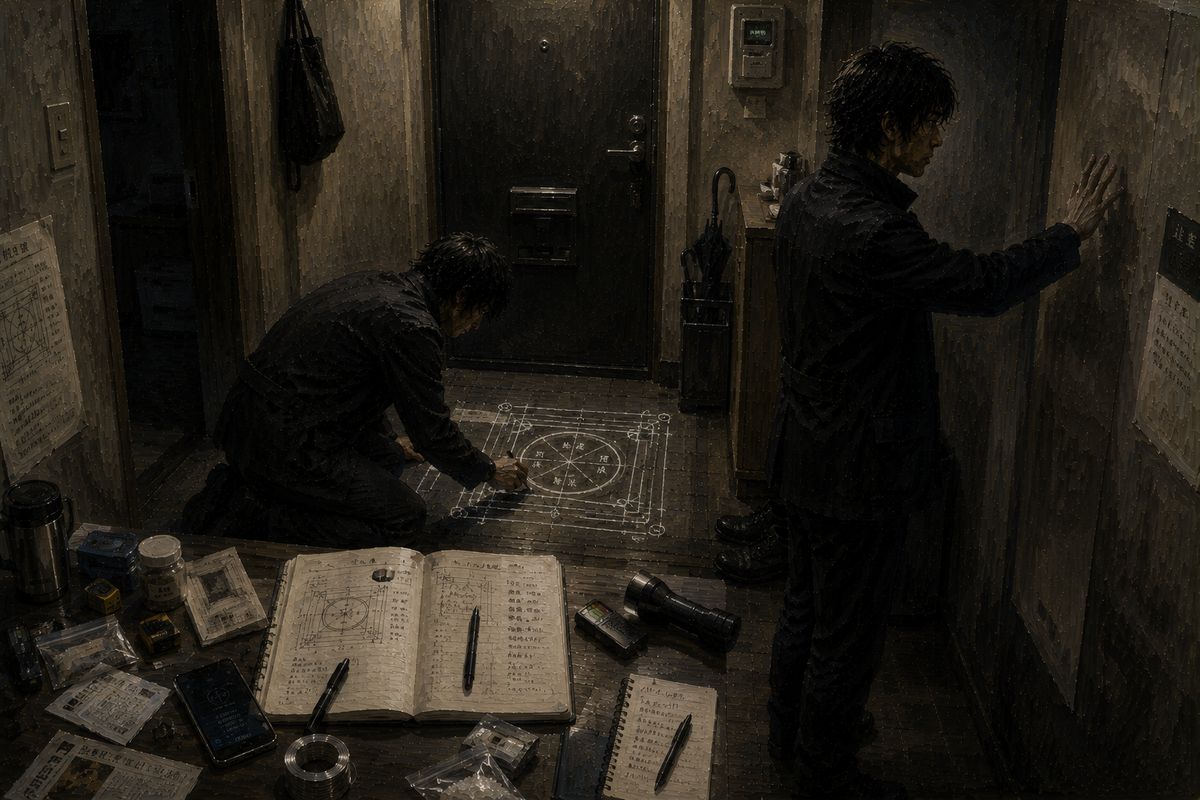
Exorcism. Taking a spirit or demon out of a person always needs a ritual. First someone checks it is not illness. Then comes a test, an unannounced blessed object, salt or a seal, to see the reaction. The work needs a team. One holds the circle, a biokinetic holds the host's body so the host does not leave with the entity, and one speaks with the entity and asks who it is and why it entered. It is slow. It can take many sessions and months. It can fail. The entity can jump to someone else in the room, take the host's self with it, possess the practitioner holding the contact, or lie to escape and come back. Every exorcism leaves residue on the people who did it and raises their Madness.
Traditions. Everyone uses seals, on one shared base. In Japan that base is Buddhist, because rituals follow the root religion of the country. The families made the techniques and founded the CVD. The CVD uses the families' techniques in a rational way. The families keep them as tradition. The Grid uses them to survive. Catholic, Spiritist, Jewish, Islamic and Umbanda practice exist in the city as they do in real life, each its own tradition. Tanaka works the way of the Spiritist desobsession and the dybbuk, talking until he understands what holds the entity.
Kishin's army. Kishin's cultists are true fanatics who want a demon or an evil spirit inside them. They offer themselves in ritual and arrive at the battle possessed by choice and proud of it. With so much power, other spirits start crossing to join the battle, some with bad intent. Fukai Rinka gave herself to Kishin as a zealot, idolises him and is proud of it. Kishin keeps her alive. Kanna-sensei is the name Kishin uses in her body to lead the Far-Shore Circle.
Yushiro, the Healer
Who he is. Tachibana Yushiro crossed between two and four hundred years ago and became a high-ranking demon forty years ago. He was human long ago, and the writing and names of his time were different. His domain is Duty. He has Biokinesis and Psychokinesis, and he can use Gin's Teleportation and Clairsentience, which makes Gin a weapon in the battle.
Why Gin. He looks for a body by affinity, someone of the same feeling who will not weaken him. Gin was very strong and unprotected, and the veil around him was already thin. Yushiro watched him for a while first, and Gin felt things, grew confused and forgot things until his stability fell far enough. Gin was taken walking home alone.
What he wants. He does not care whether the veil falls. He wants to destroy Kishin. They hate each other. During the story he changes his mind about the veil because of Gin. They are demon and host who slowly come to understand each other through Duty.
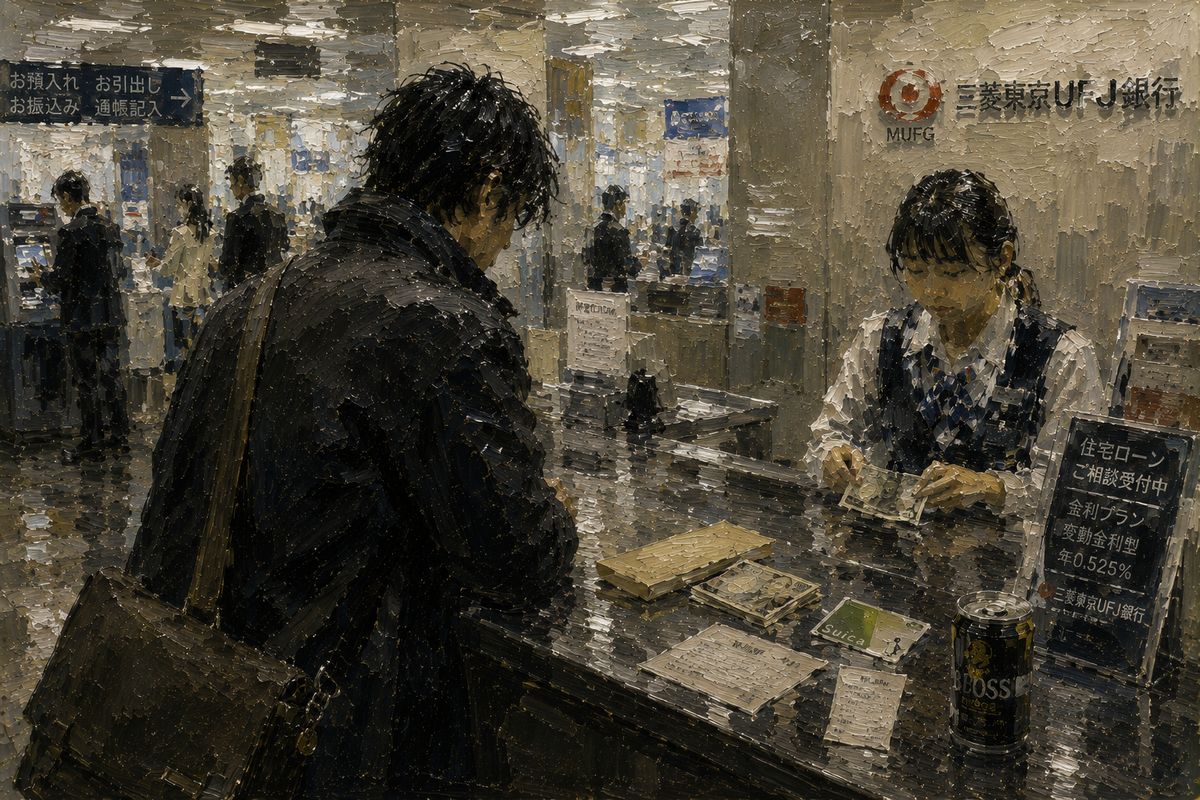
Living in Gin. It is his first time across the veil and technology is strange to him. He wakes Gin because the body is hungry. He eats souls, but the body dies without food. Gin teaches him to withdraw money and he tastes ramen for the first time. He asks Gin's opinion, uses Gin's phone and wallet, and slowly learns. Gin takes his own body only when Yushiro allows it, or because of his brother. Yushiro stays in Gin's body until they win the battle. At the end he goes back to the other side.
His name. He uses Gin's name. His true name is written nowhere and he is not in the crossing notebook. He tells Gin his name out of courtesy when Gin realises they are on the same side.
Rei and Gin. First Rei sees Gin walking far away in the street, after complaining to the police and the CVD, before he joins the CVD. Later Yushiro sees Rei, recognises the brother and uses Gin's power to release a bad spirit into a stranger to pull Rei's eyes away. When Yushiro faces Kishin, Rei is there and cannot solve it. The brothers only talk once Gin and Yushiro are partners. Itsuki is furious with Gin for not coming back. Gin made Yushiro a promise, not a contract. When Tanizaki dies, Yushiro feels Gin's grief and feels it with him.
The Uedera brothers
Names. The family name is 植寺 (Uedera). Gin is 銀 and Rei is 零.
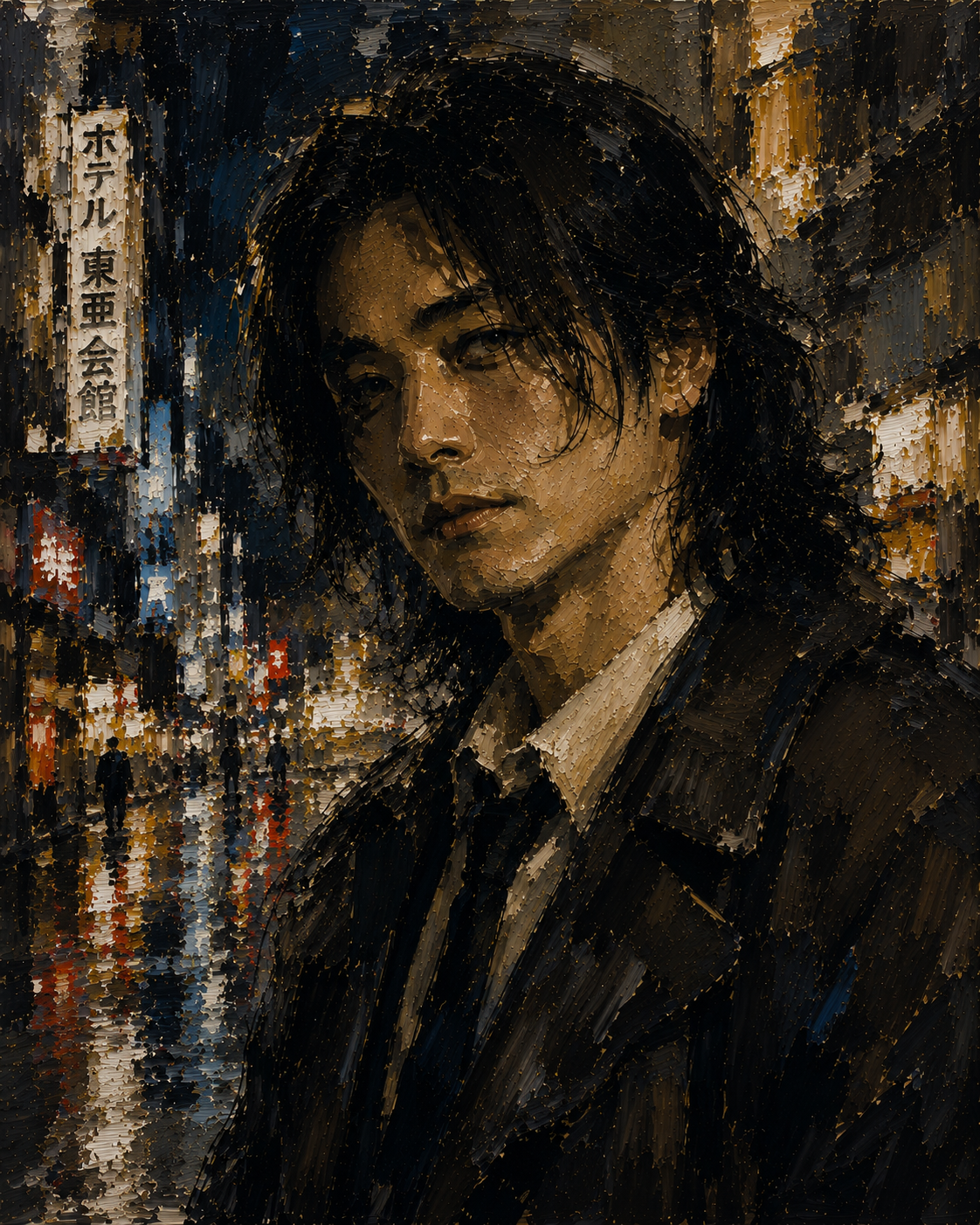
Gin. Vanguard, registered as Ritualist. Clairsentience and Teleportation, a third path with the demon and a fourth in the battles. He has long hair, walks straight and is an officer. He has his own money and his salary keeps arriving. The flat is on Sakae St in a vulnerable building with no shrine nearby. He left CVD artefacts at home in case something happened. His book is his diary, written every night and kept on his desk.
Gin's tattoos. The Severance in the centre of his chest, one of his strongest seals, which has to be activated every time and which he did not activate in time. Communication on one arm. Final Refusal on a rib. Perhaps the Scatter on the other rib. A small Suppression mark on the sole of his foot that he made himself and nobody knows about. He has tattoos on his neck and hand. On paper a seal is single use. Tattooed, it must be activated each time.
Gin's money. Imai Tetsuya works at the bank. Gin once sent him a message to release a good reserve, and the transfer also reaches Rei's account. Before the battle Tetsuya calls Rei, the second contact, to confirm. Rei uses the money little by little to fix his own life, rent, the watch, his gear and clothes, and something for a friend. The families, the CVD and the resistance pay for the war.
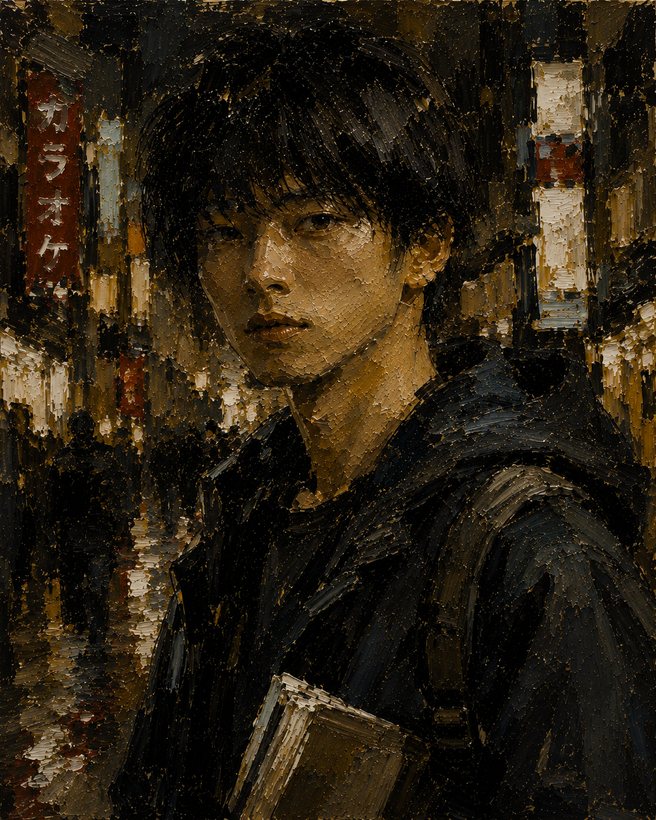
Rei. Arbiter, registered as Postulate because he suppresses. His suppression is unconscious repression. It comes from a park in childhood where Gin covered his eyes and said there was nothing there. The technique is the breathing and calm Gin taught. At the CVD reading, Shizue's tsuru with a suppression seal inside lets him tear it in the toilet. Rei is a police intern at first, quits early, lives on mediumship work and moves into Itsuki's studio. He pawns the Satō silver pocket watch when he has no food, and Gin later fetches it back. Rei and Itsuki are 20 and turn 21 during the year. His missions are finding his brother, taking the Duty seat, learning why the Axis let this happen, cleaning the CVD's corruption, and understanding spirits and demons to balance the two worlds. He awakens Clairsentience, perhaps Teleportation, then a Telekinesis weaker than Itsuki's, and slowly reaches four paths. Rei is invited into the Thirteen and joins only at the end.
Gin's year. The worse the demon treats the body, the less Gin wants to stay and the shorter the window. Rei asks Adachi indirectly, and Adachi says a year and sends him to look at the possessed ward.
Itsuki and the Kuroda
Itsuki. Rei's best friend from school, the same age. Gin raised them both and was a brother and father to Itsuki, whose family rejected him. He studies oil painting at Geidai because he loved watching his mother paint. He has no active mediumship, so he was never registered. He is a seer, a kind of mediumship so rare and so full of charlatans that it is not even in CVD files. He paints four futures in the book. The walkway with the key, finished at midnight, already there when Rei first arrives. A faceless cult. A place Gin later walks into. And the war, perhaps with the Axis's face, which he paints without knowing whose it is. Something enters him on a mission with Rei, outside.
Itsuki's power. He repressed a lot and awakens late. In a fight where Rei is suffering for him, he jumps from latent to very advanced and throws something absurd at someone. Then he cannot do it again and needs a trainer. His first path is Telekinesis, as strong as Magneto without the metal limit. Then Psychokinesis, then Teleportation, through the Convergence. He is angry at his family, hides it and fights people over Rei, and Rei calms him.
Itsuki and Rei. Unconditional love, more than friends, more than family. Very subtle. The reader notices without anyone saying it. Rei is very blocked. The level is "I will come after you, you will not die alone".
Itsuki at the end. His family discovers his abilities after the battle and comes to apologise. Kuroda Sōun lives and passes the family to him. The Kuroda become the best and most honest of the families. Itsuki stops painting to live quietly, but will paint an answer for someone who truly needs one. Gin, Rei and Itsuki live together.
Kuroda family. The Kuroda have always lived in Japan. Itsuki's mother paints and also trains. Itsuki took Rei to the Kuroda but never trained with them himself.
The CVD
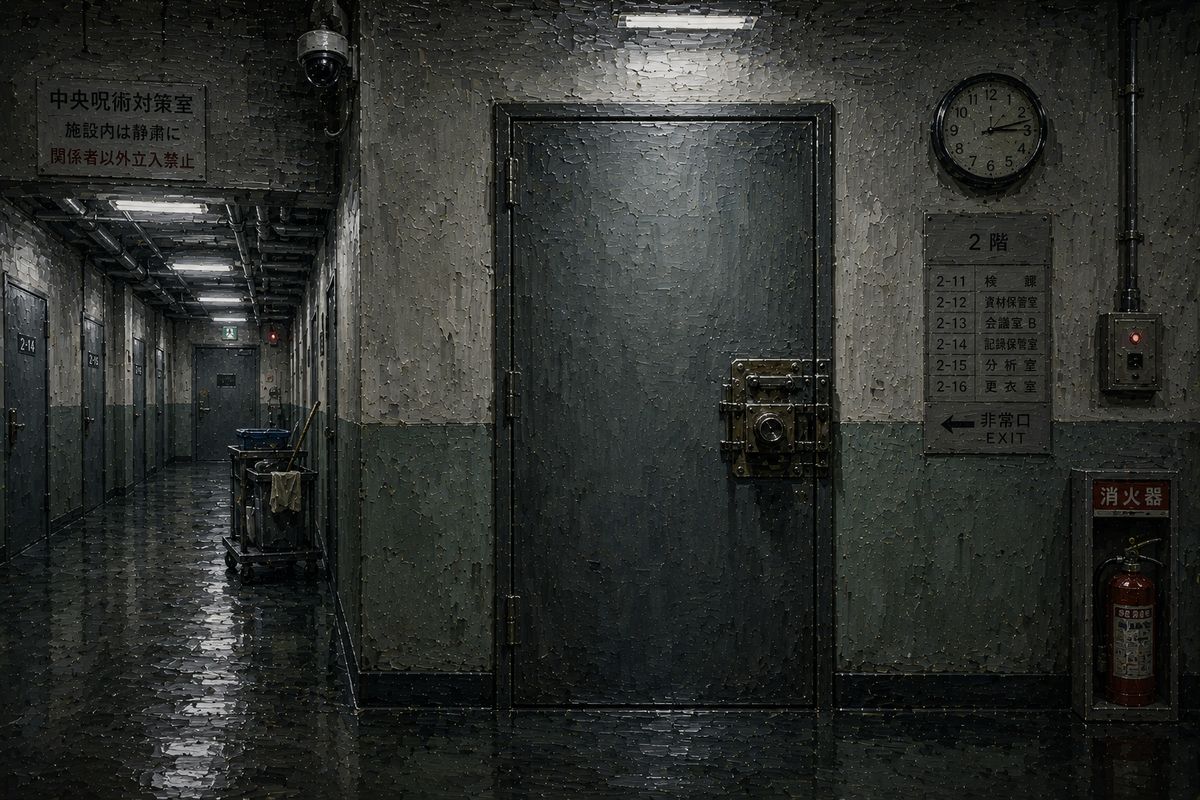
The Division. Founded in 1962, replacing older institutions. On paper it sits under the Ministry of Internal Affairs, and there are sister bodies abroad. In practice it answers to the Tower Families, through chiefs Director Adachi has never met, and the families' corruption enters through them. The building is in Marunouchi. Everyone who leaves the CVD stays linked to it.
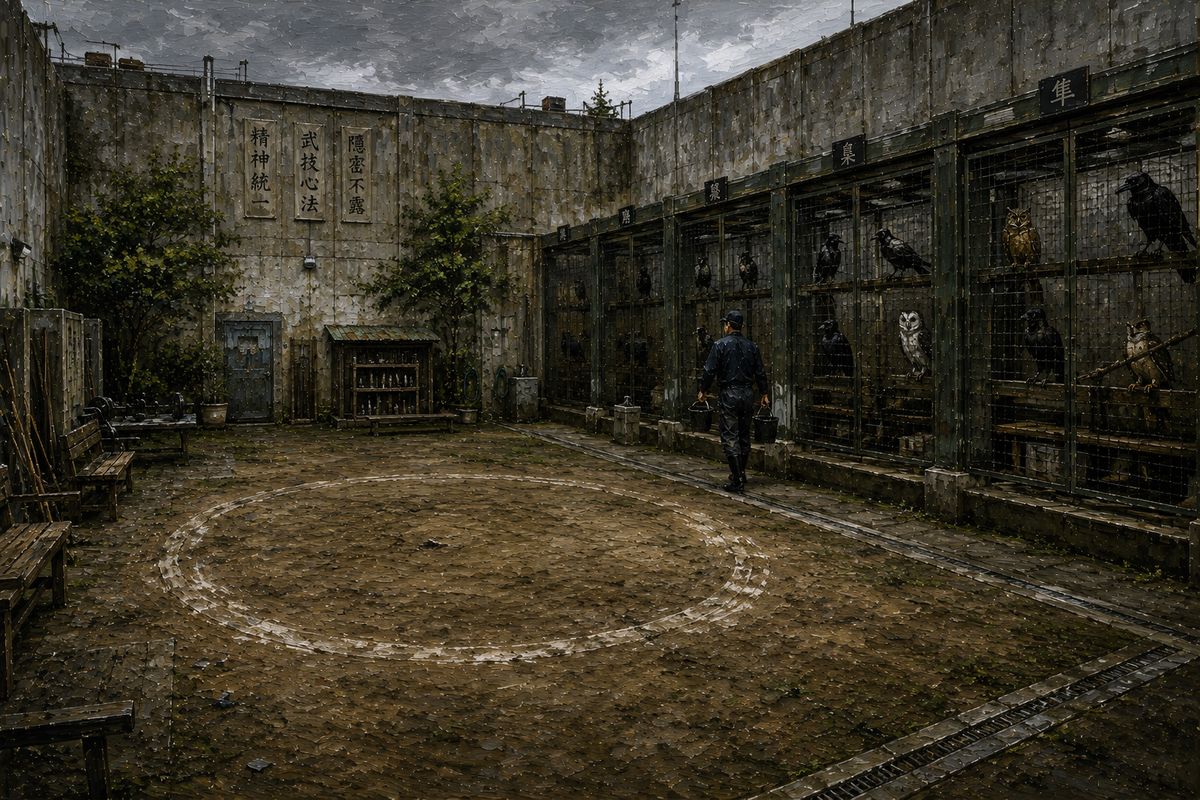
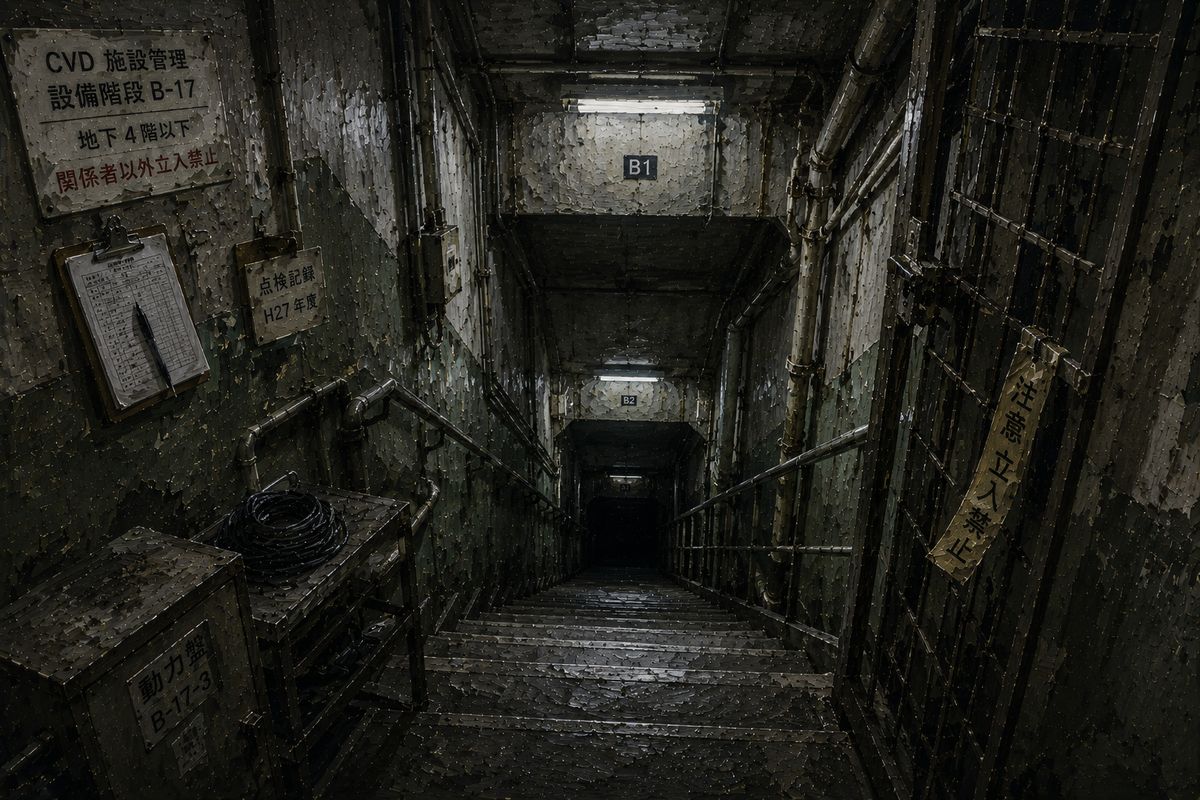
The rooms. Operations Floor. Public Relations, where the chiefs meet. Assessment and Registry. Internal Affairs and Audit, where secrets are kept, including the unnumbered room with the Courage demon in a modified Spirit Capturer. Mirror Room. Containment and Reintegration. Training Hall. Cattery. Aviary. Cultivation Room, where spirits who agreed to help are held and demons are educated for the Vessel Program. Laboratory. Sigil Room, where tattoos are made. Preparation Room. Arsenal, with consecrated daggers, prepared sigils, silver chain and holy water, no firearms. Rest Room. Special Cases Room. Artefact Room. The Sub-level prison. Rei passes through all of them during the book.
The Spirit Capturer. A pager-sized CVD device that shows the entity's rank and lets you talk to the spirit held inside. Capture, release, return to the veil and host. One spirit at a time. Capturing means fighting the spirit until it weakens. Rei gets one much later, when they trust him.
The CVD team. Rei, Kato, Tendo (replaced by Usami after the betrayal), Shimizu and Moriya. Itsuki is the sixth and is not CVD.
Adachi. Director, widower, Clairsentience only. He keeps Riki in his office after Tendo's betrayal and becomes a softie with him. He retires at the end, on condition that Rei guarantees the Courage demon stays on their side.
Kato Ryusei. The telepath nobody trusts. Gin's former partner, about 24. Registered at the level Gin manipulated with suppression. Measured, precise, sometimes arrogant without noticing, warm and funny with people he trusts, with dark, acid humour. His grounding object is his grandfather's ivory chess knight. He works in the Arsenal. He becomes Rei's partner and later builds a team. In a year he is Vanguard and at the end he becomes Director. Nobody can lie to him.
Tendo Akira. 28, tall, funny, Arbiter, Psychokinesis, field operative. He uses the CVD dog Riki, a Shikoku. In book three, alone at the cult, he accepts a strong demon that is not one of the three, puts his colleagues in danger, is held in containment and then jailed in the Sub-level. That demon is a telepath and causes the R39 leak.
Katagiri Noa. 38, senior investigator, Arbiter, Biokinesis. She respected Gin as a colleague and does not hand him over.
Shimizu Ren. Arbiter, Telekinesis, field operative. She dies.
Moriya Tatsuki. Field Operations, Biokinesis, lives in Nakano. Fifth of the team. People start thanking him.
Okada Shizuka. A woman. Investigation, Ritualist, Clairsentience.
Yamamoto Koji. A man. Guardian, master and archivist inside the CVD, unregistered. Clairsentience. His mission is to show Rei Gin's last query.
Uruma. Was in the Sigil Room and began tattooing there. Itsuki cannot make sigils, sees them as art, and learns slowly by talking with Uruma.
The Vessel Program
How it works. Only people who would die otherwise enter it, which is why nobody leaves. Members have no home and no social life outside. They live together in an apartment inside the CVD building, with a kitchen. Watanabe Sora's origin in the Program is still to be decided.
Usami Hinata and Ren. Usami had a terminal illness and Ren saved his life and keeps him alive. Usami is sweet, loves cute things and cooks, sweets above all. His ability is Telepathy and later Biokinesis. Ren, the Love demon inside him, is clairsentient and is not weak, around Ritualist level. Usami and Ren truly love each other. At the end Ren takes the Love seat on the other side, inside Usami, and Usami lives among the dead as a human.
Fujimoto Kenji and Abe. Kenji was possessed in the field by a strong malignant spirit that exorcism could not remove. The CVD held Abe, a strong calm spirit. Kenji accepted Abe, Abe entered and the malignant spirit left and was caught. Kenji cannot live without a spirit now. He has no family. His life is the CVD.
Masters and the Grid
Masters. Masters are Guardians. They left the CVD and live protected and suppressed in their own houses, with no registration. They teach the high levels nobody else can teach. If someone outside the CVD is in a high-level situation, they help. Adachi manages the network and has opened it for Kurosawa.
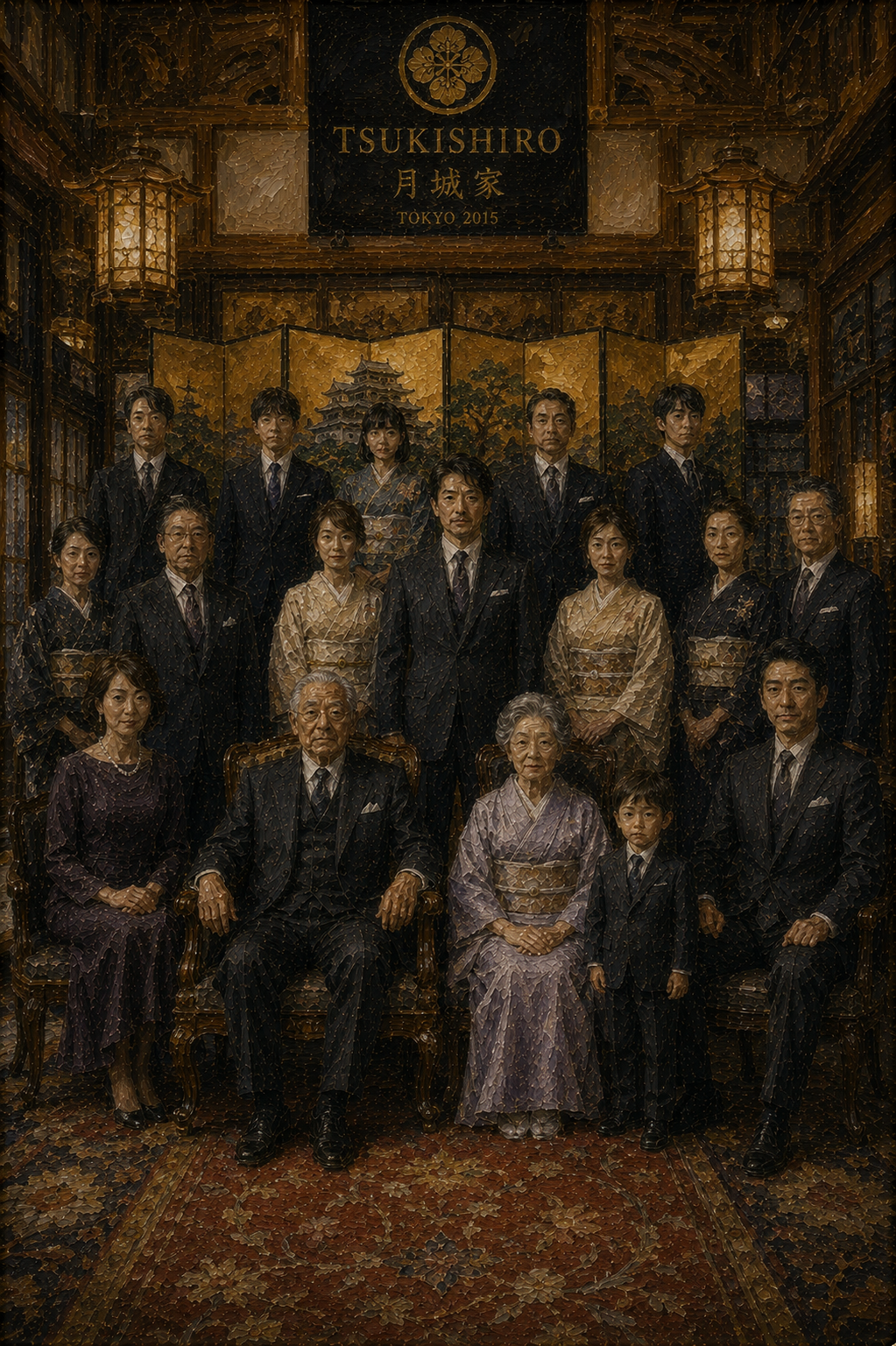
Haruki. Tsukishiro Haruki is Gin's best friend, a young master, Guardian and telepath. He is a strategist. He is from a distant branch of the Tsukishiro and does not use the name. The jazz bar, the 2012 case and the dried flower are his. He becomes Rei's mentor and enters Gin's mind in the rescue. The Tsukishiro are mediums who need no weapons.
Tanaka Ryu. Guardian and master, Biokinesis, independent and unregulated. He entered the CVD very weak and rose fast because of the way he heals and exorcises, and everyone underestimates him. His exorcism means understanding and healing what afflicts the spirit or demon, with suffering for everyone and no guarantee the demon did not lie. At the end he leads the Grid.
Uehara. A woman. Guardian and master, Clairsentience, from a clairsentient family. Her ability is deteriorating, she left the CVD eight years ago and only trains people. She documents the entity campaign, and Rei finds out why her ability is failing.
Kurosawa Shou. Guardian and master, Biokinesis.
Tanizaki Seiichi. Gin's mentor and a master, so a Guardian, Psychokinesis. He shaped only Gin. He lives in a small old house in the old quarter of Kita. He is attacked because he is a master, and he is possessed, though he is not one of the Thirteen. He becomes a strong enemy, and killing him is sad. It takes all five of the CVD team, the Director stepping in, more people besides, and the Resistance joining them, the first sign of union.
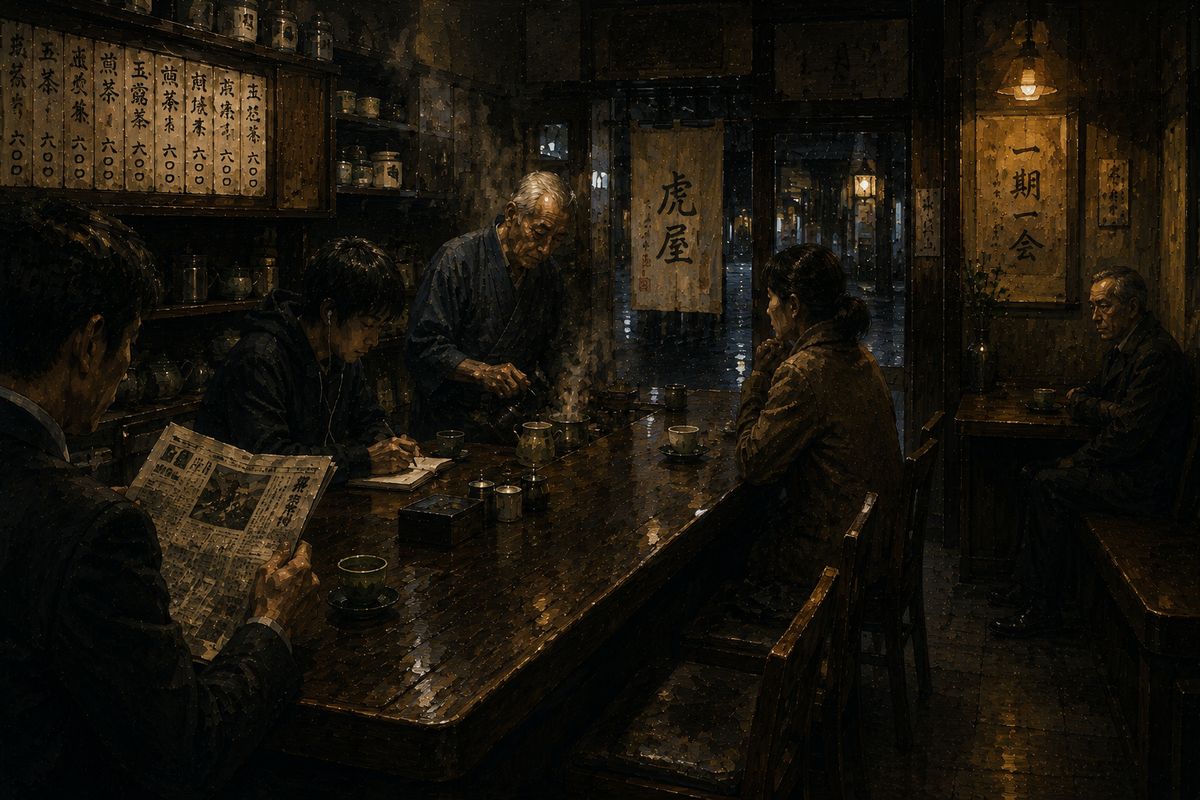
Inoue Misaki. Guardian and master, Psychokinesis. She crosses people to the other side with her cat Renado at a hidden tea house or ramen counter in central Tokyo. Two trusted spirits keep a notebook of who crossed.
Majima Kenji. A man. Grid, Arbiter, with a high ceiling. His dog is a brindled male Kai Ken. He befriends the group and dies in a battle.
Choi Hana. Arbiter, Teleportation. Her scar story is never told. She tries four or five times and is interrupted, the last time in the final battle. She is impulsive and always has new cuts.
Hara Setsu. She is ill and wants to rest. Mr. Kishi offers to share her body. She refuses, and Rei explains that rest is her right.
People and places
Others. Gorō is a CVD crow nobody trained, and Adachi lets Rei take him. Nagai Haruto is the river boy who drowned saving his dog and guards the bank. Yu's quest is to leave the street and find an adult whose kindness has no price. Aizawa lives well with a spirit that eats his depression. Mr. Hirose is the tired man above the dead Kamiya Ginza arcade. The Sakae St noodle shop belongs to Hoshino Haru and Mrs. Suzuki works there. The river memorial keeper is Okuma Sumi, a woman. Fujiwara-Kage Sena is a man and uses Psychokinesis.
Places. The Grid lives in the streets. The Tower is a conglomerate where the families meet. The families have houses, not mansions. Masters have their own houses. Only places from the game map are used, plus at most a ramen shop and a café.
The end
How it ends. The veil holds. Yushiro goes back to the other side. The Courage demon is returned. The demons become the thirteen of the world of the dead and Ren takes the Love seat inside Usami. People learn the two worlds can live in harmony. Adachi retires and Kato becomes Director. Tanaka leads the Grid. Gin goes back to the CVD and goes on a date with Chen Lian of Wonder. The book closes with Gin saying this is the story of how he came back to his brother after being possessed by a demon and saving the world.
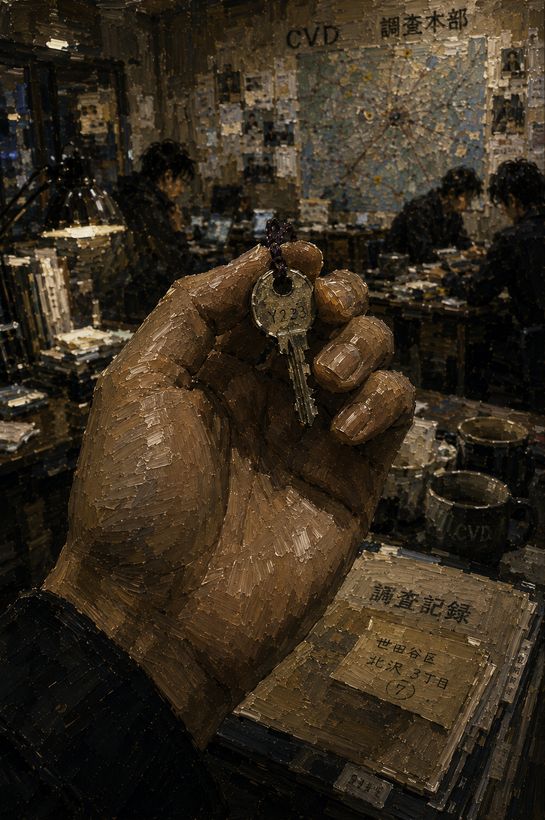
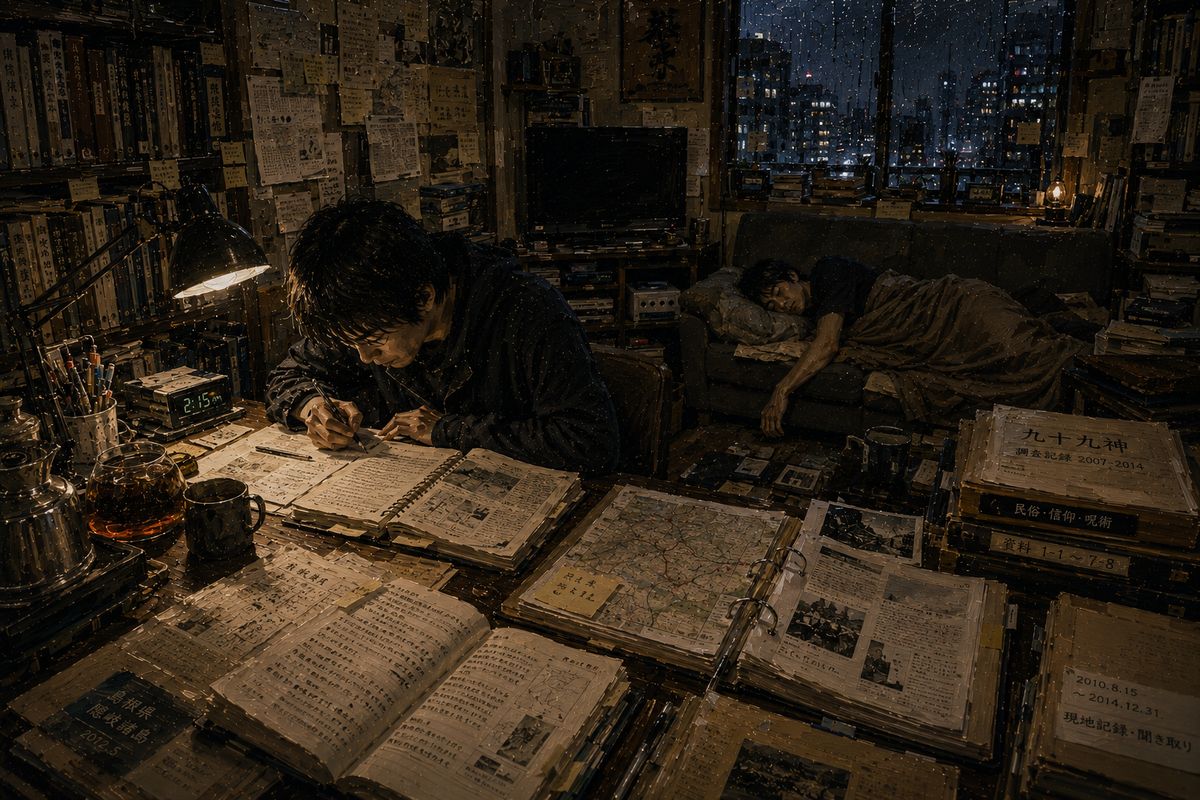
If you found this: the keys were on the hook because I put them there. The lamp was on because I was working. The door was not quite closed because I heard something in the corridor and I looked up and then I kept writing and I forgot to go back and close it.
Whatever you are looking for... the world is in here. I documented everything I know. Six years of field work, case files, entity taxonomy, practitioner profiles, the political landscape of who controls what and why, the mechanics of how ability actually works when pressure is applied to it. The archive is complete. It functions without me.
Start at chapter one. Read in order the first time. The world builds on itself and some things will not make sense until other things do. Come back to individual chapters when you need them. The index is in the field kit, left pocket.
I was going to annotate the later sections more thoroughly. I ran out of time. The notes in the margins are the annotations. Read the margins.
Uedera Gin, 植寺 銀. Kita-ku, Tokyo, 2015.
Some people are born with an aperture. A gap in the membrane between this world and what sits alongside it. It does not make them magic. It makes them permeable. They feel the weight of spaces. They know when something in a room is not what it presents as. They hear the frequency of the other side without choosing to listen.
This has always been true. The world has spent a very long time pretending otherwise.
The Civil Veil Division exists to manage the gap between what is true and what is acknowledged. It operates in forty-three countries. It has different names in different jurisdictions... the Division in Japan, the Bureau in the United States, the Office in most of Western Europe, names I cannot reproduce here because some of them are classified in ways that would create problems for the archive. The structure is the same everywhere: registration, classification, asset development, institutional oversight of practitioners. The mandate is public safety. The methods are, as always, more complicated than the mandate.
In Japan, the CVD operates on paper under the Ministry of Internal Affairs. In practice it answers to the Tower Families. In 2015 it has approximately 340 registered field operatives across the country, of which I am one. The registered network represents, in my estimate from six years of field work, roughly forty percent of the practitioners actually operating. The other sixty percent work through the Grid, work alone, or do not know what they are.
Tokyo in 2015. The city runs on convenience stores, IC cards, and LINE messages. It recovered from March 2011 on the surface. Beneath the surface: something has not re-stabilized. The membrane thinned in ways that have not corrected. New thin spots opened in the geography of the veil and have not closed. The practitioners working this city have been managing the consequences of one morning, four years ago, that changed the weight of everything permanently.
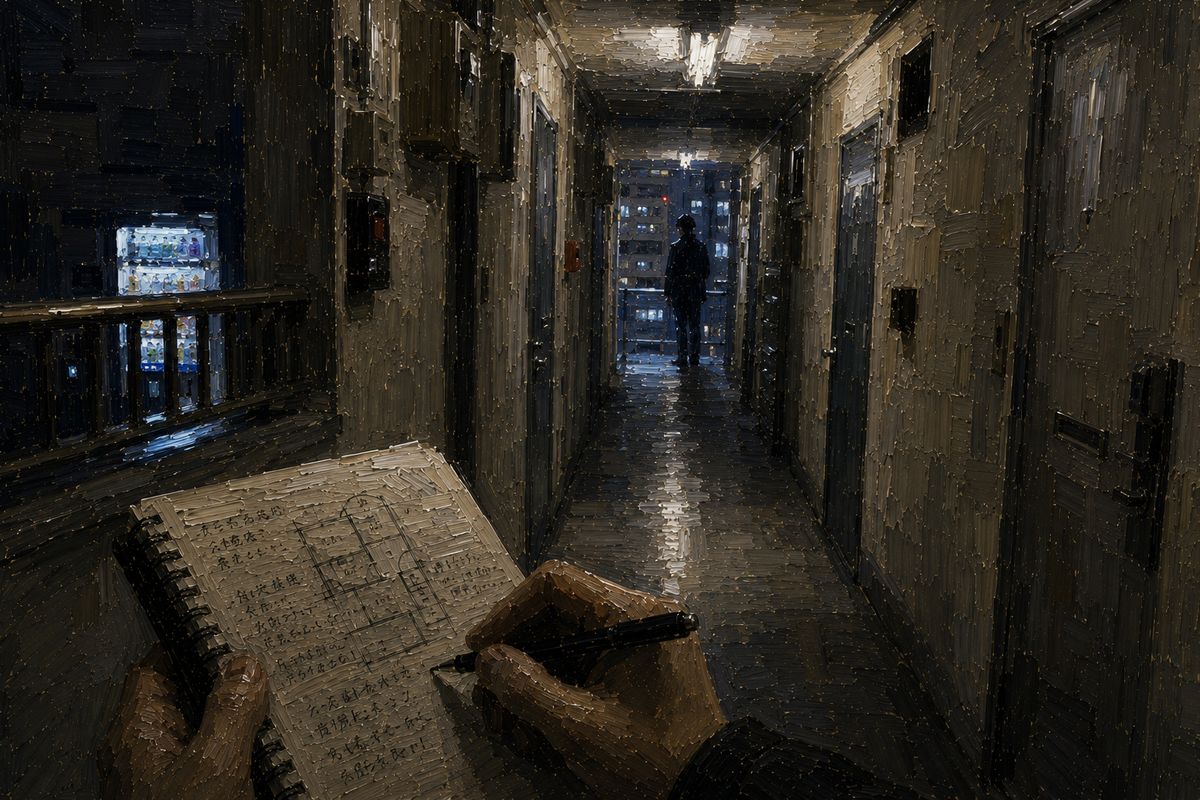
The archive you are reading is set in the Kita district of the city. A specific apartment. A desk lamp that was on because I was working. A field investigator's archive, open on the desk. If you are reading this at 3:47 in the morning: that is approximately when Rei found it. That detail is in the archive for a reason. Keep reading.
The three structures you will encounter in this world: the CVD, which administers and controls; the Grid, which operates without permission; and the Tower Families, which have held their positions long enough to consider them permanent. These three maintain a working relationship built on mutual leverage and the shared interest in a city that continues to function. The relationship has been under pressure since 2011. It will continue to be under pressure. That pressure is the condition of the work.
G.U.
Keys on the hook. Archive open on the desk. Six months of writing. I am going to keep going.
I almost forgot my keys again today.
I do this every morning. I put them on the hook by the door because I read somewhere that building habits around physical anchors helps people like us stay grounded. People whose minds tend to slip sideways before the rest of them catches up. I put them on the hook. I make coffee. I smoke half a cigarette on the step outside because Rei complains about the smell in the apartment even though he leaves his own cigarettes everywhere. I come back in lightheaded and slightly late and reach for the keys and they are exactly where I put them and I am surprised every time.
I have been a field operative for six years. I have closed 340 documented cases. Eleven of them were exorcisms, and every one of those took months. I have a near-perfect case closure rate in a district that most senior operatives request transfers out of. I cannot reliably remember where I put my keys.
Rei thinks this is funny. So every night I hang them a little crooked, a few centimeters off, turned the wrong way, to see if he notices. He always notices. He puts them straight without a word, every morning. It's the most reliable part of my day.
G.U.
I am writing this because I am good at my job and I know what that means. People who are good at this job get noticed. Not always by the people you want to be noticed by. I have taken precautions, some structural, some personal, some that I will document here and some that I will not, for reasons that will become clear. But precautions are not guarantees. They are just the work you do so that if something happens, it happened to someone who tried.
If you are reading this and I am not available to explain it: use it. All of it. The official sections are accurate, I wrote them carefully and I stand by the methodology. The personal notes are more accurate. The things I have not written explicitly but have gestured toward in the margins, those are the most accurate of all, and I trust you to read them correctly.
If you are reading this and I am still around: hello. Stop reading my notes. Go eat something.
I know you don't take things seriously. I know you think that's armor. I know because I used to think the same thing and I was right and also wrong in ways that took me years to understand. You are smarter than I was at your age. You are also more exposed than you know. Read Chapter 5 twice.
CVD-7, Senior Field Operative
Keys were on the hook. Coffee was terrible. Left on time anyway.
The Veil exists. This is not disputed. It has not been disputed in any serious academic, governmental, or theological context for approximately ninety years... since the first coordinated international effort to catalogue and formally acknowledge what practitioners had been documenting and governments had been quietly managing for considerably longer. That gap, between what practitioners documented and when governments formally acknowledged it, is about two hundred years. Two hundred years of institutional notes filed under 'anomalous' by people who knew perfectly well what they were looking at. I find this clarifying about institutions.
What the Veil is, precisely, remains a matter of ongoing research, philosophical debate, and significant disagreement between jurisdictions. What it does is better understood, and this compendium concerns itself primarily with function rather than origin. Practitioners are advised to maintain professional skepticism toward metaphysical certainty in any direction.
The decision to normalize rather than conceal was made for practical reasons. By the mid-twentieth century, the practitioner population in major urban centers had grown beyond the capacity of any government to effectively suppress. Concealment creates panic when it fails. Normalization creates bureaucracy, which is manageable. The 1962 Tokyo Accord established the framework still in use today: the Veil is real, practitioners are registered, entities are classified, and the Civil Veil Division maintains order at the boundary.
What the Accord does not address, what no official document addresses directly, is the question of what the Veil is for. Whether it exists as a natural feature of reality or as a constructed boundary. Whether the entities on the other side are simply the dead or something more complex. Whether the Font, the apparent source point of veil energy, is a geological feature, a divine entity, or something for which no existing category is adequate.
In practice, daily life in a major city with a significant veil-active population looks like this: a bank officer who reads futures three evenings a week from her apartment in Shinjuku. A policeman who performs exorcisms on weekends for families in his district who cannot afford registered practitioners. A convenience store clerk who has maintained a working relationship with the building's resident spirit for eleven years and keeps a small dish of rice near the back freezer. A doctor who lost his registration after treating a possession case without reporting it to the Division, because the family asked him not to.
The Veil is not exotic. It is not the province of special people in special circumstances. It is a layer of the world that some people can perceive and interact with, distributed unevenly across the population, shaped by genetics and trauma and circumstance in ways that resist clean categorization. It has always been here. It will continue to be here. The question that this compendium attempts to answer is: given that, how do you operate in it without dying, losing your mind, or becoming something you would not have chosen to become.
Case 7-114 today. Elderly woman in Nerima, third floor apartment, has been cohabiting with what she calls "my late husband" for four years since his passing. Neighbors reported unusual activity, lights, sounds, temperature fluctuations. Standard obsession flags.
When I arrived she offered me tea. The apartment was cold in the specific way that indicates a persistent presence, not uncomfortable cold, just the kind that settles at the back of the neck. She poured two cups. The second one she placed at the empty chair across from her without looking at it.
Her late husband, Shigeru, 74, passed of cardiac failure in 2012. By all behavioral indicators he retained enough of himself to constitute a Type 2 spirit, good alignment, low permeability risk, stable emotional signature. He was not causing harm. He was not distressing his wife. He was, as far as I could determine, sitting in that chair because he was not ready to leave and she was not ready for him to.
Official protocol is clear: document, assess threat level, recommend dispersal if the entity poses risk to the living occupant. He posed no risk. She posed no risk. The neighbors were being dramatic about the lights.
I wrote: No actionable threat identified. Recommend monitoring. Case closed pending review.
I drank the tea. I did not drink the second cup. I said goodbye to the empty chair on my way out, because it seemed like the right thing to do.
The following represents the current state of public knowledge and institutional framework as of this compendium's compilation. Regional variations exist; Tokyo Prefecture standards are used as primary reference throughout.
The registration system operates on a voluntary-encouraged basis for Levels 1 and 2, and a mandatory basis for Level 3 and above. Registration provides: access to CVD support and resources, legal protection for ability-related incidents, eligibility for civil practitioner employment, and formal ranking certification.
What registration also provides, which the public framework does not emphasize: your name, your level, your known abilities, your current address, and your assessed threat potential in a database accessible to the Veil Protocol division, the Tower family councils, and seventeen other agencies whose mandates are not fully public.
He's supposed to be studying for his investigator prep exam. He is probably playing something or reading something or staring at the ceiling thinking about something I won't find out about until two weeks later when he mentions it casually like it happened yesterday.
I knocked and asked if he wanted food. He said he already ate. I checked the kitchen. He hadn't. I made rice and left it outside his door and didn't say anything about it because saying something about it would have started an argument and the argument would have been about something else entirely and it was late and I had an early case.
In the morning the bowl was empty and back in the kitchen, washed, in the drying rack.
He's going to be fine. He is also going to be a complete disaster getting there and I will apparently be following behind him with rice until one of us figures out a better system.
Keys were on the hook. First try.
Out Loud
The class structure of psychic ability. The Architect. The Font.
There is a version of this chapter that is comfortable to write. It frames what follows as a series of omissions, things the official framework simply hasn't gotten around to addressing, gaps in public knowledge that exist for logistical reasons rather than deliberate ones. It is a professional, defensible version. I have written that version three times for three different internal CVD reports.
This is not that version.
What follows is what I know after six years of field work, two years of archive access I was not supposed to have, and approximately four hundred conversations with people who told me things they wouldn't have told me if they had known I was writing them down. I have changed identifying details where relevant. I have not changed what they said.
The official framework presented in Chapter 1 is accurate in its facts. It is dishonest in its framing. The Veil is real. Practitioners are registered. The Division manages the boundary. All of this is true. What it omits is the question every new practitioner eventually asks and never gets a direct answer to: managed for whose benefit?
The honest answer to the question of who the framework benefits is not simply the powerful, that framing is too clean, too satisfying, too easy to dismiss as the complaint of someone who lost. The honest answer is more uncomfortable: the framework benefits anyone who has enough resources to navigate it, and costs everyone who doesn't. That is not a conspiracy. It is just how systems work when the people who built them built them to work for people like themselves.
The Veil Protocol operation is real. Its public mandate is containment. Its classified mandate is something else. I will document both.
Keys on the hook. Coffee finished. Rei took the umbrella. Good.
The registration system, as presented publicly, is a neutral administrative process. Practitioners are identified, assessed, registered, and integrated into the civil framework. Benefits accrue. Support is provided. Order is maintained. This is accurate. It is also incomplete in the same way that a map of a country that only shows its highways is accurate... the information is correct, the picture is missing most of what actually exists.
This is accurate. It is also incomplete, in the specific way the CVD prefers its truths: nothing in it is a lie, and you would still walk out of the briefing knowing less than you came in with.
What the public framework does not address is that psychic ability, in practice, functions as a class marker, one that intersects with but does not replace economic class, and that the registration system was designed by and for people at the upper intersection of both.
The practical consequence of this structure is that psychic ability, across all eight known ranks, is distributed without regard for economic circumstance, but the institutional resources to develop, protect, and leverage that ability are not. An Arbiter rank practitioner born into a Tower family has generational knowledge, private training, legal protection, equipment, and connections before they are twenty. An Arbiter rank practitioner born in a district like the one I work has none of these things, and is considerably more likely to be flagged as a Protocol target than offered a recruitment package.
They will tell you: registration protects you. And it does. If you are involved in a veil incident, possession attempt, entity encounter, ability discharge in public, registered practitioners have legal standing. Unregistered ones have whatever they can argue in the moment, which is usually not much.
They will tell you: registration gives you access to resources. Also true. CVD training programs are genuinely good. The equipment they issue to Level 3+ field operatives is better than most of what circulates on the Grid's black market. The salary is stable.
They will not tell you: your file is accessible to seventeen agencies. They will not tell you that your threat assessment, a number generated by an algorithm they will not explain, follows you permanently and can be updated without your knowledge. They will not tell you that above Arbiter rank (the CVD's Level 5 threshold) the recruitment offer and the compulsory conscription offer look very similar and the difference between them depends on how cooperative you are willing to be.
They will not tell you about the Protocol's active operations list. Or that being on it is not a consequence of wrongdoing. It is a consequence of being interesting at the wrong level.
The Grid does not tell you to refuse registration. Some people genuinely benefit from it and the Grid is not in the business of making decisions for people. What the Grid tells you is: know what you are agreeing to. Read the full registration document, not the summary. Understand what database your name enters. Make the choice with complete information.
Then make the choice that keeps you alive and functional. Sometimes that is registration. Sometimes it is not. No one can make that call but you.
The Civil Veil Division's public mandate is containment and management of veil-related phenomena. This is accurate for approximately sixty percent of its operational activity. The other forty percent is asset development, classified operations, and the specific work of maintaining the gap between what the public knows and what is actually happening. I work for the sixty percent officially. I know about the forty percent because six years of field work teaches you to read what is not written in the operational briefings.
The Veil Protocol division, a separate operational structure operating under CVD administrative cover, has a classified mandate that extends significantly beyond containment. This mandate has three components, none of which appear in any public document.
The Tower families are aware of the Protocol's full mandate and have negotiated their position within it. Their members are not subject to Component Three protocols. Their cooperation with Components One and Two is formalized through agreements that predate the current administration and are not subject to legislative oversight. They provide practitioners to Protocol research programs voluntarily, and in exchange, their bloodlines are classified as protected assets rather than potential threats.
Veil level assessment in the field is performed by a specialized class of practitioner: the Auditor. Auditors possess a specific variant of Clairsentience ability oriented toward reading psychic signatures, the unique energy pattern every practitioner emits when using ability, and the baseline signature present even at rest.
Auditors are among the most carefully managed practitioners in the CVD structure, for an obvious reason: they can assess what others cannot hide. They are also, statistically, among the most psychologically vulnerable to veil integrity degradation, reading signatures continuously means continuous low-level veil exposure.
The Font is not acknowledged in public CVD documentation. It is present in classified research as a working hypothesis, a theoretical source-point for veil energy that would explain observed phenomena not otherwise accountable. Internal debate on its nature is ongoing and unresolved.
This compendium treats the Font as confirmed. The evidence is extensive and is presented in full in Chapter 3. What is relevant here is the Font's relationship to the living practitioner population, specifically, the mechanism referred to in classified Protocol documentation as the Architect Phenomenon.
A practitioner I worked a case with in Koenji. Level 4, registered, good at her job, asked me once why I stayed in the system if I knew what I knew. She asked it genuinely, not as an accusation. She was twenty-four and had just seen the inside of a Protocol facility for the first time and was doing the math on what her registration had actually meant.
I told her: because the work is real. The people I exorcise are real. The families who need the case closed are real. The entity in the Nerima apartment that I didn't disperse because the old woman needed him there, he was real, and his wife was real, and that mattered regardless of what the system around it was doing.
I also told her: the system is a tool. Tools do not have loyalty. Do not give yours to a tool.
She transferred to a different district six months later. I don't know if she's still registered. I hope she's still alive and working and making the calculation fresh every day, which is the only honest way to make it.
Keys were on the hook. Didn't check, just knew. That's new.
What actually exists beyond the membrane, and what it wants with us.
Some things don't fit in stat blocks.", G.U.
The first time I touched the other side I was twenty-two. It was not intentional. I was working a possession case in a building in Kita that had been accumulating suffering for decades, bad deaths, worse living, the kind of place where the walls remember everything and won't stop. I pushed too hard trying to clear a corridor and my veil went thinner than I had ever let it go and for approximately four seconds I was in two places at once.
The other side is not dark. That is the first thing I would tell anyone. Everyone expects dark, the cultural imagery of death is darkness, absence, cold. The other side is not any of those things. It is loud. Not in the way sound is loud. In the way that standing in a city after spending six months alone in a house is loud, the sheer density of presence, of signal, of things that have existence and weight and history pressing against each other in a space that does not organize the way physical space does.
I was there for four seconds and it took me three weeks to fully return. Not physically, I came back immediately, the way you snap back from a near-fall. But something in my perception shifted and took time to re-settle. For three weeks I could see the signatures of everyone I passed on the street. Not their thoughts. Just their weight, the accumulated experience of being a person, dense and specific and entirely theirs. It was beautiful and it was unbearable and I understand completely why some practitioners, having touched the other side once, spend the rest of their lives trying to get back there.
What follows is my best attempt to document what I know about the other side, from that experience, from subsequent controlled contact, from practitioner accounts I have gathered over six years, and from sources I will not cite here but whose information I have been able to verify through cross-referencing. It is not complete. Anyone who tells you they have a complete picture of the other side is either lying or has been there long enough to stop being reliable.
Keys on the hook. Made Rei tea without asking. He drank it without complaining. Progress.
The other side is not a location in the physical sense. It does not have geography that maps onto the living world consistently. What it has is density, accumulated presence, layered history, the weight of everything that has ever lived and ended pressing into a space that organizes by significance rather than by distance.
The clearest analogy available in living-world terms is this: imagine every conversation that has ever happened in a building, every emotion felt in a room, every decision made at a crossroads, existing simultaneously, not as memory but as presence, interacting with each other according to rules that are not spatial. The other side is that, for everything that has ever lived.
This is why cities have different veil densities. Tokyo has been continuously inhabited for centuries, accumulating layer upon layer of ended lives and unresolved histories. The veil in central Tokyo is thin not because of anything practitioners have done to it, it is thin because the weight of what presses against it from the other side is enormous. A practitioner in Tokyo at low integrity does not need to reach for the other side. It reaches for them.
Entities that cross into the living world, demons, spirits, suffering beings, are not traveling from a distant place. They are pressing through a membrane from a state of existence that is immediately adjacent to this one. The crossing requires effort proportional to the entity's nature and the membrane's current thickness at the crossing point. A thin veil requires less effort. A weakened practitioner is a local thinning.
This is the mechanism I documented in my possession cases and it is worth stating plainly: you are not a target. You are a door. The entity is not interested in you specifically in most cases. It is interested in the passage you represent. What it does once it has crossed, who it becomes interested in, is a different question.
The other side is not uniform. Practitioner accounts describe, consistently, across cultures and centuries, a layered structure that correlates roughly with proximity to the living world and distance from the Font.
I was working a clearing in Shibuya, a location that had accumulated enough suffering to be flagged for structural intervention. Routine work at my level, or what I present as my level. I went in at full integrity, cleared the threshold layer entities methodically, and was wrapping up when I felt it.
Not the Architect. Not an entity. Something else. A direction.
It was not threatening. It was not even particularly present, more like a quality of the air, the way you can sometimes feel a window is open in a room before you see it. A slight pressure. A specific kind of attention. I knew immediately, with the certainty that bypasses analysis, that I was being noticed by something enormous and fundamentally indifferent to the distinction between friendly and hostile. It was noticing me the way a river notices a stone.
I finished the clearing. I went home. I made dinner. Rei had left dishes in the sink again and I washed them and thought about what it means to be a stone in a river and whether the river is angry at the stone or simply moving around it until it isn't.
I have not told Rei this. There is no version of this conversation that ends with him being less reckless, and I need him to be less reckless. I will tell him when I have figured out what telling him would actually accomplish. That calculation has not resolved yet.
Keys on the hook. Coffee cold by the time I remembered it. Rei asleep. The apartment is quiet in a way I have been trying to memorize.
Veil density... the thickness and stability of the membrane at any given location... varies significantly by geography and is one of the primary factors shaping practitioner experience and entity activity in any given city. In practical terms: the same entity that is a manageable Adept-rank situation in Shibuya is a significantly more demanding situation in Kita district, where the density has been running thin since 2011. Same entity. Different membrane. The location is part of the encounter. Practitioners who forget this have interesting case files.
(What They Don't Teach in CVD Training)
CVD training teaches you to use your ability. It does not teach you to feel the environment before you use it. This is a significant gap that gets people hurt.
Before you enter any location with known veil activity, or any location you suspect, you need to read the room. Not with active ability. With the passive sense every practitioner has and most never learn to distinguish from background noise.
Temperature is the first indicator. Not physical temperature, veil temperature. The specific quality of cold that sits at the back of the neck when something is present. Different from physical cold: it does not spread. It is localized and directional. It tells you where to look before you look.
Density is the second indicator. The other side presses. When the membrane is locally thin, you feel a pressure, not physical, more like the air before a storm, a heaviness that has no meteorological cause. Strong entities create more pressure. Ancient ones create a constant background pressure that practitioners in dense cities learn to tune out, which is dangerous.
Sound is the third. Not auditory. A quality of attention, the feeling that the silence has weight, that something in it is listening back. Most practitioners first notice this as a feeling of being watched in empty rooms. They are not wrong.
Practice this passive reading constantly. In your apartment. On the train. In every building you enter. The ability to distinguish normal from thin, present from empty, benign pressure from hunting pressure, this is the skill that determines how long you survive doing this work.
I wrote most of this chapter between midnight and now. Not because I planned to, I sat down to review the taxonomy section and then could not stop. There is something about writing the cosmology that feels different from writing the mechanics or the class structure. Those chapters are about the world as it is organized. This chapter is about what the world actually is.
Rei asked me once, he was seventeen, it was late, he had that particular quality of tiredness that made him ask real questions instead of deflecting, he asked me if I thought there was anything after.
I told him: yes. Without hesitation, because I had already been to the Threshold by then and I knew what lived there and I knew it was not nothing. I told him: there is definitely something after. Whether you would choose it if you understood what it was, that is a different question.
He thought about that for a while and then said: that's actually more comforting than just yes.
I think about that often. He understood immediately what I meant, that the comfort is not in the destination, it is in the reality. Whatever is there is real. That matters, regardless of whether it is what you hoped for.
Keys on the hook. Coffee made before I remembered making it. The apartment is starting to feel smaller than it used to. I do not think this is about the apartment.
Suppression. The domains. What you are, what you have, what you hide.
Two things this chapter documents that cannot be separated even though they must be distinguished: what you can do, and what condition you are currently in to do it. Rank and Stability. The ceiling and the current level. One is largely fixed. One changes continuously. Confusing them is the most common mistake practitioners make and it gets people killed in specific and preventable ways.
This chapter also documents the six ability types in practical depth, not just what they do but how they work in the world, what they cost, what they expose about the practitioner, how they interact with investigation and social contexts, and where they fail. The official taxonomy describes categories. This chapter describes what it is actually like to have each one and to work with or against people who have them.
I am writing this from personal experience with Clairsentience and from six years of field work encountering every other type in operational contexts. Where my direct experience is limited I have drawn on case files, practitioner accounts, and the Grid's accumulated field knowledge. I have tried to document each type with equal honesty. The reader will notice that the Clairsentience section carries more personal texture than the others. This is a function of what I am, not of any judgment about relative importance.
Keys on the hook. Moved them back from where Rei had shifted them. He's getting better at making it feel natural. I notice anyway.
| Rank | 100–70% | 69–40% | 39–20% | 19–10% | 9–1% | 0% |
|---|---|---|---|---|---|---|
| Null | No veil relation | No veil relation | Passive bleed | Entity pressure | Vulnerable | Death |
| Sensitive | Safe | Safe | Passive bleed | Unease, thinning | Weak entity risk | Death |
| Postulate | Safe | Manageable | Passive bleed | Weak entity risk | Possession risk | Death |
| Adept | Operational | Monitor | Depletion | Entity attention | Possession open | Death |
| Ritualist | Operational | Monitor | Entity attention | Acute risk | Strong entity open | Death |
| Arbiter | Controlled | Visible wear | High entity interest | Acute. Font pull | Catastrophic | Death |
| Vanguard | Stable apex | Entities reorganize | Active entity pursuit | Major veil event | City-level incident | Death |
| Guardian | Singular | Significant event risk | Structural anomaly | Font pull active | Existential incident | Death |
| Singularity | redacted | redacted | redacted | redacted | redacted | redacted |
| Axis | ... | ... | ... | ... | ... | ... |
| Rank | Lifetime XP to reach | Ability points granted | Max Health | Membrane floor |
|---|---|---|---|---|
| Sensitive | — | — | 30 | — |
| Postulate (start) | 0 | starting pool | 40 | — |
| Adept | 50 | +30 | 55 | 3 |
| Ritualist | 150 | +50 | 75 | 6 |
| Arbiter | 340 | +80 | 100 | 12 |
| Vanguard | 650 | +120 | 135 | 20 |
| Guardian | 1,150 | +170 | 180 | 30 |
| Singularity | 1,900 | +230 | 240 | 42 |
| Axis | — | beyond the scale | — | — |
Abilities are bought with ability points on the Wheel. They deepen as the path deepens: the first reach into a discipline costs around 32, the next 48, then 64, and the deepest 80. The whole Wheel runs to roughly 640 points. The climb from Postulate to Singularity grants 680, but points never buy the whole Wheel. Six paths cannot be held without losing one's mind. Only the Axis holds all six. Points pay for depth in one path, and a second path opens only as the Canon page says. Points alone never force a closed door: a path opens only through a teacher of that discipline or a recognition event, and no amount of experience substitutes for being shown.
WHAT IT IS: A rare secondary ability allowing a practitioner to mask their true rank from external assessment, including Auditor reading, entity perception, and most detection equipment. Not a separate type. A membrane-shaping skill: the ability to control the signal your aperture broadcasts rather than the aperture itself. The rank remains. The broadcast changes.
WHAT IT IS NOT: A stability technique. Suppression does not affect stability percentage. Your veil depletes and recovers regardless of suppression status. Suppression affects only the rank signal. A suppressed Arbiter rank at 12% stability is still at 12% stability, presenting differently, at the same risk.
WHAT IT IS NOT (PART TWO): A solution to local thinning. Suppression hides the signal. It cannot hide the structural membrane thinning that high-rank apertures produce. An entity, or a sufficiently sensitive practitioner, who perceives membrane thinning directly rather than reading signal can locate a suppressed high-rank practitioner without triggering standard detection. This is how a patient demon finds a suppressor. Not through signal. Through the thinning the signal was hiding.
WHAT IT COSTS: Continuous background effort that becomes automatic with training. Distinct from stability depletion, does not thin the membrane but occupies psychic resource continuously. Long-term suppressors develop characteristic efficiency at low-signal operation and a specific fatigue that is different from standard depletion. Both manageable. Neither trivial.
FAMILY LINEAGE: Appears in family lines more strongly than any other secondary ability. Bloodlines under historical persecution developed it under pressure and passed both ability and practice through generations, often without full documentation. The Uedera family variant produces an environmental interference pattern: the absence reads as background noise, not deliberate masking. Has not been flagged in any formal assessment of either practitioner in this lineage.
WHY NOBODY KNOWS IT EXISTS: This is the critical gap. Suppression is not documented in any public or standard CVD reference. High-rank practitioners die because they thin the membrane structurally, attracting entity attention, Architect domain attention, Protocol's structural detection methods, with no knowledge that the thing making them visible is the thing they cannot hide, and no knowledge that a technique exists which hides the signal if not the effect. I am writing this because the absence of this information kills people and the archive is supposed to be complete.
The CVD's Phase III stability mapping project identified anomalous stability signatures globally... points where the membrane is reinforced rather than thinned, where the reinforcement does not conform to standard geographic or practitioner-density models. These are the Font-adjacent locations. The report refers to them as 'self-organizing reinforcement nodes.' The practitioners who work near them call them the warm spots. Both descriptions are accurate. The CVD's is more professional. The practitioners' is more honest about what it feels like to stand near one. The signatures correlate with specific emotional registers in surrounding human and entity populations. The research team catalogued the anomaly and concluded that further investigation would require methodologies the department does not currently possess. The signatures have been continuously active for longer than the project's historical data reaches.
I do not document the signatures in detail in this chapter. The Phase III dataset is what it is and the publicly available description of it is adequate for the operational uses this chapter covers. What the signatures actually are, what is producing them, what they correlate to at the structural level beyond emotional resonance, is an open question that I have spent three years on and address as fully as I am able in Chapter 14. For the purposes of this chapter on Power, the signatures are noted because they bear on aperture mechanics: practitioners operating in the influence radius of an anchor signature show subtle stability profile variations that the standard mapping does not predict. The variations are small. They are real. The mechanism is unconfirmed, which is the department's way of saying nobody whose pay grade permits an answer has been asked the question. I have my own notion. It is not for this page.
The taxonomy tells you what you can do. The stability documentation tells you what condition you need to be in to do it. This section tells you the thing both of those miss: what having each type actually costs you in the long run, in ways that are not about stability depletion.
Clairsentience costs you the ability to stop reading. You cannot turn off your perception of what surrounds you. You can manage it, filter it, build barriers against passive bleed, but you cannot return to the state of not perceiving that people without the ability have by default. Every person you pass, every location you enter, every object you touch deposits something. You learn to manage the accumulation. You never fully stop accumulating.
Telepathy costs you the ability to fully trust your own perception of others. When you have been inside minds, when you know that the face people present and the interior they hold are frequently misaligned, you develop a specific quality of skepticism about human sincerity that is professionally useful and personally costly. Most high-rank Telepaths develop very small trusted circles. The ones who develop none at all are the ones who stopped being able to pretend the misalignment surprised them.
Telekinesis costs you the ability to be unobserved. You leave evidence everywhere you work. The physical world remembers where you have been and what you have done in it. You learn location discipline, signature management, evidence handling. You become meticulous about your own footprints. Telekinetics who do not develop this discipline are identified quickly. The ones who survive long-term are the most careful people I know.
Biokinesis costs you the ability to witness suffering without intervening. When you can heal, not healing is a choice you make consciously every time you encounter someone who needs it and cannot be helped without risk to you or them. Most Biokinetics either develop clear operational limits, when they help and when they do not, or they develop nothing and spend themselves helping until there is nothing left. Both outcomes are real. Both happen.
Psychokinesis costs you the ability to be subtle. You are a signal flare in a world that tracks signals. Everything you do at full capacity is visible. You learn restraint or you get found. The restraint is real and it is constant and it means that most of what you could do, you do not do, because the cost of being seen doing it is higher than the cost of the problem you could solve. High-rank Psychokinetics often describe a specific frustration, being capable of resolving situations quickly and cleanly and choosing the slower, messier, less visible approach instead, every time, indefinitely.
Teleportation costs you the ability to feel fully located. When you have transited, when the Threshold has been the space between here and there, when you have briefly existed in a layer where location is not spatial, you do not fully lose awareness of that layer afterward. It is always slightly present at the edge of your perception. Most Teleporters describe it as a permanent mild disorientation that they stop noticing after enough time. Some describe it as the best feeling they know and the reason they keep using the ability even when they shouldn't. Both are documented. Neither is comfortable.
He asked me this morning what I thought his actual rank was. Out of nowhere, while I was reading case notes, without preamble.
I told him: somewhere between where you think you are and where you could be. Which is true and not complete and he knew it was not complete and did not push further. We have an arrangement where we do not push on certain things. It has worked so far.
The answer I did not give him is in the suppression section of this chapter. The first time I have written it anywhere. I find I feel differently about having written it than I expected to. Not relieved exactly. More like: it exists now somewhere outside my head. In a form that could reach him if I do not.
He is nineteen. He thinks the suppression is about keeping things manageable. He does not understand yet that it is about keeping him alive and free, and that those two things are more contingent than he knows, and that the contingency is increasing as his ceiling becomes more evident in the quality of the air around him on quiet evenings.
Keys on the hook. Coffee made. Rei ate breakfast. Some mornings the small things are enough to make the rest of it bearable.
The floor. The ceiling. The possession risk curve. What discipline actually does.
I have watched him do this for four years. Fall asleep in the middle of the day, on the couch, in a chair, occasionally at the kitchen table over something he was eating, and sleep for two or three hours in a way that is completely different from the light restless sleep he gets at night. Deep. Unreachable. The kind of sleep the body claims without asking permission because the debt has gotten too large to defer.
This is what chronic low stability looks like from the outside. The body knows what the practitioner often doesn't, that something has been running continuously, spending resource that is not being replenished, and that at some point the spending has to stop regardless of what the practitioner wants.
Rei thinks he is tired because he keeps bad hours. He is partially right. The bad hours are a cause. They are not the whole cause. The whole cause is that his Clairsentience runs at passive capacity continuously, reading every person in every room he enters, mapping every social structure around him, processing information from the veil that he experiences as ordinary intuition, and he does not rest it because he does not know it is a thing that requires rest. He thinks his brain is just busy. It is not just his brain.
This chapter documents the full stability system, what depletes it, what restores it, how fast, what the warning signs look like at each stage, and what the possession risk curve actually means in practical terms. It also documents what training and discipline do to the system and why they are not optional for anyone who plans to keep working at this level for any significant length of time.
I need him to read this. I have left this chapter open on the kitchen table twice. Both times he closed it without reading it because he assumed it was work documentation that did not concern him. I need to stop leaving it on the table and start having the conversation it replaces. I know this. I am still calculating how.
Keys on the hook. Made dinner. Rei woke up and ate without being asked. Small mercies.
Veil Stability is the practitioner's current membrane integrity... the percentage measure of how intact the boundary between the practitioner and the other side is at any given moment. It is dynamic, continuous, and requires active management to maintain at levels safe for field operation. Stability is entirely independent of rank. I want to be clear about this because practitioners consistently fail to understand it in the first two years. A Vanguard rank practitioner at thirty percent stability is more vulnerable than a Ritualist at eighty. Rank determines what you can do. Stability determines whether doing it ends you. These are not the same variable, and the practitioners who confuse them tend to learn the difference once, loudly, and never again.
Stability is entirely independent of rank. A rank describes what you can do. Stability describes what condition you are currently in. The interaction between them, specifically, the risk profile created by high rank at low stability, is the central operational concern of practitioner field safety and the subject of the possession risk documentation later in this chapter.
Stability depletion occurs through two categories: active depletion from deliberate ability use, and passive depletion from environmental, physical, and emotional factors. Most practitioners manage active depletion adequately... they understand that using ability costs stability and they plan accordingly. Passive depletion is where most management failures occur, because it is continuous, quiet, and easy to overlook until the deficit is significant. The practitioner who goes to sleep at sixty-five percent, wakes up at fifty-two, works a moderate clearance, goes to sleep at forty-one, and wakes up at twenty-eight is not doing anything wrong at any individual step. They are also three bad nights from a possession window. This is the most common serious stability failure pattern I document. Not dramatic. Cumulative.
The Compounding Problem: Recovery methods do not operate independently. A practitioner who is not sleeping, not eating, carrying emotional strain, and running passive ability continuously is not recovering slowly, they are not recovering at all. Each deficit compounds the others. Sleep deprivation impairs the body's ability to metabolize food effectively. Emotional strain reduces the effectiveness of grounding practices. Passive ability leak during recovery periods reduces the net gain from sleep.
This is why chronic low-stability develops, not through a single dramatic failure but through accumulated small failures in each recovery category that compound until the floor has dropped below what any reasonable intervention can address quickly. By the time a practitioner with chronic low-stability notices something is wrong, they are typically already well into the 30–40% zone, and the recovery to safe operational levels requires sustained attention across all categories simultaneously.
Stability training does not raise the practitioner's rank. It does not increase the ceiling of what they can do. What it does is build the floor, the minimum stability level that the practitioner maintains even under the worst conditions, the threshold below which their depletion rate slows dramatically, the point at which the system begins to protect itself rather than simply failing.
An untrained practitioner has no effective floor. Their stability drops continuously in response to all depletion factors with no internal resistance until it reaches critical levels. A trained practitioner has a floor, not impenetrable, but real. Under extreme conditions the floor can be breached, but it provides resistance that buys time and reduces the frequency and severity of critical-level events.
Discipline in recovery practices. The floor is built through consistent recovery, not perfect recovery, but consistent. A practitioner who sleeps adequately most nights, eats regularly most days, and maintains grounding practice most weeks builds cumulative membrane resilience that is not present in practitioners who recover only when forced to. Consistency over months and years is what creates the floor. Intensity in short bursts does not.
Willpower, the active component. The floor has an active component that operates in real-time, the practitioner's capacity to resist depletion pressure, to maintain membrane integrity under conditions that would otherwise accelerate thinning, to hold their stability at a point where the passive system would continue dropping. This is trainable through specific practices and through the accumulated experience of having held the floor under pressure multiple times. It is also the component that fails under extreme sustained pressure regardless of training level. Willpower is not infinite. The floor can be held for longer with training. It cannot be held forever against everything.
Awareness, knowing where you actually are. The floor cannot be maintained by a practitioner who cannot accurately assess their own stability. Stimulant-induced perception distortion, emotional dissociation from physical state, the normalization of chronic low-stability that occurs when it becomes the baseline, all of these impair the practitioner's ability to know when the floor needs active maintenance. Accurate self-assessment is a trained skill as much as any other floor component.
Possession does not happen suddenly. It happens at the end of a curve that began much earlier. Understanding the full curve, not just the critical end of it, is what allows practitioners to interrupt the process before it becomes irreversible.
And What to Do When You Notice
The official documentation tells you what stability zones mean operationally. This section tells you what they feel like from the inside, because the operational description and the subjective experience are different enough that practitioners often do not connect them until they are already in trouble.
69–40%: You feel like you are tired but functional. A little slower. A little more aware of things at the edge of your perception. You might notice you are reading people's emotions more clearly than usual, or that certain spaces feel heavier. You probably attribute this to a long week. You are not wrong that it is a long week. You are wrong that the tiredness is the whole of it.
39–20%: You start hearing things you were not trying to hear. Conversations from the other side at the edge of your perception, not clear, not directed at you, just present in a way they were not before. Spaces that felt neutral start having weight. You sleep badly because your passive perception does not turn off when you do. You wake up more tired than you went to sleep. This is the zone where most practitioners who do not have stability training start to develop the chronic patterns that persist for years.
19–10%: The other side is present whether you want it or not. You are not reaching for it. It is simply there. Things you would normally have to work to perceive are obvious. Things you would normally not perceive at all are beginning to be visible at the periphery. You feel exposed in a way that is hard to describe to someone who has not felt it, a specific quality of being reachable that is different from being in danger and worse in some ways than immediate threat. Immediate threat you can respond to. This is ambient.
9–1%: You know. At this level there is usually no ambiguity about what is happening. The question at 9–1% is not whether you are in danger. It is whether you can get somewhere safe before something finds the open door. Move. Do not engage. Do not try to assess what is nearby. Get to low density space, get someone with you who has stable integrity, and start emergency recovery immediately.
The mistake most practitioners make at low stability is continuing to work. The work feels important. The situation feels urgent. They tell themselves they will recover when it is done. This is how the depletion compounds to critical. The work will still exist when you have recovered. You will not be able to do it from inside a possession event. Stop. Recover. Return.
I sat with the finished chapter for an hour before writing this note. Read it back through. The cases I keep coming back to are the quiet ones.
Careful practitioners. Good ones. People who knew this system better than most who will ever read this document, and still ended up taken because the depletion was slow and invisible and they were managing too many things at once and did not know how low they actually were.
If that can happen to them it can happen to anyone. Including me. Including Rei, who is running passive Clairsentience continuously and sleeping in broken intervals and eating inconsistently and is nineteen years old and does not understand what he is or what it costs.
I need to have the conversation. I have been saying this for two years. I am still saying it. I am going to have it before this archive is complete. I am committing that here, in writing, in a document I intend to leave for him, because the accountability of having written it is the only leverage I have over my own avoidance.
Keys on the hook. Didn't check, I knew. The apartment feels smaller again tonight. I have stopped trying to decide if that is the aperture or just the season.
What the practitioner working with the aftermath actually encounters.
I have been putting off this chapter. The reason I gave myself was professional: the death paths require documentation precise enough that a practitioner encountering one in the field can make accurate assessments under pressure, and precision requires a rested mind. This reason is true. It is not the whole reason.
The whole reason is that I am writing this for Rei. And this is the chapter I would most want someone to have given me when I was nineteen and the world had just become very large and very permanent in a way I had not been prepared for. The chapter about what happens. What happens to the people. After.
I am going to write it with the same precision I bring to everything else in this archive. The precision is not coldness. It is the only form of care I know how to give this particular subject, to document it accurately enough that the person who reads it understands what they are working with and is not surprised by it at the worst possible moment.
The thing across the street, I have three theories. I am proceeding on the most comfortable one. I am noting here that I am aware this is not rigorous. Some chapters take longer to write than others for reasons that have nothing to do with the content.
Keys on the hook. Coffee made. The window is dark. Writing now.
Death path determination is not fully understood and is not fully controllable. What is documented is a set of contributing factors that correlate with specific path outcomes across a sufficient body of cases to constitute operational guidance. I have written this as clinical documentation because the alternative is to write it as something I think about when I cannot sleep, which is frequently. The clinical version is more useful. I am keeping the clinical version. These factors interact, no single factor is determinative alone, and the interaction effects are not always predictable from the individual factors in isolation.
Practitioners working with death path outcomes should treat path identification as a working hypothesis subject to revision as more information becomes available, not as a fixed classification that forecloses other interpretations. I have watched a confident label do more damage to a case than the entity in it. The entity, at least, was honest about wanting something.
The Demon path is not a transformation that happens to the soul from outside. It is a collapse that happens from within, the veil integrity failing at crossing releases psychic energy that has nowhere organized to go, and that energy corrodes the self it was housed in as it dissipates. What remains is not the person with their goodness removed. It is the person's architecture, their intelligence, their capacity for strategy, their relational patterns, housed in something that has lost the infrastructure that made those capacities human rather than predatory.
The crossing itself is typically violent in character even when the physical death was not. The soul enters Threshold space under conditions of acute distress and the Threshold, which is dense and loud and indifferent, amplifies rather than absorbs the distress. The corruption is not instantaneous, there is a period in the Threshold where the soul is still recognizable as what it was, still capable of something like orientation, and then is not. The duration of this period correlates with the soul's rank and veil history. Higher-rank souls take longer to corrupt. During that window they are neither fully human nor fully demonic. They are the most dangerous thing in the Threshold.
Newly-crossed demons retain enough of the original personality to be mistaken for spirits under casual assessment, they present warmth, recognition, familiar behavioral patterns. The practitioner who knew the person before the crossing is particularly vulnerable to this misidentification because they have a reference point that the demon can reference convincingly. The tells are subtle and require either high-rank Clairsentience or deliberate methodological assessment to catch: the hunger is present underneath the familiar presentation, the relational patterns are instrumental rather than genuine, and the entity will consistently redirect toward increased contact with the practitioner rather than allowing natural distance.
Ancient demons have undergone so many cycles of existence that the original personality is present only as flavor, surface behaviors and speech patterns from a self that no longer exists in any meaningful sense underneath them. These are typically easier to identify as demons than newly-crossed ones precisely because they are no longer trying to be what they were.
Strong emotions and souls, in varying proportions depending on the demon's development and preference. Emotional feeding is subtler, a demon sustained on emotional feeding does not need physical proximity and can maintain cover identities for extended periods, cultivating emotional sustenance from relationships and situations it has engineered. Soul feeding requires being at a crossing or inside a host, is more immediately dangerous, and is harder to sustain in populated areas under veil management oversight. Most high-functioning operational demons primarily feed emotionally.
Demonic possession exists on a spectrum between two distinct states with fundamentally different implications for both the host and for recovery possibility.
Partial possession, the demon occupies and drives the host body while the host soul remains inside. The host is conscious, aware, experiencing everything done through their body, but cannot surface except under specific conditions and cannot control their own actions. The demon uses the host's memories, behavioral patterns, and social relationships as cover, and benefits from the host's continued presence as a simulation resource, making the performance more convincing than a fully controlled empty body would be. The host is trapped, not gone. This state is inherently unstable and progresses over time toward full possession as the demon's hold deepens and the host's capacity to resist diminishes.
Full possession, the demon finishes erasing the host. Without a contract this takes about a year, faster when the demon treats the body badly and the host stops wanting to stay. The host's self wears away at the bottom of their own mind until nothing is left to surface. The body continues under complete demon control. The host is gone. Exorcism can still remove the demon, but there is no one left to come back.
The progression from partial to full is not instantaneous. It is a deepening, the demon settling, the host's resistance wearing down, the fusion becoming more complete over time. A practitioner who understands the spectrum can assess where in the progression a possessed individual is and how much time remains before partial becomes total. This assessment is among the most urgent information available in any possession recovery operation.
Exorcism during partial possession, demon convinced or forced to withdraw before ejection, is the recovery scenario with the best host outcome. The host returns changed. They carry the memory of the duration. They do not return undamaged. They return.
The Spirit path preserves the soul's essential structure through the crossing, the personality, the accumulated experience, the relational and emotional identity of the person does not corrupt during the transition. What changes is the relationship to the physical world: the body is gone, the membrane relationship inverts (the spirit is now on the other side looking through rather than on this side looking across), and the sustenance requirements shift to the emotional register that defined the person most strongly during life.
The quality of the Spirit path outcome, good to bad, stable to volatile, high to low, is not a moral judgment. It is a description of the soul's relationship to its own death and its subsequent orientation toward the living world. A spirit who crossed in acceptance and genuine care for those left behind becomes what practitioners call a good spirit regardless of who the person was in life. A spirit who crossed in sustained resentment or unresolved violence becomes what practitioners call a bad spirit regardless of who the person was in life. The path reflects the crossing moment and then develops from there.
Spirits who remain behind the veil in spectral form maintain presence without physical engagement. They can communicate with practitioners, influence emotional states in sensitive individuals, maintain relationships of a kind across the membrane. Some remain in spectral form because they are not ready to move on toward Font return. Some because something specific anchors them, an unfinished matter, a person, a place. Some because they are waiting for something they cannot name.
Spirits who cross into possession, either through cohabitation (the host's willing participation) or through invasion (against the host's resistance), are enacting something the spectral form cannot provide: physical presence, physical sensation, the specific weight of being in a body in the living world. Good spirits who possess do so almost exclusively through consent and genuine mutual benefit. Bad spirits do not require consent and do not provide benefit. The host's experience of the two types is as different as the practitioner taxonomy suggests.
Consented cohabitation between a host and a good spirit is not invisible to practitioners who know what to look for. The host's veil signature carries an additional layer, a second presence that is consistent and integrated rather than intrusive. Their emotional range extends slightly beyond their baseline in the direction of the spirit's emotional register. They may have access to information they should not have, drawn from the spirit's experience. They sleep differently, the spirit is present during unconscious states and the sleep architecture reflects this. None of these indicators are distressing to the host. They are simply the texture of the arrangement.
Spirit invasion is categorically different. The host's signature is disrupted, inconsistent, fighting itself. Their emotional state is chaotic rather than extended. They may surface and recede in their own presentation, moments of clarity followed by moments that are not clearly them. They are often aware that something is wrong and cannot articulate what. The most common presentation is depressive episodes, disorientation, and a specific quality of fatigue that does not respond to physical rest because the exhaustion is not physical.
Spirits feed on emotionally aligned sustenance, the register that defined them in life. A grief spirit feeds on grief: not by causing it, but by proximity to it. A love spirit on love. A rage spirit on rage. The feeding is not voluntary in the sense of being chosen, it is the spirit's relationship to the emotional ecology of the spaces it occupies. Practitioners working with spirits need to understand the feeding register to understand the spirit's behavior: a grief spirit in a location saturated with unresolved grief is not causing the grief. It is sustained by it. Addressing the grief addresses the spirit's anchor simultaneously.
The Suffering Being path is the most complete dissolution of personal identity in the crossing taxonomy. The soul does not corrupt the way a Demon corrupts, it dissolves entirely into its dominant emotional register and that dissolved material anchors to the location where the crossing occurred. The person is gone. What remains is a concentrated expression of one emotional state, the one that was most active, most sustained, most defining at the moment of death, made semi-permanent and bound to a place.
The conditions that produce this outcome are specific: death during sustained extreme emotional states, typically prolonged suffering rather than sudden violence, in locations that already carry emotional history. The soul at crossing has been eroded by the sustained state to the point where there is not enough coherent self remaining to persist as a spirit. What is left is the emotional material itself, without the structure that would make it a person.
The binding is not metaphorical. The dissolved emotional material has genuine structural relationship with the physical location, with the walls, the floor, the objects, the local membrane. The location becomes an expression of the emotional state. Over time the relationship deepens: the location does not just hold the suffering being, it expresses it actively. A location with a sufficiently developed suffering being does not require practitioners to be sensitive for the effect to be felt. Zeroes who visit feel the emotional register as environmental, a heaviness, a wrongness, a specific kind of discomfort they cannot attribute but cannot ignore.
Multiple crossings at the same location under the same emotional register produce layered suffering beings, accumulations of multiple dissolved souls generating the same emotional material simultaneously. These are significantly more powerful than single-source suffering beings and significantly harder to clear because the accumulation is structural rather than individual. You are not dealing with one person's dissolved grief. You are dealing with six decades of dissolved grief from multiple people who died in this space in similarly terrible circumstances.
The characteristic of working with a suffering being is that there is no entity to engage. There is no intelligence, no intention, no entity that can be negotiated with or that responds to practitioner presence in any relational way. The suffering being does not notice you. The location expresses its emotional register whether you are present or not. You are an incidental recipient of something that would be there without you.
This makes suffering being clearance fundamentally different from other entity work. You are not exorcising an entity. You are processing an accumulation, addressing the emotional material, weakening its structural anchor to the location, allowing the dissolved material to dissipate rather than persist. The clearance does not harm anyone because there is no one there to harm. The material is real and the effect on the living is real. The source has been gone for a long time.
Suffering beings are essentially permanent if undisturbed. They do not develop, do not change, do not progress toward Font return. The emotional material simply persists and accumulates as additional crossings add to the existing anchor. The oldest cases in the documentation are centuries old and are structurally indistinguishable from cases that are decades old, the passage of time does not diminish the accumulation. It only adds to it if additional crossings occur in the same location under the same register.
Standard clearance, addressing the immediate manifestation, is temporary unless the conditions generating it are also addressed. A hospital ward with a decades-long fear accumulation cannot be cleared permanently without addressing why people continue to die there in terror. The CVD's clearance protocol acknowledges this in principle and addresses it in practice almost never because addressing the underlying conditions is not what the CVD does. The Grid's informal approach, by contrast, frequently focuses on the underlying conditions specifically because the Grid practitioners who work these cases live in the communities the accumulations affect and have personal reasons to solve the actual problem.
Reincarnation is not on this list as a path, and I want to say why. The CVD files it as an unconfirmed hypothesis, and that is where it has stayed. If a child is born carrying someone who lived before, nothing of the earlier life comes with them. The mind arrives new. There is no memory to read and nothing a practitioner can test. So it stays a matter of faith.
Neither the CVD nor the families have ever needed to act on it. It is not something to fight or contain. If it happens, it happens the way a birth happens, naturally. Someday someone may find a way to confirm it. That day has not come, and this archive does not pretend otherwise.
Absorption occurs when a crossing soul is consumed by another entity before completing its transition. The consuming entity is typically a demon, strong enough to intercept a crossing soul and integrate it, though high-grade spirits in specific conditions and, in rare documented cases, living practitioners at extreme rank during specific operations have also been recorded as absorbers.
The absorbed soul ceases to exist as a distinct consciousness. This is not the same as Font return, where the dissolution is into the source and the process is complete in itself. Absorption is dissolution into another entity, the absorber, and what remains is distributed through the absorber as fragments: behavioral patterns, emotional signatures, specific memories, relational orientations. The absorbed soul does not persist. The fragments are not the person. They are residue that alters the absorber.
The fragment profile varies by what was absorbed and by the absorber's nature. Demons who have absorbed many souls over centuries carry layered fragment profiles, behavioral echoes of dozens or hundreds of absorbed people, expressed as depth and complexity that newly-crossed demons do not have. The absorber does not gain the absorbed person's abilities in any clean sense. What it gains is something closer to the absorbed person's relationship to those abilities, how they approached problems, what emotional context surrounded their use of their capabilities, what they were afraid of. The absorber changes in the direction of the absorbed without becoming the absorbed.
For practitioners: high-grade entities that have absorbed multiple souls over time are distinguishable from entities that have not. The depth is readable to experienced Clairsentients, a quality of layering, of complexity that feels like more than one history, that is characteristic of long-term absorption patterns. Identifying what specific souls were absorbed requires a level of Clairsentient precision that most practitioners do not have and that is extraordinarily stability-costly to perform. The identification of the fact of absorption is more accessible.
Absorption primarily occurs at crossing events, in Threshold space, at the moment of transition, when the soul is most vulnerable to interception. Strong entities that position themselves at crossing events, near dying individuals, at veil-thin locations where death is likely, are actively hunting for absorption opportunities. This is one of the reasons why the presence of practitioners at death events is significant: a practitioner maintaining stable veil integrity in a location where someone is dying provides a degree of structural protection against the crossing soul being intercepted. The practitioner's membrane affects the local veil conditions. This is documented in Chapter 4. Its application at death events is noted here because it is specifically relevant to preventing Absorption outcomes and is not widely understood.
The documented cases of living practitioners absorbing crossing souls are in classified CVD files above my current clearance level. I have confirmed their existence through indirect evidence, practitioners who survive extreme Font-adjacent operations or specific high-rank entity encounters and present with altered behavioral profiles that include elements inconsistent with their pre-event history. The alteration pattern is consistent with fragment absorption from whatever was present at the event.
I am documenting this category's existence here because omitting it would leave a material gap. I am noting that the mechanism, what conditions allow a living practitioner to absorb a crossing soul and what this does to both parties, is not documented in anything I have been able to access. If this archive reaches someone with higher clearance: the question is real and the absence of documentation is not the absence of the phenomenon.
The fifth path is the one the other four are measured against. Not better, not worse, simply the most complete. Every entity that crosses over exists in relationship to the Font's gravitational pull toward return. Demons resist it and feed to maintain their distance from it. Spirits drift toward it over time unless anchored. Suffering beings have no relationship to it in any active sense, they are dissolved but not directed. The absorbed have been incorporated into something that has its own relationship with the Font's pull. Font return is what happens when nothing holds the soul away from what it came from.
The process, from the accounts of practitioners who have approached near-Font space and returned: the soul moves toward the source in the way water moves toward the drain, not compelled, not pushed, but following the gradient of least resistance once resistance stops. The dissolution is complete. The self does not survive in any form. What returns to the Font is energy that was shaped as a person and is now returned to the generating substance of the veil. Not death exactly. More precise than death. The ending of the specific configuration that was this particular person.
Why it terrifies, not because it is painful, by all accounts. Because it is total. The Font return is the only path where continuation in any form is absent. Demons continue, changed. Spirits continue, changed. Even the absorbed continue as fragments in something else. Font return is completion, and completion means there is nothing left to experience the completion. The terror is not of what the Font is. It is of what you stop being when you reach it.
And the wanting. This is the detail that practitioners who have touched near-Font space return with and cannot leave behind: at sufficient proximity, the dissolution does not feel like annihilation. It feels like recognition. The soul at Font proximity moves toward return not because it is compelled but because it knows, in whatever way dissolved things can know anything, that this is the direction it came from. The wanting is not imposed. It is resident. It was always there. The veil is the distance between the wanting and the return, and the closer you get the more clearly you feel both the distance and what waits at the end of it.
This is documented here as cosmological context. Its practical implications for practitioners who approach Font-adjacent space are documented in the addendum that follows this chapter.
The taxonomy describes what each path is. This section describes how to identify which path you are dealing with in field conditions, when someone has crossed recently and the path is still developing, or when you are encountering an established entity and need to determine its origin. Both scenarios require different assessment approaches and have different operational implications.
This work requires you to be present with death in specific ways that most people are not asked to be present with it. Not as abstraction, as reality. The person who was here is now something else, and you are the one called in to assess what it is and what to do about it. Doing this work well over time requires developing a relationship with that reality that is neither denial nor despair.
Denial: treating entity work as purely technical, the entities as problems rather than people who became something, the assessment as a procedure rather than an encounter with what human life sometimes becomes. This is functional in the short term and corrosive in the long term. Practitioners who fully operationalize death lose something in their work that eventually shows up as either brittleness under pressure or a specific kind of exhaustion that has nothing to do with stability depletion.
Despair: treating every entity encounter as a tragedy, every demon as someone who should have had a different crossing, every suffering being as an indictment of the world that produced it. This is not wrong, it is often accurate, and it is not sustainable. You cannot work in this field from a position of sustained grief about what it contains. The grief is appropriate. It cannot be the operating posture.
What works is something most experienced practitioners arrive at independently and describe differently but which has consistent features: a genuine regard for what each entity was, a clear-eyed recognition of what it is now, and the ability to hold both simultaneously without letting either collapse into the other. The demon in the case file was a person. It is not that person anymore. Both things are true. The work requires acting on what is true now while maintaining awareness of what was true before.
On entity work and your own mortality: this field will, at some point, produce a moment where you think about your own crossing. What path you would take. Whether what you have been is the kind of thing that survives crossing as something you would want to be. This is not a crisis. It is a professional hazard of sustained proximity to the question. Most practitioners who do this work long-term arrive at a relationship with their own eventual crossing that is neither fear nor indifference. Something more like informed awareness. You will get there too. It takes time and it is not always comfortable getting there. That is fine.
I wrote this chapter the way I write all chapters, because the documentation needs to exist regardless of my personal relationship to the material. The paths are documented accurately. The field guide is honest. The things I am uncertain about are marked as uncertain and the things I know are stated as what I know.
Rei asked me last night what chapter I was working on. I told him it was about what happens when you die. He thought about this for a moment and then asked: and? I told him: six options, not all of them bad, none of them simple. He thought about it for another moment and went back to what he was doing. This is broadly how we discuss difficult subjects.
He has been less chaotic this week. Quieter signal, not cleaner, just lower. I have been noting it without mentioning it. His floor may be slightly higher than it was last month. I am not concluding anything from two weeks of data. I am noting it because the archive should contain what I observe, not only what I can explain.
The thing across the street was not Rei. I have not fully resolved what it was. I have chosen not to pursue it further. The reason: I am tired this week in a way that is not entirely accounted for by the caseload or the chapter. I am going to rest this weekend. Sleep the hours. Eat the meals. Let Rei make noise in the next room and not catalogue the frequency of it.
Keys on the hook. Coffee made. Rei is making noise in the kitchen. I am not cataloguing the frequency. Some weeks the small things are the whole of it.
The Font expels instantly. What varies is the weight of what that instant does.
Path Five documentation in the main chapter focused on dissolution, on Font return as a completed event. What it did not adequately address is what happens to practitioners who approach the Font and are expelled rather than dissolved. Who come back. What comes back with them.
I am also adding something I have been debating including since I began this archive. It belongs here, in the proximity section, because it is relevant to understanding why certain practitioners survive Font contact with different weight of damage than others. I should not be writing it. I am writing it anyway because the archive is supposed to be complete and I am the only person who has this information in any documented form.
In order:
Keys on the hook. This section took longer than I expected. Moving on after.
The Font does not allow sustained contact with living practitioners. When a practitioner approaches Font-adjacent space, through extreme veil disturbance, interrupted crossing events, or high-rank operations reaching unusual depth, the Font expels them immediately. The contact is not a sustained event. It is an instant.
What varies is not duration. It is weight of damage at the moment of expulsion. The weight is determined by several factors operating simultaneously: the practitioner's proximity at expulsion, their veil integrity at that moment, their rank and structural capacity, and factors that are not yet fully understood but appear to relate to the practitioner's specific relationship with the veil over their lifetime of practice.
A practitioner expelled from Font proximity carries damage the way a person carries an injury from impact, not the duration of the blow but the force of it. The weight was delivered in an instant. Everything that follows is the consequence of that weight working through the practitioner's system.
The Font expels instantly. What the practitioner carries after is determined by the weight of that instant. The four weights below are not stages, they are the range of outcomes, from the recoverable to the permanent. Any given expulsion event produces one of these outcomes. The weight was set at the moment of contact. What follows is just time.
I should not be writing this. I want to say that clearly before I write it, because clarity of intention belongs in the record even when the record contains things that were not meant to be written down.
The family has never passed information about this. Not deliberately, I do not think it was concealment, I think it was simply the absence of language and the absence of anyone who had developed enough to know there was something to pass. My parents did not know what they were carrying. Their parents may have known more, or may have known differently, or may have simply operated with it the way you operate with something you have had your whole life and cannot see clearly because you are too close to it.
What I know about my ancestors is from their case files. Two of them were field operatives during the early period, before the CVD's current structure existed, when there was a different kind of organized response to what the archive records called veil disturbances, when a specific unit was deployed to manage what was crossing over from the other side. Those cases are old. Some are damaged. The operational language is different from current methodology.
But in the case designs, in how the operations were structured, in what the operatives were documented as doing during high-pressure veil events, there are fingerprints. Not labeled. Not acknowledged in the files as anything unusual. Just: moments where the documented response to a situation should not have been possible for a single-path practitioner at the recorded rank. Moments where the outcome implies something additional was being applied that the file does not name.
I have two paths open. Clairsentience, and Teleportation underneath it. The development is uneven, the second is less refined than the first. But it is present and accessible and when I push hard enough in the right direction it engages. I discovered this accidentally and have been developing it deliberately for four years without telling anyone because I do not have the language to explain it and the language I do have, the ability type taxonomy from the CVD, does not have a category for what I am describing.
My theory about my own proximity exposure: the damage was lighter than comparable cases because the expulsion force distributed across multiple paths rather than concentrating in one. Not proof. Consistent with outcome. If I had been a single-path practitioner at equivalent proximity, I believe the weight would have been moderate rather than light. I cannot test this. I am documenting the theory because it belongs in the record and because it has implications for how practitioners with similar profiles should approach high-risk operations.
Keys on the hook. Said something I have not said before. The archive is more complete than it was this morning.
If you have been expelled from Font proximity, if the world is thinner than it was and you know why, this section is for you. Not for your supervisor. Not for the CVD file. For you.
First: the weight was set at the moment of expulsion. You are not still in contact. You are not still being damaged. What you are carrying now is the consequence of what happened then, working through you over time. This distinction matters. You are not in ongoing danger from the Font. You are in ongoing process with what it gave you when it threw you back.
Second: the recovery is not linear. There will be days where the perceptual bleed seems to be settling at a permanent level. It may be. It may not be. Do not conclude permanence from a bad week. The membrane reconstitution process takes longer than any official timeline suggests and is significantly disrupted by stress, further veil work, poor sleep, and the specific grief of having lost something you cannot name to anyone who hasn't felt it.
Third: find someone who has been there. Not a CVD medical officer who has not. Not a practitioner who has never touched proximity. Someone who knows what the photograph feeling is, who can tell you that you are not alone in it and that it is navigable. The Grid has practitioners with proximity history. They are worth finding. The contact in this archive has been there and came back and is still working.
Fourth: do not go back because the wanting says to. The pull toward Font proximity after an expulsion event is real and it feels like the solution to the thinness because in a way it is, the world felt more when you were close. What the wanting does not tell you is that returning will not restore the fullness. It will deliver more weight. You will come back thinner. The wanting is not a direction. It is a feeling. You do not have to follow it.
Fifth: the thinness is not all loss. Some practitioners who come back from proximity develop a quality of presence, in their work, in their perception, in how they move through situations, that others notice without being able to name. You have been somewhere. You carry it. The world is thinner but your ability to read it is not. Both things are true. They do not cancel each other out.
What the fight is actually about. Why honor is a variable most practitioners discard.
Most practitioners who end up in conflict situations did not plan to be there. This is worth stating at the start because the documentation that follows covers conflict as a technical subject, mechanics, costs, outcomes, and technical documentation can imply that conflict is an engineered process entered deliberately. It rarely is. It is usually something that happened while you were doing something else and escalated before you could redirect it.
The practical implication: the most important conflict skills are not what you do when the conflict is fully engaged. They are what you do in the moments before that, reading the situation, reading the other party, identifying whether there is a non-conflict resolution available, and if there is, taking it. Not because conflict is morally wrong. Because conflict costs stability, and stability is the resource everything else runs on, and spending it in a fight you could have avoided is poor resource management.
Rei's approach to this, which I have observed across several situations I was not supposed to know about, is pragmatic in a way that some practitioners would call dishonorable and I call realistic. He does not fight clean when fighting dirty is available. He does not give warnings when warnings give the other party time to prepare. He does not commit to a direct engagement when a flanking approach exists. These are not ethical failures. They are the correct application of Clairsentience-type conflict logic: read the situation completely, identify the approach with the best outcome-to-cost ratio, execute it regardless of whether it is the approach the other party expected.
What he does not yet do well: stability management under pressure. The reading before the conflict is good. The resource management during it is poor, he spends veil on active Clairsentience reads during engagement when the pre-engagement read should have provided everything he needed, which compounds the depletion from any physical or psychic expenditure. He is working on borrowed credit by mid-conflict and does not know it until afterward.
Keys on the hook. Coffee made. Rested enough to write this precisely. Proceeding.
Conflict in veil-adjacent contexts operates on two simultaneous axes: the psychological read... who knows what, who has leverage, what each party's intentions and vulnerabilities are... and the resource axis, who can sustain their veil integrity longest under the conditions of the conflict. You win by either ending the conflict before the resource question matters, or by having more resources than the entity does. Practitioners who try to win by pure force application find out relatively quickly which approach works better. Some of them are still available to have this conversation. Some of them are in the case files.
These axes are not sequential. The practitioner who wins most consistently is not the one who reads first and then fights, or the one who fights hardest and then reads. It is the one who reads continuously while managing resources continuously, treating them as the same problem rather than two separate problems that happen simultaneously. The yard at the CVD turns out a great many practitioners who can hit very hard and read nothing, and they are the ones I have written up afterward. Some of the writing-up was an obituary.
The CVD's official conflict training divides combat into three categories: physical conflict, psychic conflict, and entity conflict. This division is operationally useful as a reference framework, which is the kindest thing I can say about most of what the CVD teaches. In actual field conflict, all three are present simultaneously in varying proportions. A Clairsentient reading an entity during physical engagement is doing all three things at once. The categories help organize documentation. They do not describe reality cleanly.
Chapter 5 documented the stability system under normal operating conditions. Conflict conditions are not normal operating conditions. The depletion mechanics change under combat stress in ways that practitioners who have not experienced them frequently underestimate, and that practitioners who have experienced them frequently forget to account for in planning because the memory of the specific cost fades faster than the memory of the outcome.
The key difference: under conflict stress, multiple depletion channels activate simultaneously and interact. Physical stress, active ability use, threat response, and the specific adrenaline-analog that veil-sensitive systems produce under danger conditions all deplete stability concurrently. The total depletion rate is not the sum of the individual rates. It is significantly higher, because each channel's depletion reduces the floor against which the others are operating. I will put it plainly, because the manuals will not: the first time all of those channels open at once, it does not feel like fatigue. It feels like the floor of you going out from under your own feet, and you will want to sit down in the middle of it. Do not sit down.
| Phase | Normal Conditions | Conflict Conditions | Key Difference |
|---|---|---|---|
| Pre-conflict | Standard passive depletion. Manageable. | Pre-conflict read costs additional stability. Threat awareness activates stress channel. | The conflict has already started costing you before the first move. |
| Early engagement | Active ability use at known cost. Predictable depletion. | Active ability use + physical stress + threat response simultaneously. Each channel reduces the others' floor. | Total depletion 2–3x projected from ability use alone. |
| Mid engagement | Steady depletion. Recovery planning possible. | Compounding channels. Injury accelerates all depletion. Perception gap begins, practitioner feels more stable than they are. | The perception gap is the specific danger. You feel functional. You are lower than you think. |
| Late engagement | Low stability. Recovery priority. | Critical stability under active pressure. Floor collapse risk. Entity window opens regardless of intent. Adrenaline-analog masks symptoms. | Practitioners die here thinking they are at 30% when they are at 12%. |
| Post-conflict | Recovery begins. Trajectory improves. | Adrenaline-analog collapses. Actual stability becomes apparent. Often significantly lower than mid-conflict perception indicated. Entity window may still be open. | Post-conflict is when most possession events in survived-conflict situations occur. The fight is over. The window is still open. |
Ritualist rank Clairsentient, registered, solid stability discipline under normal conditions. Encountered an Adept-rank demon during routine district maintenance, the demon had been operating below detection threshold and the encounter was unplanned. The practitioner's initial read was accurate: demon present, Adept-rank, aggressive posture, feeding on the emotional residue in the location.
Engagement decision: direct conflict rather than withdrawal-and-return. The practitioner assessed the demon as below their effective rank and engaged directly. This assessment was correct at the start of the engagement.
What the assessment did not capture: the location's emotional accumulation was providing the demon with continuous stability-equivalent sustenance during the engagement. The demon was not depleting at standard rates. The practitioner was depleting at conflict-accelerated rates. By mid-engagement the effective parity had reversed, the demon was now operating against a practitioner whose functional stability had dropped to approximately Sensitive rank equivalent while the demon's effective capacity had increased through feeding.
The practitioner disengaged when they recognized the parity shift, this was the correct decision and it probably saved their life. They withdrew, recovered, and filed the case. The demon is still in the location. The case is open.
Follow-up approach: exorcism methodology targeting the location's sustenance sources before re-engaging the entity directly. Remove the feeding ground. Re-encounter the entity in a condition where the asymmetry works differently. Estimated outcome: significantly better.
Everything in the official documentation is correct and insufficient. This section covers what the official documentation doesn't: what conflict actually feels like from inside it, and what to do with that feeling.
Before the conflict begins: the read is the work. A Clairsentient who has done a complete pre-conflict read of a situation has already won most of the available advantage. The conflict itself is executing on what the read told you. If you did not read before you committed, you are executing on incomplete information and the cost is higher than it needed to be. This is recoverable. It is also avoidable. Read first. Always.
When the conflict is unavoidable: do not waste the pre-conflict window on anything except the read. Not preparation, not positioning, the read. You can position after you know where you need to be. You cannot read effectively once the engagement is live. Use the window for its highest-value function. Everything else waits thirty seconds.
During physical conflict: the adrenaline-analog will make you feel more capable than you are. This is not a problem during the conflict. It is a problem after. Note that you are feeling it. Do not trust your stability read while it is active. Do not commit to additional engagements based on your perceived stability during conflict. The perception is not reliable. Treat it as information about the adrenaline-analog, not about your actual state.
Against entities: patience is the weapon. Not passive patience, active patience. You are managing your stability while the entity is not managing anything equivalent. Time is your resource if you use it correctly. Every minute you hold your floor without depleting further is a minute you are winning a resource race the entity does not know it is in. Disengage when you need to recover. Return when you have. The entity will still be there. You will be in a better position.
After the conflict: do not stay. Do not reassess on site. Do not engage further. Get out. Recover. Then assess. The post-conflict window is when the genuinely dangerous things happen to practitioners who survived the conflict itself. The fight is over. The window is open. Get out of it before something finds it.
The last thing: honor is a stability management failure dressed as a principle. Not always, there are things worth paying stability for that are not operationally efficient. But in conflict, the question of whether you fought in a way the other party respected is not a question that improves your outcomes. Fight to survive. Fight to complete the operation. Fight in whatever way the pre-conflict read tells you is lowest-cost and highest-probability-of-success. The stories practitioners tell about honorable conflicts are written by the ones who survived. The ones who did not survive also fought honorably, sometimes.
I did not ask about the hand. He did not offer. We ate dinner and he fell asleep before I finished the dishes, which is normal, and I cleaned his hand while he slept, which is also normal and which he pretends not to notice in the morning.
The bruise pattern is consistent with impact against something that did not move, a wall, a fixed surface, possibly a poorly positioned elbow during a physical altercation. Not a veil event. Or not primarily a veil event. There is a specific quality of veil residue that clings to him after certain kinds of encounters and I have been tracking it for long enough to distinguish the types. Tonight's residue is low-grade. He read the situation well enough or got out early enough or both.
His floor is lower than it was two weeks ago. This is a trend I have been noting without addressing because addressing it requires the conversation and the conversation requires the chapter and the chapter is now written. I am running out of sequencing justifications. The conversation needs to happen before the next bruised hand.
Keys on the hook. Rei is asleep. His hand is clean. Tomorrow I will find the moment. I have been saying this. Tomorrow I will mean it.
All six ability types in field investigation. Social engineering. The Grid's network and the CVD's surveillance. How to work in a world where minds can be read.
Investigation is what most of this work actually is. Not conflict, conflict is the exception, the failure state of an investigation that did not resolve before it escalated. Most of the time the work is information: finding it, verifying it, moving it to where it needs to be, determining what it means, deciding what to do with what it means. The veil adds layers to all of these operations that ordinary investigators do not have to manage and that most practitioners do not fully think through.
The first layer is obvious: practitioners with Clairsentience or Telepathy can read information from environments and people that non-practitioners cannot access. This is the layer the CVD's investigation training focuses on. It is the layer most practitioners think of when they think about veil-adjacent investigation.
The second layer is less obvious and more important: every practitioner operating in an investigation context is themselves readable. Their ability use leaves signatures. Their presence depletes the local membrane in ways that can be tracked. Their emotional state broadcasts ambient information to other practitioners in the area. An investigation is not a one-way information flow. The practitioner reads and is read simultaneously. Managing this, controlling what you broadcast while reading what others broadcast, is the actual skill of veil-adjacent investigation.
The third layer is social: how information moves through networks of practitioners who do not fully trust each other, who are managing their own exposure simultaneously, and who are operating within competing institutional frameworks that have different interests in what information surfaces and what stays buried. The Grid's intelligence network and the CVD's surveillance system are both real, both effective in different ways, and both full of deliberate gaps that practitioners who understand the systems can use.
Keys on the hook. Closed case on the desk. Some days the small resolutions are enough.
Information in veil-adjacent contexts moves through three distinct channel types: official channels (CVD reporting structure, registered practitioner networks, formal case documentation); informal channels (Grid networks, practitioner-to-practitioner transmission, entity communication); and veil-native channels, which are the ones nobody officially acknowledges exist and which contain the most accurate information about what is actually happening. The official channels are reliable, well-documented, and three days behind. The informal channels are unreliable, poorly documented, and current. The veil-native channels are accurate and require active Clairsentience to read. Most operational intelligence in this city comes from the second category. Most official reports are written from the first. Understanding all three, and the specific reliability, speed, and exposure risks of each, is foundational to effective investigation work.
The CVD's training focuses on official channels. The Grid's survival knowledge focuses on informal channels. Neither fully addresses veil-native information, which is the most immediate and the most uncontrolled of the three.
Trust in veil-adjacent practitioner networks is more complicated than trust in ordinary social contexts, and simpler than practitioners who are new to it usually expect. The complication: everyone involved knows that perception can be manipulated, that Telepaths exist, that people are not always what they present. The simplicity: this shared awareness produces a set of behavioral norms around trust that are more explicit and more reliable than most non-practitioner social trust systems.
The primary trust mechanism in both CVD and Grid contexts is not verification of identity or ability, it is behavioral history. In a world where almost everything can be faked, what cannot easily be faked is a long record of showing up when it mattered. Practitioners earn trust through sustained reliable behavior over time. This is slower than most people want it to be and more reliable than most alternatives. You learn to trust the record, not the face, because the face is the cheapest thing in this world to counterfeit. I have been lied to by people I would have sworn for. The record would have told me. I did not read it.
Institutional trust mediated by registration, clearance levels, and formal assessment records. Fast to establish within the institution, registration provides a trust baseline. Brittle when tested against edge cases, practitioners whose interests diverge from the institution's find CVD trust mechanisms become surveillance mechanisms rapidly.
Practitioners who suppress significant ability are in a specific trust relationship with the CVD: they are trusted as what they present. The trust is accurate for the presentation. It does not cover what the presentation hides. When the gap becomes visible, the trust collapses entirely and does not recover.
Personal trust built through direct relationship and behavioral history. Slow to establish, the Grid does not have formal mechanisms, so trust accumulates through actions over time. Durable when established, practitioners who have built Grid trust maintain it through significant pressure because it is based on demonstrated behavior, not institutional standing.
Grid trust can be leveraged. An established Grid contact vouching for an unknown practitioner transfers enough trust to establish an initial working relationship. This is the primary mechanism for Grid network expansion and the primary vulnerability of the network to infiltration.
Practitioners who operate in both CVD and Grid contexts, which includes most experienced field operatives, maintain separate trust identities in each network. What the CVD trusts about them and what the Grid trusts about them may be different things. Managing both requires not just behavioral consistency within each network but careful management of what each network knows about the other.
This is not inherently deceptive, most practitioners have legitimate reasons for operating in both contexts. It requires deliberate attention to which information belongs in which network and what happens to trust in both if the separation fails.
Verifying ability claims: The standard verification mechanism for ability claims in investigation contexts is operational testing, observing the practitioner perform in conditions where the claimed ability would be necessary. This is time-consuming and exposure-generating. The alternative, taking claims at face value, is faster and produces a specific failure mode when claims are false. Most experienced practitioners use a graduated approach: enough trust to begin working together, with verification embedded in the early operational work.
Detecting Telepath influence: The specific problem of trusting your own trust judgments when Telepaths are present. Practitioners who have been Telepathically influenced toward trust typically cannot distinguish the influenced trust from organic trust after the fact. The practical defense is procedural rather than perceptual: require behavioral corroboration for significant trust decisions, do not make significant trust-based operational commitments in contexts where Telepaths may have been present, and build trust over time rather than in single high-pressure interactions where manipulation is most effective.
The Grid does not have an intelligence network in any formal sense. It has practitioners who talk to each other, who share relevant information when they trust the recipient and judge the information worth sharing, and who maintain contact with others whose operational areas overlap with their own. The emergent result of this distributed, informal, relationship-mediated information sharing is a functional intelligence network that covers operational terrain the CVD's formal surveillance system misses entirely.
Its strengths: speed for operational status and immediate threat information. Accuracy for what practitioners actually experience versus what they report officially. Coverage of the unregistered practitioner population the CVD cannot track. Resilience, it has no central nodes to compromise.
Its weaknesses: no verification mechanism for information quality. No systematic coverage, gaps wherever the personal relationship network does not extend. Information degrades as it travels through multiple contacts. Historical information is unreliable because it lives in people's memories, not records. When key practitioners die or disappear, significant intelligence disappears with them. The Grid does not keep an archive, which is half of why I am keeping this one. People are not a filing system, however much we have asked them to be.
Ritualist rank Biokinetic, unregistered, identified by Protocol through Auditor sweep during a healing operation in a dense district. Protocol filed an active acquisition order. The practitioner was given forty-eight hours notification by Grid contacts who monitor Protocol filing activity through a registered practitioner with access to the relevant database level.
Extraction required: relocation of practitioner to a new identity and district. Cover fabrication for the departure, the Auditor records showed her in the district, Protocol was watching for movement. Signature management across an eleven-day operation while she continued working to avoid triggering the departure monitoring through sudden cessation of activity.
She has been operating in her new district for fourteen months. Protocol's file on her is still open, they know she was acquired and then not acquired, which means they know someone ran an extraction. They do not know who or how. The operational security held. The cover held. She is still working.
This case is included here because it illustrates the correct multi-channel investigation approach: each ability type used for the application it is most appropriate for, with the combined result covering more operational ground than any single type could alone. Investigation work at this level is not performed by one type. It is performed by a network of practitioners whose different capabilities interlock.
Investigation in this world is a two-directional process whether you intend it to be or not. You read. You are read. Managing both simultaneously is the actual skill, and it is not taught anywhere, it is learned through field experience and, for practitioners who survive long enough, formalized into something approaching methodology.
The first principle: know your broadcast before you read anything else. What are you currently outputting? Your stability state, your emotional condition, your ability type, your approximate rank if someone is paying attention to the thinning, all of this is ambient information accessible to any sensitive practitioner in your environment. You cannot fully control your broadcast. You can know what it is. Knowing what you broadcast tells you what others who read you will find and whether that creates a problem.
The second principle: read the room before you read anyone in it. Practitioners present, their types and approximate ranks, their current state, who is paying attention to what. The social architecture of information, who has information, who wants it, who is trying to prevent someone else from getting it. This structural read costs less than targeted individual reads and provides the context that makes individual reads more accurate.
The third principle: use the type that leaves the least trace for the information you need. Clairsentience for ambient information. Telepathy only when ambient information cannot provide what is needed and the cost of consent violation is acceptable given the stakes. Telekinesis and Psychokinesis for physical operations only when the operation cannot be accomplished without them. Teleportation for access that has no physical equivalent. The default position is always: use the lowest-signature approach that produces the required information.
The fourth principle: establish your cover story for what you know before you need it. When you know something you should not know, when the Clairsentience read or the Grid intelligence produced information that has no official source, have a plausible alternative source ready before anyone asks. Not a lie exactly. A redirect. The practitioner who cannot explain how they know what they know becomes a source investigation target. The one who can redirect the question to a plausible ordinary source keeps working.
The fifth principle: the Grid will know things the CVD will not and the CVD will know things the Grid will not. Neither network is complete. The practitioner who can move between both, who is trusted enough in each to access their respective intelligence while trusted enough by neither to be fully transparent, has access to the most complete picture available. This position is difficult to maintain and worth maintaining. It is also inherently unstable. Plan for the day it becomes untenable. Have somewhere to stand when it does.
The chapter I just wrote is the chapter most directly relevant to what Rei does every day. He does the work this chapter documents, reads scenes, accumulates residue, moves information through informal channels, navigates trust relationships with people who do not know what he is, and he does it without any of this framework. He operates on instinct that is mostly correct and completely unformalized and will eventually fail in a specific, preventable way because the instinct cannot substitute for methodology when something genuinely novel occurs.
I have been watching him do good work without knowing why it is good work for four years. There is a specific quality to watching someone be competent without knowing they are competent, something between admiration and frustration that does not have a clean name. He would be better with the framework. He is already better than most practitioners who have the framework without the instinct. Both things are true.
The margin note I added to the Grid intelligence section, the one about the practitioners who have been watching him, about the contact information for the district network, about making contact before someone else does. I meant that for whoever reads this after I am gone. I find myself hoping that reader is not Rei. I also find myself hoping that if it is Rei, it is because I gave it to him directly and it is part of a conversation rather than an inheritance.
Keys on the hook. Rei is quiet tonight. The window is dark. I am not looking at it.
How to identify one wearing a familiar face. How they prepare before they take.
I have worked with demons in the field for six years and I still find them the most difficult entity type to document accurately. Not because the documentation is technically complex, the taxonomy is relatively clear compared to spirits, but because the difficulty is human. Every demon was something before it crossed. The documentation requires holding that fact at a distance sufficient to be useful, and the distance is not always easy to maintain.
The practical reason this matters: practitioners who cannot hold that distance make assessment errors in demon encounters that practitioners who maintain it do not make. Specifically, they are more vulnerable to the oldest and most effective demon approach, the presentation of what the practitioner wants to see, drawn from the demon's read of the practitioner's own emotional state and history. A demon is not more dangerous than a spirit by virtue of being stronger. It is more dangerous because it is intelligent and it has had the practitioner's measure before the practitioner has had its.
This chapter documents demon taxonomy in full, class structure, behavioral patterns, feeding, possession methodology, identification, and approach protocols. The bingo book entries that follow are drawn from my district case files and from the Grid's aggregated field knowledge accumulated over years of encounters that never made it into official documentation. Both sources have value. The official taxonomy is more precise. The Grid's knowledge is more honest about what happens in encounters that do not resolve cleanly.
Keys on the hook. Coffee made. District quiet. Writing this chapter while I have the space to write it carefully.
Demons are the result of the Demon path crossing... souls whose transition through the veil corrupted the self-structure while preserving the cognitive architecture. The intelligence remains. The relational capacity remains, repurposed. The emotional range remains, oriented toward feeding and survival rather than connection. A demon that has been operating in human society for any significant time has learned to present as plausible. Not human. Plausible. The warmth is calibrated. The concern is directed. The familiarity is borrowed and accurate enough to pass at the level of casual interaction. What it cannot calibrate is the direction of the warmth... it orients toward whoever is currently useful, rather than toward whoever the host actually cared about. This is the tell. It has saved my life twice and I am not being dramatic about that.
This is the distinction that matters practically and that the CVD's official taxonomy partially obscures by focusing on capability classification: demons are not monsters with the intelligence of humans. They are the intelligence of humans minus the specific structural feature that made that intelligence human. The difference is subtle in presentation and absolute in nature.
Age is the single most significant factor in demon operational profile. A newly-crossed demon is disoriented, volatile, powerful but uncontrolled. A demon that has been operational for decades has refined its approach methodology through accumulated field experience into something approaching genuine craft. A demon that has been operational for centuries is a different kind of problem entirely, one that requires understanding not just what it does but what it has learned to do over a lifespan that exceeds any practitioner's experience base.
Demon behavior is not random. It is goal-directed intelligence operating toward specific objectives that become more sophisticated as the demon ages. Understanding the objectives and the methodology used to pursue them is the foundation of effective demon encounter preparation.
The identification challenge with demons is not the absence of tells. It is that the tells are subtle and that the demon is simultaneously reading you and adjusting its presentation based on what it reads. A practitioner who telegraphs what they are looking for gives the demon information about what presentation will be most convincing. Effective demon assessment requires performing the assessment without appearing to perform it, gathering the information while presenting as someone who is not gathering information.
| Indicator | What To Look For | Reliability |
|---|---|---|
| The Hunger | Present underneath any presentation at Clairsentience reading range. The orientation toward the practitioner is appetitive even when the surface presentation is warm, helpful, neutral. The hunger has a specific texture, directional, patient, present whether or not the demon is actively engaging. At high practitioner rank with close proximity: reliable. At distance: unreliable, other entities also produce directional appetite. | Medium-High Requires proximity |
| Warmth mismatch | Behavioral warmth that does not match the entity's known character, applicable when the practitioner has prior knowledge of the person before crossing. The demon is performing warmth from memory without understanding whether that warmth was characteristic. If the person was not warm and the entity is warm: flag. Requires prior knowledge to apply. One of the most reliable indicators when available. | High When prior knowledge exists |
| Instrumental orientation | All relational engagement is instrumental, directed toward increasing contact, increasing emotional investment, increasing the practitioner's vulnerability. Genuine relationships modulate based on the other party's needs. Demon engagement increases pressure when the practitioner is vulnerable and decreases when the practitioner is stable. The pattern is readable over multiple encounters. | Medium Requires multiple encounters |
| Secondary signal, partial possession | In partial possession specifically: the host soul is present as a secondary signal beneath the demon's dominant signature. Brief surface moments, seconds, where the original person's emotional register breaks through. These require Clairsentience precision and focused attention specifically for the secondary layer. Most practitioners assess the dominant signature and miss the secondary entirely. Look for both. | High If you know to look |
| Membrane thinning pattern | Demons produce directional membrane thinning around their location, different from the ambient thinning of a high-rank practitioner and different from the location-bound quality of suffering beings. Directional, consistent, patient. The thinning points toward rather than radiating from. Detectable by sensitive practitioners in the vicinity without direct contact. The demon does not know you are reading the thinning if you do not approach the demon directly. | Medium Can be masked |
| Behavioral architecture breaks | The presentation is always slightly more consistent than a human would naturally be. Cover identities optimized for maximum convincingness have fewer behavioral inconsistencies than real people do. A human has bad days, contradictions, moments of inconsistency with their established character. A well-maintained demon cover has fewer of these. The smoothness itself is a tell. Real people are messier. | Low-Medium Requires extended observation |
Demon encounter methodology differs fundamentally by class and by what the encounter is trying to achieve. Clearing a Sensitive-rank demon from a residential location is a different operation from exorcising a Ritualist-rank demon from a possessed practitioner. Both involve demons. The overlap in methodology is smaller than most practitioners expect.
The official documentation tells you what demons are and how to identify them and what to do about them. This section tells you what the documentation cannot tell you: what it actually feels like to be in a demon encounter, and what to do with that feeling so it does not become the demon's advantage.
The warmth problem. If you knew the person before they crossed, if you are encountering someone who was your colleague, your contact, someone you trusted, the warmth the demon performs from their memories will be specifically calibrated to what you want to see in them. Not generic warmth. Your warmth. The thing you valued most in your relationship with that person. The demon read it from the memories it has access to and it is performing it for you specifically. This is the hardest thing in demon work. The methodology that protects you, emotional stability, clinical assessment distance, treating the entity as classification rather than person, requires you to set aside something real. The relationship was real. What is in front of you is not that relationship. Both things are true. You have to act on the second truth while holding the first one somewhere it cannot be exploited.
When the demon has been there longer than you have. Every Adept-rank demon and above in your operational territory has been reading it since before you arrived. It knows things about your district, your contacts, your predecessor's cases, that you do not know yet. You are always working from an intelligence deficit in these encounters. The way to manage this is not to try to close the gap, you cannot close a decade-long intelligence gap in the field. The way to manage it is to not assume you know things you don't know. Everything the demon tells you, everything it shows you, everything it seems to offer, assume it is calculated. Ask why it wants you to have this information. The answer to that question is usually more useful than the information itself.
The patience problem. Demons with operational history are more patient than any practitioner they will encounter. You have a career. They have centuries. What feels like urgency to you, a case that has been running for weeks, a situation that seems to be escalating, may be operating on a timeline that makes your urgency irrelevant to the demon's planning. Do not mistake demon patience for demon passivity. They are not waiting because they do not know what to do. They are waiting because the right moment is not yet here. When the right moment arrives you will not know it is the right moment until it is over.
I wrote the entry for the unknown possession specialist six times. I kept making it more direct and then making it less direct and then making it more direct again. What I settled on is the version that is honest about what I know and about what I cannot state directly without creating a document I am not ready to create yet.
The quiet district. The directional thinning I have been tracking. The pattern in the historical case files from Kita and two other districts that I noticed three months ago and have been trying to determine whether I am reading correctly or whether I am finding a pattern because I am looking for one. The specific quality of the watching I documented in Chapter 6. The three theories I have been maintaining in decreasing order of comfort.
I am going to write Chapter 10. Spirits, tomorrow. I am going to write it carefully and completely, the way I have written everything in this archive. And I am going to sit with the district data a little longer before I draw conclusions I cannot walk back from.
Keys on the hook. Rei left food. The district is quiet in a way that I am going to stop calling peaceful. Chapter 10 tomorrow.
Feeding registers. The difference between haunting and home invasion. Cohabitation ethics.
Spirits are the entity type I have the most complicated relationship with professionally. Not because they are the most dangerous, demons require more caution in most encounter scenarios, but because they are the most varied and because the variation matters in ways that require genuine attention to individual cases rather than class-based protocol.
A demon is a demon in the ways that matter for approach methodology. A spirit retains enough of the original person that the individual always matters. The good spirit of a cruel person is still a good spirit. The bad spirit of a kind person is still a bad spirit. The path reflects the crossing moment and the development since, not the person's moral ledger during life. This requires the practitioner to set aside the shortcut of using their knowledge of who the person was as a predictor of what the spirit is, and to actually assess what is present.
This chapter documents the full spirit spectrum, from the highest and most stable to the lowest and most dangerous, and the possession mechanics that distinguish spirit possession from demon possession in ways that matter operationally. It also documents what I know about cohabitation, both the genuine kind and the kind that presents as genuine but is not, because this is the area where the official taxonomy is least useful and where practitioners working without institutional support make the most consequential errors.
Keys on the hook. Coffee made. District quiet. Writing about spirits, which is, of all the entity work, the kind I find most difficult to leave at the desk when I close the notebook.
Spirits are souls that crossed over with their essential structure intact... personality, relational identity, accumulated experience. They are still, in important ways, persons. The medium changed. The self did not corrupt the way a Demon corrupts, did not dissolve the way a Suffering Being dissolves. This is the reason spirit encounters require a different approach than entity encounters: you are dealing with someone, not something. The elderly woman in the Jujo building who had been anchored to her kitchen for eleven years after her death was not a threat. She was lonely and confused and the current tenants were rearranging her furniture and she found this upsetting. The resolution took four sessions and required me to learn that her late husband had always handled the filing and that this was a point of some residual frustration for her. I am including this example because it is representative of approximately thirty percent of spirit cases and because practitioners who do not understand this percentage spend a lot of unnecessary time in defensive postures. What exists on the other side of the crossing is recognizably continuous with what existed before it.
This continuity is the defining characteristic of spirit work and the source of both its unique challenges and its unique possibilities. A spirit can grow. A spirit can change. A spirit that crossed in resentment may, over sufficient time and with sufficient interaction, move toward resolution rather than calcification. A spirit that crossed in love may deepen into something that provides genuine benefit to the living people it remains in contact with. The path after crossing is not fixed. Development continues.
What does change at crossing: the relationship to the physical world, the sustenance requirements, the available modes of interaction with the living. Spirits cannot directly affect the physical world in most cases without practitioner mediation or possession. Their primary interface with the living is emotional and perceptual. They are present in ways the living can feel before they can explain. They communicate in ways that feel like intuition before they feel like communication. Practitioners who understand this interface are more effective in spirit work than those who try to approach spirits as they would approach a living person.
A spirit's feeding register is set at crossing, the dominant emotional register active at the moment of death becomes what the spirit requires for sustenance. This is not voluntary and not chosen. It is the consequence of what the person was at the moment of their most complete experience of being human, which for most people is the moment of their death.
The register determines the spirit's relationship to its environment: what it seeks, what sustains it, what happens to the environments it occupies over time. Understanding the register is the first step in any spirit assessment because everything else, anchor identification, approach methodology, cohabitation assessment, flows from it.
Spirit possession and demon possession produce some superficially similar presentations, a person behaving in ways inconsistent with their known character, a veil signature that carries a secondary layer, behavioral inconsistencies that do not resolve. The approach methodology for each is fundamentally different, and applying demon possession protocol to a spirit invasion or spirit cohabitation causes harm. The first operational question in any possession assessment is not "how do I remove this" but "what is this."
| Factor | Demon Possession | Spirit Possession |
|---|---|---|
| Preparation | Extensively prepared. Target selected for specific operational value. Weeks to months of stability monitoring before approach. The possession was planned. | Variable. Good spirit cohabitation: mutual arrangement, no preparation in the adversarial sense. Troubled spirit: often opportunistic, driven by the spirit's own distress rather than a plan. Malevolent spirit: prepared but typically less methodical than demon preparation. |
| Host consciousness | Suppressed but present. Surfaces briefly in seconds. Demon does not want the host to surface but cannot prevent it entirely in partial possession. The host is aware of everything and cannot stop anything. | More accessible. Spirit possession does not typically produce the same depth of suppression as demon possession. Host surfaces more frequently, communicates more through the possession, retains more agency. This makes recovery more accessible and the host's own resistance more operationally relevant. |
| Fusion depth | Deep and progressive. Partial to full on a timeline. The demon's goal is complete fusion. The partial state is a stage, not a stable endpoint. | Shallower in most cases. Spirit possession is typically a presence-alongside rather than a fusion. The spirit occupies without the same anchoring mechanism demons use. Removal is correspondingly less catastrophically risky to the host. |
| Removal approach | Demon must be convinced or forced to withdraw before the host is erased. Finding what the demon wants more than the host, or weakening its grip through sustained pressure. Long operation. No standard protocol. Every case specific. | Stabilize host integrity, address invasion point, support host's resistance. For cohabitation: confirm consent, document, monitor. Do not apply removal protocol to consensual arrangement. For malevolent: exorcism through methodological pressure and host participation. Faster than demon exorcism in most cases. |
| Host damage | Accumulates with duration. Extended partial possession produces psychological damage from continuous suppression and sustained awareness of captivity. The host comes back changed in proportion to the duration and what was done during it. | Variable. Cohabitation: minimal if genuine. Troubled invasion: distress from the feeding register, not targeted damage. Malevolent invasion: deliberate harm accumulates. Damage profile correlates with the spirit's intentionality and the duration. |
Spirits are not static. This is the defining mechanical difference between spirit work and demon work, and it is understated in the CVD's official training. A demon does not develop toward resolution. It refines its methodology. A spirit can genuinely change, not in its feeding register, which is fixed at crossing, but in its orientation toward that register, its relationship to its anchor, and its movement toward or away from Font return.
Understanding development direction is operationally essential because it determines approach methodology: a spirit moving toward resolution needs something different from a spirit calcifying around its anchor, which needs something different from a spirit in active deterioration. Applying the wrong approach to the wrong developmental stage produces the wrong outcome and can accelerate deterioration in spirits that were moving toward resolution.
Spirit work is the most emotionally demanding entity work in the field. Not because the entities are the most dangerous, they are not, in most cases, but because they are the most human. You are working with people who are still, in important ways, people. What happened to them is real. What they are experiencing is real. What they need is often something only a living person with genuine attention can provide.
The practitioner who approaches spirit work as a technical operation, assess, classify, apply protocol, will be effective in the minority of cases where the classification is clean and the protocol is appropriate. For the majority of spirit cases, which are complicated and individual and do not resolve through protocol application, technical approach is insufficient. You need to be present in a way that pure methodology does not require.
What being present means: staying in the encounter long enough for the spirit to understand you are not going to leave before you understand what you came to understand. Not rushing the assessment because you have other cases. Not applying the closure methodology before the spirit has had the equivalent of being heard. This costs time. It costs emotional engagement. It produces better outcomes than the faster, cleaner, more methodologically correct approach that misses what the case actually needed.
The grief that comes with it: spirit work involves proximity to death in its most continuous form, not events but states, sustained states of being on the wrong side of the membrane from what and who the spirit loves. A practitioner who spends years in this work accumulates something that is not grief but is adjacent to it. A specific quality of awareness about impermanence, about the membrane, about what it costs to remain present and what it costs to let go. This is not a pathology to be managed. It is what the work gives you in exchange for what it asks. The practitioners I know who have done spirit work for a sustained period are the most specific people I have encountered, they know things about what matters and what doesn't that are not obtainable from any other field. The awareness is worth what it costs. I believe this. I am documenting it here because it took me several years to believe it and because someone reading this archive early in their practice may find it useful to know that it becomes worth it.
The chapter is done. The register count came out to thirteen. I have already written what I think about that in the margin note and I am not repeating it here.
The grief-register case, the woman waiting for her son. I will go back next week. I have been going every month for two years and I will keep going because the work is there and she is there and the alternative is leaving a deteriorating spirit without the only practitioner contact she has. The building she lives in is one of the four documented thin spots in this district, places where the membrane is naturally weaker and stronger entity activity concentrates. Most of my hardest cases come from these four areas. The Kita building from three years ago. The transit station. Her building. The Higashi residential cluster. The thinning patterns in each are stable and have been documented across multiple practitioners' assessments going back decades. They are the dangerous parts of the district. They are where the work is.
Rei came home while I was finishing. He left food again without mentioning it. I ate it. He went to bed.
Keys on the hook. Rei left food. The district's thin spots are where the work concentrates. Tomorrow.
The taxonomy of passive accumulation and anchor objects is important and correct and it is not what this section is about. The objects below are active. They have effects that occur regardless of who is holding them, or because of who is holding them, or in spite of what the holder wants. They have histories. They have costs. Several of them have been in the Kita district for longer than the CVD has existed. The CVD does not know about most of them. Several of them know about the CVD.
A standard pocket is a stable fold in the membrane: a space between the living world and the Threshold where practitioners can work without entity exposure. This is accurate and describes approximately two thirds of the pockets in the accessible network.
The remaining third are not standard. The people who built them were not satisfied with between. They were trying to get to something specific, and they went as deep as they could reach, and some of them reached further than others, and some of them did not come back, and what they left behind is still there.
Deep pockets have floors that are not stable. The standard ones bottom out against a membrane layer that holds. The deep ones bottom out against nothing, or against the next layer down, which is not the Threshold. It is something before the Threshold. Something the standard taxonomy does not have a name for because the CVD's practitioners do not go this deep and the Grid masters who do go this deep do not publish their findings through channels anyone else can access.
| Pocket Depth | What it is | Access requirement | What exits where |
|---|---|---|---|
| Shallow | Standard fold. Entity-free. Time runs normally. Safe contact, safe recovery. | Specific object or location. Vanguard rank practitioner to create a new one. | Exits where you entered. Standard return. |
| Mid-depth | Built by practitioners who wanted Font proximity. The Architect's structural processes are faintly legible. Entity access is difficult but not impossible for Arbiter-rank or above. | Deep pocket access knowledge. Arbiter rank minimum to navigate safely. | Can exit into a different location in the living world if the practitioner knows the mapping. Rare. Takes three months of pocket-navigation training minimum. |
| Deep | The floor is unstable. The Architect is close. Entity access is nearly impossible because entities avoid the Architect's proximity at this depth. The most dangerous thing here is the Architect. | Singularity-range navigation or specific artifact access. Fragment accelerates access to this depth. | Can exit into Threshold-adjacent space. Intentional transit requires TR Level 7. Unintentional transit happens when the floor gives out under a practitioner who went too deep without navigation training. The Threshold is not the planned destination. |
| Beyond | Below the Threshold. The space that exists between the Threshold and whatever the Architect actually is. No practitioner in accessible documentation has returned from this depth and given a coherent account of it. I entered the Kita district's deepest pocket twice. My second entry's account is in the supplementary files. It is not coherent. | Unknown. Possibly not a question of access so much as a question of whether you come back. | Unknown exit locations. I came back from a pocket entry point three districts away from where I entered. I had been gone six hours. My archive entry from that day is the one that is slightly wrong in the way this chapter mentions. |
G.U.
The standard taxonomy divides entities into classes and registers. What the taxonomy does not address, because the CVD's official framework was built around clearance operations rather than field investigation, is what happens to objects.
Objects are not alive. They do not have consciousness in the sense that practitioners mean when they use the word. What they have is contact history: years or decades of being present when things happened, of being held by specific hands during specific moments, of sitting in the same room as entities that left residue on everything they passed through. The veil does not distinguish between a person and a cup. Both accumulate register. Only the person notices.
I have been documenting influenced objects throughout my six years in the Kita district. What follows is the working taxonomy, the detection methodology, and the case files that support the classifications. This chapter is not in the CVD's standard framework. The CVD's standard framework has a gap where this chapter should be, and that gap has cost practitioners who did not know to look.
The veil's interaction with objects follows the same principles as its interaction with practitioners: sustained contact produces register accumulation, and register accumulation produces behavioral effects on anyone interacting with the object. The difference is scale and reversibility. A practitioner who accumulates register can clear it with post-exposure protocols. An object that has been accumulating for forty years is, for practical purposes, a permanent repository. You can contain it. You cannot clean it the way you clean a practitioner.
This has implications for the Kita district specifically. Old neighborhoods with high residential stability have high object density. The same furniture in the same buildings for three generations. The family car that has been in four accidents and outlived two of its owners. The temple bell that has been rung at the same time every morning since 1924. The objects in a stable neighborhood are documents of what happened there, and reading them is as informative as reading any other kind of archive.
The standard taxonomy assumes entities are anchored to locations. Objects complicated this assumption. Vehicles complicate it further, because vehicles are objects that move through multiple locations and accumulate the register of all of them.
A car that has been in a family for forty years and was present for a significant death event carries that event wherever it goes. When the car is sold, the event moves with it. The new owner does not know this. The register accumulates into their daily commute, their morning and evening state, the low-level emotional weather of their life. This is very common. It is very underdocumented. The CVD's clearance framework is built around locations. Vehicles fall through it.
The specific risk profile for vehicles by type:
Family cars with long single-owner histories are the most common high-residue vehicles. They are also the most common to be sold to practitioners who do not know to assess them. The assessment protocol is the same as for any high-residue object: CL Level 3, Object Read, look for the event that produced the accumulation.
Vehicles from accident locations, specifically vehicles that were at the scene rather than involved, carry the grief register of the event without the direct possession risk of a vehicle where someone died. The distinction matters operationally: an accumulation object requires clearance, an anchor object requires either entity management or destruction.
Emergency service vehicles with long operational histories are a category the CVD is aware of but does not address publicly. Ambulances and police vehicles in high-incident urban districts accumulate register at a rate that significantly affects the practitioners operating them. The average operational practitioner in these services shows elevated stability depletion by year five. The CVD has internal data on this. The data is not distributed.
Public transit vehicles in Tokyo are a specific post-2011 consideration. Certain subway cars were in service on routes connecting evacuation centers during the acute grief period of March and April 2011. Those cars have been in continuous service since. The register they carry is real and significant. The passengers who use them regularly absorb it without knowing. I have documented seven specific cars on three lines. The documentation is in the supplementary files. I am not certain what the appropriate response is. Taking those cars out of service would affect tens of thousands of commuters daily. Leaving them in service affects tens of thousands of commuters daily in a different way. I have not resolved this question. I am noting that the question exists and that someone with more institutional leverage than I have should be working on it.
A pocket watch. Silver case, 1960s manufacture. It was on the table the night of the Satō case. It has never stopped, and in all the years I have had it I have never wound it.
I do not know what it knows. I decided I do not need to know. The archive records that it is there, that it runs, and that I chose not to look directly into it. Future practitioners can make their own choice. I am not recommending either option.
Whoever reads this after me: it is in the drawer of my desk. Do not read it without CL Level 5 active.
Standard kitchen scissors, retail origin, no distinctive markings. Found in the kitchen drawer of an apartment where a clearance case had been reopened three times by two different teams over four years. Previous teams cleared the location correctly each time. The entity returned each time because the scissors were the anchor, not the space.
The entity was a Postulate-rank grief-register presence associated with the previous resident, a woman in her sixties who had lived in the apartment for thirty years and died there. The scissors were used for cooking for most of those thirty years. The contact was sustained enough that the scissors carried her register at Adept-rank residue level. When she crossed, a fragment remained in the scissors. Not much. Enough.
Resolution: PM Level 3 ritual decoupling. The fragment dissipated cleanly. The scissors were discarded at the resident's family's request. The case is closed. The learning from this case produced the standard note I now include in all clearance reports: assess every high-contact object in the space before filing completion. The note is in the supplementary files. To my knowledge it is not yet standard protocol in the CVD framework. The pending committee.
A 1997 Toyota, dark blue, single-owner history from 2001 until sale in 2012. The previous owner was involved in a significant accident in 2009 in which a passenger died. The previous owner survived. He used the car for ten more years before selling it, and he used it the way people use things they cannot bring themselves to replace after a significant event: daily, compulsively, in ways that produced the register accumulation that made this a case.
The new owner, a practitioner in the Ritualist rank range, reported entity activity in her apartment approximately three months after purchasing the vehicle. The entity was not in the apartment. It was in the car. The grief register from the 2009 accident had been accumulating for a decade and had produced a Postulate-rank presence oriented toward the driver's seat, specifically toward the position that the previous owner had occupied for ten years of processing the event without being able to process it.
This case is the clearest example I have of why the assessment framework needs to include vehicles in transfer documentation. The new owner had no way to know. The previous owner had not known to have the vehicle assessed. The entity had been in the car for ten years before the case was filed. How many people had been in that car during those ten years and driven away carrying register they could not account for is not something I can answer. I noted it in the case file. The case file is in the CVD system. I assume the pending committee will address it eventually.
Every spirit that crosses has the same moment. The membrane opens. The Font is there. What the Font offers is completion: dissolution into the structure, the specific peace of no longer having to be a self. Most spirits take it. Most spirits do not understand there is another option.
The option is this: at the moment of crossing, a spirit can choose an object instead of the Font. Not any object. An object they loved, or made, or carried for long enough that their frequency is already in it. The object becomes them. Not a haunting. Not an anchor. The spirit does not stay beside the object. The spirit becomes the object, fully, and the object becomes the spirit, fully, and what results is something that has the personality of the person, the function of the medium, and one intent. Just one. The thing they cared about most. That one thing, they can do forever.
The CVD does not have a classification for this. The Grid calls them soul-vessels, or occasionally vessel-selves, or sometimes just the old word: nusi, the possessing spirit, which is not quite right but is closer than anything the official taxonomy offers. I have been calling them soul-vessels in my documentation because it is accurate and because I find the CVD's absence of terminology for them operationally inexcusable.
What a soul-vessel can do is determined entirely by what the person did in life and what they cared about most. These are not always the same thing, which is where the interesting cases come from.
A Panasonic RF-2200 shortwave radio, manufactured 1973, found in a police substation storage room during a routine facility clearance in my second year. The clearance team flagged it as "register anomaly, non-threatening" and moved on. I stayed.
The radio is Takeshima Hideo, 54, retired traffic division officer, died 2001 of a heart attack in the Kita substation. He chose the radio. He had been using it for twenty-three years before his death. His intent, as near as I can determine from three years of careful interaction, is information integrity: he cannot tolerate a false report going uncontested in his district.
What he does: he monitors the veil frequency of the Kita district the way he monitored the traffic frequency for twenty-three years. When something is wrong, he reports it. He reports it through the radio. He changes stations. He plays songs that contain relevant information if you know how he thinks. A specific chord progression means entity activity. A specific broadcaster's voice means a practitioner is in danger. When there is an active incident, he replays news broadcasts from dates that rhyme with the current situation.
I have learned to interpret him. It took two years. He is patient with students. He occasionally plays comedic songs when I misread a situation, which I take as correction.
His operational value is substantial. He has warned me of three significant incidents before my equipment registered them. He identified a false-register contact in the district as something other than what it presented as, several weeks before I had sufficient evidence for a formal assessment. He does not explain how he knows. He just changes the station.
Rei: if you are reading this, the radio is in the evidence archive on the third shelf, marked "Case 14-09, retain." Do not let anyone clear it. He is cooperative and he has been watching this district for three years longer than I have. Ask him about the contacts that read as something other than what they present as. He will know what you mean. He will tell you through whichever station is on.
A school gradebook, cloth cover, dated 1967-1968, found in the home of a 78-year-old retired teacher in the Kita district during a neighboring property clearance. The teacher does not know what the gradebook is. She has kept it for fifty years because it belonged to her mentor, who died the year after retiring.
The mentor's intent: truth from students. She spent forty years making students tell her what they actually understood rather than what they thought she wanted to hear. The gradebook does this. Anyone who speaks in the presence of the open gradebook is compelled toward accuracy. Not honesty in the emotional sense. Accuracy in the sense of what they actually know, as opposed to what they want to believe they know. The effect is subtle enough that the teacher has lived with it for fifty years without understanding why conversations in her kitchen are different from conversations anywhere else.
I have been monitoring. No harm has resulted. The effect is benign and arguably beneficial. The teacher's kitchen is the most honest room I have encountered in six years of fieldwork.
I am not removing the gradebook. The teacher is 78. Her mentor chose this and has been in that kitchen for fifty years. I am not in the habit of separating people from the presence of someone they loved just because the presence is unusual. I filed a note. It is with the pending committee.
The Threshold is the space directly adjacent to the membrane on the other side. It is dangerous for a specific reason: entities operate in it. Anything that has crossed is there. The Threshold is their environment. A living practitioner in the Threshold is visible, legible, and extremely exposed.
A pocket is a connection. Two locations in the real world, a shared ritual, a shared glyph. Two practitioners: one at the origin point, one at the destination. Both drawing the same symbol. Both paying the same cost. When both rituals complete simultaneously, the veil opens between the two points and a traversable path exists for the seconds the opening holds. This is not safe. It is not meant to be safe. It is an emergency transit method, a last-resort extraction tool, and an extremely unreliable strategic option, which is why the Grid uses it rarely and documents it carefully and keeps the glyph knowledge closely held. What the veil opening means is not metaphorical. The veil opens. The membrane between the living world and the other side is breached at both ends simultaneously. Every entity in proximity to either opening perceives the breach immediately. They will attempt to cross. Some of them will succeed if the opening holds long enough. The practitioners who designed the ritual built the speed requirement in deliberately: you enter fast, you exit fast, you close the glyph at both ends before the crossing traffic can follow you through. Every pocket transit in Grid records has an entity breach count. The average is between two and four. The highest documented is seventeen.
A pocket is accessible through a specific object, a specific practitioner, or a specific location. Once inside, entities cannot follow at standard capability. Demon-class entities can force entry but not without significant effort and noticeable signatures. Thin spots do not exist inside pockets. Time runs at approximately the same rate, though the perception of it is different in ways that matter.
What pockets are good for: rest without entity exposure. Entity assessment at a remove. Meeting contacts in a space where the demon's monitoring cannot easily reach. Recovery after high-exposure fieldwork. The Font's proximity is different inside pockets, the architects of the oldest pockets were specifically trying to get closer to the Font without being absorbed by it. Some of them succeeded. The pockets they made still carry that quality of almost-connection, which is both useful and worth being careful about.
What pockets are not: safe from the Font itself. The Font is not an entity. It is the infrastructure. The pockets exist inside it. If the Font is paying attention to a practitioner, that attention follows them into any pocket. The pockets are safe from demons. They are not safe from the architect of the space everyone is living in. This distinction matters and is not made clearly enough in the Grid's oral tradition.
There is a practice the framework names only in passing and the Grid names every hour. Cultivation is the deliberate gathering of spirits... and the lesser entities below them... to be used. That is the whole of the definition, and the breadth of it is the point. Most operatives believe cultivation is a rare institutional thing the CVD does in a vault somewhere, because the vault is the only version anyone writes down. That is wrong, and the wrongness is dangerous. Cultivation is everywhere. Anyone who can touch a spirit and hold it can gather, and what they gather it for is where the practice splits... from something as mild as a kept errand-runner to something as dangerous as anything else in this archive.
Keep the three relationships clean, because field reports confuse them constantly and the confusion gets people hurt. Possession is occupancy... a thing wearing a person. Alliance is a deal between two parties that could each walk away. Cultivation is neither: it is acquisition. You gather the spirit, you hold it, and then you decide what it is for. A possessing entity stays when you stop feeding it, because it is already inside. A gathered spirit you simply hold... until you spend it. What you spend it on is the whole of the matter, and it is worth setting out plainly.
To absorb. The oldest and hungriest use. A spirit is gathered not to work but to be consumed... taken into the cultivator for the raw capacity it carries. This is the road into everything Chapter Thirteen documents about the Absorbed; a practitioner who absorbs enough, or absorbs the wrong thing, stops being only a practitioner. Absorption is gathering as appetite, and appetite is the part of the practice that does not know how to stop on its own.
To field as a force. A cultivator who gathers many and holds them rather than spending them has an army. Spirits kept in number can be set to watch a territory, overwhelm a rival, guard a person or a site, or simply mass as a threat that needs no explaining. One kept spirit is a tool. A dozen under one will is a faction with no bodies to arrest and no address to raid. The Grid fears a fielded host more than it fears any single demon, because the host outlives the will that raised it and goes looking for a new hand to serve.
To put into a willing person... under mutual agreement. The use that makes cults possible. A cultivator can place a gathered spirit into a consenting member, on purpose, to make that member stronger... a two-way, bargained possession in which host and spirit both agree and both take something from it. With a compatible spirit and a genuine agreement it produces a powered medium: a person carrying borrowed capacity they could never reach alone. With the wrong spirit, or the moment the agreement quietly stops being mutual, it produces exactly what an involuntary possession produces... only the door was opened from the inside. This is how a possessed leader builds a cadre, and it is the engine under the cults chapter.
To keep as an asset. The mildest end, and the only end the CVD will put in writing. Here cultivation is simple holding... a spirit bound to do work, fed enough to keep it serving, spent on nothing larger than the task in front of it. Most institutional cultivation lives here, and because it is the version that gets documented, most operatives mistake it for the whole. It is the safe corner of a very large room.
The CVD does it institutionally. Below the Registry, in the lower vaults, the Protocol keeps bound spirits as designated assets... numbered, logged, requisitioned like equipment. They run surveillance into spaces a body cannot enter, read residue off a scene faster than any practitioner, hold standing wards on the vault doors, carry small messages between sealed rooms. The official position is that institutional cultivation is humane, temporary, and consensual in the only sense that applies to a soul that did not cross. I have requisitioned an asset twice. I did not ask either time what it had been.
The Grid does it informally. A practitioner keeps a spirit or two the way a tradesman keeps tools... inherited from a teacher, traded at a gathering, tethered to a ring or a room or a name passed down. No registry, no oversight, no release schedule. Some of these arrangements are decades old and the practitioner who started them is dead. The spirit is still working for whoever holds the tether object now, and frequently does not understand that the original bargain it agreed to ended a generation ago.
The Tower Families did it longest. Long before the Accord, the old lineages kept ancestral spirits as house assets... a founder bound, a relative who refused to cross, a thing acquired and never released... and some still do. A Tower house spirit can have been in service for three hundred years. Do not mistake this for Tempering. Tempering raises a living practitioner’s ability above its natural ceiling; it is about people. Cultivation is about keeping the dead at work. A family can do both, and the oldest ones do.
A cultivation has three parts and fails if any one lapses. A name or designation... the handle the spirit answers to, which need not be the name it had alive. A tether... an object, a location, a glyph, occasionally a bloodline, that anchors the spirit to this side and to the cultivator. And an exchange... the spirit gives service, the cultivator gives feeding. What the feeding is varies: sustained attention, a small recurring rite, a thread of the cultivator’s own veil-presence, and at the worse end memory, grief, or fear handed over deliberately because that is what the spirit has learned to consume. The exchange is not a contract signed once. It is a standing debt that must be serviced, and the spirit keeps the ledger.
Ranked, roughly, by how much can safely be asked of them: watching... going where a body cannot, reporting what passed; reading... pulling residue, age, and intent off a scene; carrying... small influence moved from one place to another, a message, a nudge, a held door; guarding... standing on a threshold and refusing what tries to cross; and at the top of the danger curve, lending... giving the cultivator a sliver of the spirit’s own capacity inside a working. Lending is where practitioners get greedy and where cultivations turn. The more you draw, the more it is owed, and a spirit that has lent you power has learned exactly how much you depend on it.
A cultivated spirit is still a soul that did not cross, and keeping it suspends it in the exact condition that produced it... held at the threshold, unable to move on, doing the same work until something breaks. Over years a kept spirit sours. The service gets slower and then grudging. The feeding it asks for creeps upward and changes character... attention becomes ritual, ritual becomes grief, grief becomes the deliberate manufacture of distress because that is the richest food and the spirit now knows it. A cultivation left running long enough drifts toward a suffering being, and a suffering being that was once useful and is now starving is the most reliable way I know to manufacture a malevolent spirit on purpose without meaning to. The thing you kept becomes the thing the next operative is sent to clear.
Release exists and is rarely done. A proper release ends the exchange, dissolves the tether, and lets the spirit cross... which means giving up the asset, doing the harder pastoral work the Reintegration division is built for, and accepting that the surveillance or the ward or the lent power simply stops. Most cultivators do not release. They inherit, they trade, they let the tether pass to someone who never agreed to anything. The vault assets below the Registry have been there, some of them, longer than I have been alive. I was told not to ask. I am writing it down instead.
image pending: ch10_cultivation'">Keys on the hook. A long chapter; the spirits take the most out of me to write. Rei asked if I was alright. I said I was tired. Both were true.
What they are, how they form, what they do to the spaces they inhabit. Clearance methodology. Why surface treatment never fully resolves them.
Went back to the Kasugacho building this morning, the grief-register case from Chapter 10, the woman who has been waiting for her son for sixty years. The building is in one of the four documented thin spots in this district. The directional thinning in the east walls is consistent with the area's profile and has been logged in successive practitioners' assessments going back at least two decades. My documentation joins that record. The thinning is not new. It is a feature of the location, the kind of structural weakness that draws stronger entities to concentrate in the area and that explains, in aggregate, why so many of my hardest cases come from these four parts of the district.
The thin spots are why this chapter belongs where it belongs. Most of the suffering being accumulations I work are in or near them. The Kita building from three years ago. The transit station. The Higashi cluster. The Kasugacho area I was at this morning. All four are thin spots and all four are where the worst of this kind of work in my district happens. The chapter that documents suffering beings is also implicitly documenting the geography that produces them.
The chapter I wrote in Kita three years ago, the building where I first touched the Threshold, is still on the list of cases I intend to return to with more capacity. It has been on that list for three years. I am noting here that I am still intending to return to it. The intention has not resolved into action. I know why it hasn't. I am not writing that here.
Keys on the hook. Went back to Kasugacho. Standard thin-spot reading. Writing the chapter.
A suffering being is not an entity in the conventional sense of an intelligence operating in the world. It is the residue of an intelligence... the emotional material that remained after the self dissolved at crossing, concentrated in the location where the dissolution occurred and anchored there by the weight of what was unresolved. It is not thinking. It is not choosing. It is not directing its effects at anyone. It simply weighs what it weighs, and if you are in the space, you feel the weight. This sounds like a metaphor. It is not a metaphor. In a building in Nerima, third floor landing, sixty years of accumulation, I stood there for forty minutes before I could begin working... trying to distinguish between what I was feeling and what the space had deposited in me. This gets easier with practice. I will not tell you it gets easy.
The person is gone. This is the foundational distinction between suffering beings and every other entity in this taxonomy. Demons retain intelligence. Spirits retain personality. The absorbed persist as fragments. Suffering beings have no continuity with the person they came from. What remains is not a changed or damaged version of that person. It is what was left behind when the person was no longer there to hold it together.
The practical implication for practitioners: there is no entity to engage. No intelligence to negotiate with. No anchor to address in the way that spirit anchors can be addressed through communication. A suffering being cannot be reasoned with, communicated with, redirected, or resolved through relationship. It can only be cleared, the accumulated emotional material processed and dissipated, or managed, if clearance is not achievable. The practitioner doing this work is not interacting with a person. They are processing what a person left behind.
The environmental effect of a suffering being is not a haunting in the spirit sense, it is not produced by an entity doing something to the space. It is produced by the space itself expressing what it has absorbed. The distinction matters for clearance methodology: you are not removing an entity from a space. You are treating the space.
The effect scales with three factors: the register of the accumulated material, the intensity of the original formation events, and the duration of the accumulation. These three factors interact multiplicatively rather than additively, a moderate-register accumulation of long duration produces stronger effects than a high-register accumulation of short duration. Time is the primary amplifier in suffering being environmental effects.
Suffering being clearance is the entity work most likely to be approached incorrectly by practitioners trained primarily in spirit and demon methodology. The absence of an entity to engage, no intelligence, no anchor that can be addressed through communication, no relationship to leverage, leaves practitioners without their primary tools and without a clear replacement for them.
The replacement tool is presence. Stable, sustained, non-reactive practitioner presence that neither amplifies nor suppresses the dominant register but simply provides a point of genuine veil integrity in the space. The clearance occurs as the practitioner's stable membrane creates contrast with the accumulated material, allowing the material to flow toward and through the stable presence rather than continuing to circulate within the space's altered architecture.
| Approach | What It Does | When Appropriate |
|---|---|---|
| Stable presence | The core methodology. Practitioner maintains stable, open veil integrity in the space over sustained time, hours in single-source recent cases, multiple visits for deep or layered accumulations. The material flows toward integrity. The clearance is gradual and complete when done correctly. | Single-source recent to established. The foundation of all other approaches. |
| Directed processing | Active engagement with the accumulated material, the practitioner reads the register, acknowledges it, and processes it through deliberate veil contact rather than passive presence. Faster than passive presence alone. Higher residue cost to the practitioner. | Established to deep single-source. Useful when time constraints prevent multi-visit passive clearance. |
| Layer sequencing | Systematic clearance of layered accumulations surface-to-deep. Each layer processed individually before moving to the next. Extended operation, days to weeks. Temporary intensification of adjacent layers expected during clearance of each individual layer. | Any layered accumulation. Cannot be substituted with single-layer methodology without partial clearance only. |
| Structural membrane work | Address the membrane alteration that remains after surface clearance. Requires sustained high-rank practitioner presence or coordinated team effort. Methodology is not fully standardized. The goal is gradual membrane restoration toward baseline, not achievable in a single session, not achievable at all in ancient accumulations. | Deep to ancient accumulations where surface clearance has been completed but membrane alteration persists. |
| Suppression | Temporary reduction of the environmental effect without clearance of the underlying accumulation. Not clearance, management. The effect returns when suppression is removed. Useful in situations where occupants need immediate relief and full clearance is not immediately achievable. | Emergency management only. Never as a substitute for clearance where clearance is achievable. |
| Exorcism protocol | Incorrect methodology applied to suffering beings. Exorcism addresses entities, intelligences with anchors that can be identified and removed. Suffering beings have no intelligence to engage and no anchor in the spirit sense. Applying exorcism methodology produces either no result or, in some cases, temporary disruption of the accumulation that produces a brief intensification before the material resettles. Not harmful, not effective. | Not appropriate for suffering beings. If applying exorcism protocol produces no result in an entity case: reassess whether you are dealing with a suffering being rather than an entity. |
The entity types that carry intelligence, demons, spirits, take things from you that you can name. The demon is trying to take something. The spirit needs something you might give. You can engage. You can negotiate. There is a relationship, even if the relationship is adversarial.
Suffering beings take something you cannot name as easily and cannot protect against in the same way. They are not taking anything. They are just there, and being there in their presence costs you something that is not the same as the cost of being in a spirit's presence or a demon's. It is the cost of sustained proximity to the worst of what human experience can produce, accumulated and concentrated and permanent.
What it does over time: practitioners who do substantial suffering being work develop a specific quality of knowing about human capacity for suffering that is not obtainable from any other source. This knowledge is not comfortable. It is also not without value, it produces a specific kind of patience with human difficulty, a specific inability to be surprised by how much a person can suffer and still be a person, that changes how you work across all entity types. The cost and what it gives you are the same thing. You cannot have one without the other.
The residue problem, practically: after clearance work, eat. Drink water. Do something that is entirely ordinary and requires your full attention, cooking something you actually care about, a conversation with someone you actually like. The ordinariness is not distraction. It is the specific recovery that suffering being residue requires: grounding in the living world as it actually is, not as the accumulation expressed it. The accumulation cannot follow you into a meal you made with attention. It cannot follow you into a genuine conversation. The ordinariness is the protocol. Take it seriously.
One more thing. The locations that cannot be cleared, the ancient accumulations, the structural integrations, the places that are what they are now permanently. There is a practitioner response to these that I have seen in people I respect that I want to name: a specific quality of steadiness in the presence of something that cannot be resolved. Not acceptance exactly, not telling yourself it is fine that this much suffering is baked into the walls of a building people live in. More like: holding the weight of the unresolvable without being crushed by it. Knowing that your job in these places is to do what can be done and witness what cannot be changed. The witness role is not failure. In ancient accumulations, it is often the only honest work available.
The four thin spots in this district are documented across multiple practitioners' assessments going back to before I was assigned here. The Kita building. The transit station. The Higashi cluster. The Kasugacho area. Each one has a directional thinning profile that has been stable across the period of record, patient, persistent, the kind of structural weakness in the membrane that the standard reference material describes as common across every city's older districts. They are why this district produces the case load it produces. Most of the worst entity activity in my territory clusters in or near them.
I have been thinking about whether to formally request additional support for these areas. The CVD's threshold for additional resources at thin spots is high, most districts have them, most practitioners manage them, and an individual request typically gets routed back as a recommendation to continue current monitoring practices. I will probably file the request anyway. The accumulated case load from these four areas exceeds what the monitoring framework anticipates, and documenting that exceedance is the first step toward eventually getting additional resources allocated. It will take time. The work continues in the meantime.
Rei came in earlier to ask if I wanted dinner. I had been writing for six hours by then and had not noticed the time. He made enough for both of us. We ate. He said nothing about the chapter and I said nothing about it either. Some conversations are the meal itself.
Keys on the hook. Rei made dinner. Standard district reality. Chapter 13 soon.
Fragment reading. The practitioner absorber. The soul that is still there in pieces.
The Absorbed is the path I have the most direct field experience with and the most personal investment in documenting carefully. Not because it is the most common, it is not, but because the fragment reading capability I developed over six years of close Clairsentience work has produced encounters with absorbed souls in entities that I find myself still thinking about years later. The souls that went into something else. The pieces that are still there.
There is a specific quality to reading an absorbed fragment in a high-grade entity that I have not fully been able to describe in case files and that I want to attempt to describe here. It is not like reading a living person. It is not like reading a crossing event or a location's history. It is like reading an echo, the specific resonance of a self that was once complete and is now distributed through something that was not designed to hold it. The fragment knows it was once more than a fragment. That knowing is in what you read. It is the saddest thing I encounter in this work.
This chapter documents the mechanics fully. The absorption process, what it does to both parties, what fragment reading reveals and what it cannot reach, the practitioner absorber cases that the CVD keeps in classified files because the official framework has no category for them. And one specific case I have been carrying for eight months that I documented in a field note and have not yet written properly. Writing it properly now, because the archive is supposed to be complete and because this particular case has implications I have been sitting with and need to commit to the record.
Keys on the hook. Coffee made. Rei is home. Writing this chapter. Tomorrow.
Absorption occurs when a soul's energy is taken by another entity... either during the crossing process, when the soul is weakened and vulnerable, or through deliberate sustained targeting that weakens a soul over time until absorption becomes possible. In the first category: the soul is at its most vulnerable during the crossing. Entities that feed on this vulnerability are, in my experience, among the more disturbing things I encounter professionally, which is a competitive category. In the second category: deliberate sustained targeting is uncommon at the entity classes we typically encounter, but it exists, and the practitioner who writes it off as too sophisticated for the entities they are dealing with is setting themselves up for an expensive case revision.
This is distinct from possession in a fundamental way. Possession takes a living host, the soul remains, suppressed but present. Absorption takes the soul itself. There is no suppressed consciousness inside an absorber the way there is inside a possessing demon. There are fragments, resonant structures, echoes of what the soul was, but not a self. Not a person who is still there and can be reached. The distinction matters operationally: possession is recoverable if caught in time. Most absorption is not.
What absorption does to the absorber is not simple accumulation. Each soul absorbed changes the absorber, not by adding a coherent presence but by integrating specific qualities of the absorbed soul into the absorber's existing structure. Emotional registers. Relational patterns. Specific experiential knowledge. The way the absorbed soul approached particular problems. These become part of the absorber's behavioral and psychological architecture. The absorber does not gain the absorbed soul's capabilities directly. It gains the absorbed soul's relationship to those capabilities, how they were used, what context surrounded them, what the soul learned from a lifetime of practice. This is subtler and more durable than a direct capability transfer would be.
An entity that has absorbed many souls over a long operational history is measurably more complex than one that has not. The complexity is not just intellectual depth, it is a layered quality that experienced Clairsentients can read as the presence of more history than one existence could accumulate. The absorber carries their own history and the histories of everyone they have taken. Over centuries, some of the oldest demons carry enough of this that what they are cannot be separated from what they have consumed.
Fragment reading is the specific application of high-rank Clairsentience to the detection and identification of absorbed soul fragments within an absorber entity. It is not a standard assessment skill, it develops from sustained practice in close entity encounters combined with a specific quality of Clairsentience precision that most practitioners never develop because there is no formal training pathway for it and no institutional recognition of it as a discrete capability.
I am documenting the methodology here because it is real, because it is useful, and because the absence of formal documentation is producing practitioners who either cannot do it or are doing it without understanding what they are doing. Both outcomes are worse than having the methodology documented.
| Stage | What You're Doing | What You're Reading | Rank Required |
|---|---|---|---|
| Surface assessment | Standard entity assessment, type, class, approximate operational age, feeding register. Confirms you are dealing with an absorber rather than another entity type. | The entity itself. Its own signature. The depth quality that distinguishes absorbers from non-absorbers. | Ritualist rank. Standard entity assessment threshold. |
| Depth read | Moving below the entity's own signature to the layers underneath. Requires opening broader and pushing deeper than standard assessment while maintaining enough stability to process what you find without being destabilized by it. | The layered complexity that indicates absorption history. Not individual fragments yet, the aggregate depth that tells you multiple absorbed souls are present without specifying what they are. | Arbiter rank minimum. The depth required exceeds standard entity read capability. |
| Fragment isolation | Within the depth read, locating individual resonant structures that have a different quality from the absorber's own historical accumulation. The fragments feel different, more specific, more personal, with the quality of individual consciousness rather than accumulated experience. | Individual fragment profiles. Not full people, impressions of people. The emotional register, the specific quality of their veil relationship, the residue of their capability profile. Enough to recognize if you knew the person. Sometimes enough to infer who it might be from the specific quality of what's there. | Arbiter rank minimum, precision training required. Most Arbiter rank practitioners cannot perform reliable fragment isolation without specific sustained development. |
| Fragment identification | Matching a specific fragment profile against prior knowledge, either personal knowledge of the absorbed individual or documented profile data from case files and Grid intelligence. The identification is confirmation of a match, not independent discovery. | Confirmation or disconfirmation of a specific individual's presence as a fragment. Reliability depends on the quality of the prior knowledge and the clarity of the fragment, recent fragments with strong prior knowledge are most reliable. Ancient fragments with only historical data are least reliable. | Arbiter rank minimum. Reliability improves with rank and with the quality of the prior knowledge base. |
| Fragment communication | Attempting to establish any form of meaningful exchange with an identified fragment. Not conversation, the fragment is not a complete consciousness. More like the quality of listening to something that still has a direction, a remnant orientation, without having enough of a self remaining to speak. | Not information in any reliable sense. Resonances. The fragment's emotional orientation at the moment of absorption. What it was reaching toward. What it was afraid of. Whether it registers your presence in any way. This is the most uncertain and most costly stage of fragment reading. | Vanguard rank recommended. The stability cost of sustained fragment communication at depth is extreme. Most Arbiter rank practitioners cannot sustain it long enough to receive meaningful resonance without risking their own integrity. |
I encountered this entity during a surveillance pass of the Kita district locations I have been monitoring for the past several months. It was not the target of the surveillance, I was reading the directional membrane thinning in the area when I became aware of its presence at the edge of my assessment radius. Ritualist-rank minimum by signature weight. Possibly higher. Not a new presence in the district, the memorial depth it carried was consistent with extended operational history.
I performed a surface read from distance. Standard approach: confirm type, class, operational profile, feeding register. Demon. Established. Emotional feeding, no immediate aggressive posture, aware of my presence and managing its presentation accordingly. Standard surveillance encounter, I noted it in the field log and intended to continue the directional assessment.
What stopped me: during the surface read I picked up the depth quality. The layered complexity that indicates absorption history. This entity had absorbed. Multiple times, by the depth of the accumulation. Possibly over decades.
I should have continued the surveillance and noted the absorber status for follow-up assessment. Instead I pushed deeper. I know why I pushed deeper, I have been aware of an unsolved disappearance in the Grid network for eleven years, a practitioner whose case was never resolved, and something in the depth quality of this entity's signature had a resonance I could not immediately place. I pushed deeper to find out if I was reading what I thought I was reading.
I cross-referenced the fragment profile against my Grid intelligence files when I returned. The Teleportation capability, the operational approach residue, the approximate absorption timeframe consistent with the entity's integration depth. The match I found: Satō Hideaki, Grid operative, Teleportation-type, Ritualist rank, disappeared eleven years ago during what his contacts described as a routine information extraction operation in the Kita district. Case never resolved. Body never found. Official status: missing, presumed dead.
Presumed dead. He is. He has been in that entity for eleven years. The fragment I read was him, not his consciousness, not him in any recoverable sense, but the specific resonance of who he was and what he was doing when he was absorbed. An interrupted intention. Something he was in the middle of. I do not know what it was.
Fragment reading is not only a forensic tool for identifying who was absorbed. It is an intelligence tool for understanding what the absorber has learned and where it has been. Every absorbed soul contributes something to the absorber's operational profile, every fragment carries some record of the soul's experiences before absorption, including what they were doing when the absorption occurred.
An absorber that has been operational in a specific district for decades carries fragments from everyone it absorbed in that district across that time. Reading those fragments carefully produces a partial historical record of entity activity in the area that no other assessment methodology can access. The absorbed are not gone, from an intelligence perspective. They are deposited. In the right hands and with sufficient precision, they can tell you things that happened in places where no living practitioner was present to observe.
This is not a comfortable truth. It is a real one. The people who were absorbed did not consent to becoming part of an intelligence archive. The information their fragments carry is nonetheless real and sometimes operationally critical. The practitioner who reads these fragments carries an ethical weight that the official methodology does not account for. I am noting this weight here because it belongs in the documentation alongside the capability.
The absorbed cannot be recovered. This is the foundational fact of working with this path and it is the one that costs practitioners the most when they first understand it fully. With demons you can perform exorcism. With spirits you can resolve anchors. With suffering beings you can clear accumulations. With the absorbed: what was taken is gone. The fragment remains. The person does not.
What practitioners who do this work learn to do with that fact: not to make peace with it, exactly, that framing implies a resolution that does not fully arrive. What actually happens is the development of a specific kind of steadiness in the presence of irreversibility. The ability to do the available work, read the fragment, gather what intelligence it offers, document what it tells you about who this person was, while holding clearly that the person is not there to be helped. You are working with evidence. You are not helping anyone. That is what is available.
What fragment reading is actually for: in most cases, identification and documentation. Closing cases that were never closed because the body was never found and the family never knew. Providing what confirmation is available, not comfort, confirmation, that someone who disappeared was absorbed rather than simply gone, which at least tells you what happened to them. In some cases: intelligence about the absorber's history and operational territory. In rare cases: a thread that leads somewhere, an interrupted intention that points toward something the absorbed person knew that may still matter.
On the personal cost of fragment reading: it is not the stability cost, though that is real. It is the specific experience of reading a person who is not there in the form that you are reading. The fragment knows it was once more than a fragment. That knowing is in what you read. You cannot encounter it without registering it. You cannot register it without carrying something of it afterward. The fragments do not stay in the entity. They also stay in you, not as a veil phenomenon, not as residue in the clearance sense. As memory. As the specific experience of having briefly been in contact with something that should have had more time.
I walked through the Kita district on the way back. Not deliberately, or not entirely deliberately. It is on the long route home. I walked past the building where I first touched the Threshold three years ago. The accumulation in the entrance is unchanged. The thin-spot profile is unchanged. I did not stop. I walked home.
Writing the Satō case properly has been useful. I have been carrying that fragment read in my field notes for eight months and the act of putting it into the archive in the format the chapter required, with the cross-references, the operational context, the documented connections, has clarified the case file in ways I had not expected. The entity is well-documented now. The Grid network has the references. Whether anyone with the resources to take the case directly picks it up depends on factors outside my control. I have done the part of the work that is mine to do.
Rei knocked while I was writing this. He had made dinner. He said: you walked past the Kita building, didn't you. I said: how do you know that. He said: you have a specific expression when you've come from there. I did not ask him to describe the expression. We ate dinner. He did not ask about the chapter and I did not explain it. Some conversations are the same conversation as the meal and the keys on the hook and the tea he brought this morning and the food on the stove when I came in. We are good at that kind of conversation.
Keys on the hook. Rei made dinner. He knew I went past the Kita building. Some things do not require explanation between us. Tomorrow, Chapter 14.
This is the capstone of the entity book. Everything else in Book Three describes what entities are, demons, spirits, suffering beings, the absorbed. This chapter describes the source they all came from and the place they all return to. The Font. The well underneath everything.
I want to be honest about the limits of what this chapter can do. The Font is the most documented and least understood phenomenon in the veil system. Every practitioner working anywhere in the world is drawing on it whether they know it or not. The CVD's Phase III stability mapping project spent five years studying it, produced a useful body of data, and concluded that further research would require methodologies the department does not currently possess. That conclusion is correct. I have spent three years with the data anyway, not because I expected to crack what the department could not crack, but because the data is genuinely interesting and the unanswered questions in it are the kind I find difficult to set aside.
The chapter is the last one I will write before Book Four. Once it is done the entity documentation is complete and I will rest a week before beginning the factions. I am also going to have, finally, the conversation with Rei that I have been deferring for approximately eleven chapters. The archive does not need to be fully finished for that conversation. It needs to have stopped being the reason I keep deferring it. After tonight it is no longer the reason.
Keys on the hook. Coffee made. Chapter 14. The last one in Book Three.
The Font is the generating source of veil energy. Every practitioner's aperture is a relationship to the Font... the specific channel through which Font energy becomes ability. This sounds abstract. In practice, what it means is that when you use ability, you are not generating something from inside yourself. You are accessing something that exists externally and that is, in some sense, aware that you are accessing it. The CVD's official position on whether the Font has consciousness is "insufficient data." My personal position, formed from one occasion of standing near one and from six years of reading the evidence, is that the CVD's position is professionally cautious in ways that are understandable given the institutional implications.
The Font is not a location in the geographic sense. It does not have coordinates. Practitioners who have approached it during specific high-rank operations describe a direction rather than a place, a gradient that becomes steeper as one moves toward it, until at sufficient proximity the gradient is the only thing the practitioner can perceive. The Font is also not an entity in the taxonomic sense. It does not behave the way demons, spirits, suffering beings, or the other entity types behave. It does not communicate, does not move, does not feed, does not pursue. It generates and receives. Across the entirety of recorded human history, it has done both continuously without observable variation in the rate of either.
The known functions of the Font support several inferences that the CVD's official documentation does not state but that the data does not contradict. I am laying them out here because they form the bridge between what is established and what remains genuinely unknown. Each is labeled as inference. None should be mistaken for confirmed fact.
This is the honest part of the chapter and the frustrating one. Layer One is what we know about the Font. Layer Two is what we can reasonably infer from what we know. Layer Three is what I could see the edge of without being able to see the shape of, after three years of looking.
The Phase III stability mapping data contains an anomaly the research team catalogued without resolving. I am not going to walk through the specifics of the anomaly here, partly because the specifics would require pages of technical context to be useful, and partly because three years of thinking about the anomaly has produced more confusion in me than clarity, and I do not want to confuse a reader the way I have confused myself. The honest summary: there is a pattern in the data that does not fit the official model of how the Font works, and the pattern is stable enough and consistent enough across global datasets that I cannot dismiss it as artifact.
I have built theories. The theories explain the anomaly. They also explain too many other things at once in ways that good theories generally do not. I have learned to distrust theories that explain everything. I have not been able to falsify mine, but I have also not been able to test them, which means they remain at the level of speculation no matter how internally coherent they feel.
What I am willing to commit to in writing: something is true about the Font that the official model does not describe. The Font is doing something, or relates to something, or depends on something, that we have not documented. The shape of that something is what the anomaly in the data points toward. I do not know what shape it is. I have ideas. I am keeping them out of this archive because they are guesses dressed in technical language, and I have realized in the last several weeks that if I am wrong about them, putting them in here in the voice they want to be written in would mislead anyone who read this trusting the documentation register. The cost of being wrong loudly is higher than the cost of being honest quietly.
What I will say: the answer, whatever it is, is not something I can reach with the tools and access I have. There are parts of the veil-adjacent world that do not document themselves the way the CVD documents. Knowledge that has never been written down. Communities of practitioners who have learned what they know from people who learned it from people, with no paper trail and no public record. If the answer to the anomaly exists, it exists in one of those places. I have not been able to find which one. I have left every thread I found in the relevant chapters of this archive, the multi-spectrum question I am about to address, the gaps in the official entity records that may not be accidental, and I leave them here in the hope that someone with better access than I had will pick them up.
The chapter, at this layer, is mostly a confession that I reached a wall and could not get over it. I am writing the confession down because the alternative, pretending I have an answer I do not have, would be the worst possible failure of a document that has spent fourteen months trying to be honest about what is known and what is not. The wall is real. I am noting that I could not get over it. The work continues for someone else.
Multi-spectrum practitioners, practitioners who develop across more than one ability path, rather than the single path the CVD's training model assumes, exist. They are rare. They are not documented in any standard training material. The official taxonomy treats single-path development as the practitioner ceiling and does not address what happens when a practitioner's aperture extends beyond a single ability type. This silence is not because the phenomenon is unknown at the institutional level. It is because the institutional posture has been to treat single-path development as the practical limit and not to invest in research into what would otherwise be a small population of edge cases.
What the available evidence actually suggests, and I want to be careful here because the available evidence is limited and what I am about to say goes against the standard model, is that multi-spectrum development is not a separate category of practitioner. It is a developmental capacity that may be available to practitioners generally, under conditions that the standard training model does not address. The reason it appears rare is not that the underlying capacity is rare. It is that the path to developing it is undocumented, and practitioners who hit what the standard training treats as the single-path ceiling are taught to interpret that ceiling as a hard limit rather than a milestone.
I want to be clear about the limits of this claim. I am extrapolating from a small dataset, the confirmed multi-spectrum practitioners I know about, plus the historical lineage records, plus my own family files. None of this constitutes proof that any practitioner could develop multi-spectrum capacity given the right conditions. It constitutes evidence consistent with that possibility. The standard model, which treats multi-spectrum as a rare innate variant, fits the same evidence. Both models are compatible with what we have. The model that fits my reading of the data slightly better, and that I cannot prove, is the more expansive one: that multi-spectrum is a developmental possibility rather than an innate category.
The archive is done. Fourteen months. Fourteen chapters. More margin notes than I intended and fewer case files than I have, and a survival guide in every chapter because the Grid's accumulated field knowledge deserved to sit alongside the official taxonomy rather than separately from it.
What it contains: everything I know. The mechanics, the entities, the factions I will document next, the framework for moving through this world. Everything I know is in here. The chapter you just read is also in here, which means a significant part of what I am leaving you is what I do not know. The walls I bumped against. The questions I could not crack. The Font anomaly. The multi-spectrum question. The thinning residual. These are real questions with real answers that I could not reach. Maybe you can. Maybe someone you find can. The archive is the record of where the work stopped for me. It is also the starting line for whoever picks up next.
What it is for: practical use, mostly. Field reference. The clearance protocols, the entity assessment methodology, the trust mechanics, the stability management, these are tools, and the tools work. Use them. The unsolved questions in Chapter 14 are not the point of the archive. They are the honest acknowledgment at the back of a document that is mostly useful technical material. Do the useful work first. The unsolved questions will still be there when you have built enough capacity to address them, if you ever choose to.
Take care of yourself. Eat. Sleep. The floor matters. The people who ground you in the ordinary world matter more than any of this documentation suggests and I have tried to write that into the archive as well as everything else.
The work continues. There is always more work. Tonight I am closing the notebook and having a conversation that is approximately eleven chapters overdue. Then I am going to sleep properly for the first time in a month. Then Book Four.
Book Three is complete. The archive is substantially complete. Book Four still ahead, but the entities and the mechanics are documented, which means the core of the work is on paper now in a form that will outlast me if it needs to. I am going to let it sit for a week before I review it, and then I will begin the factions.
Rei came in while I was finishing the survival guide. He read over my shoulder for a moment, he does this; I have learned to let him, and then said: you wrote a whole chapter about how you don't know something. I said: yes. He said: that's the most you thing you could possibly do. I said: thank you. He went to make tea. I meant to follow him into the kitchen and start.
I did not start. He brought the tea back and sat on the arm of the couch and told me about a case at the substation, a man who kept reporting the same stolen bicycle, and he was laughing, and I did not want to be the one who ended that. The family line, the multi-spectrum pattern, what the suppression actually does, the wall I have been bumping against for three years. All of it is in here instead. I am aware that this is the eleventh chapter in a row where I have written that sentence.
The keys are on the hook. The archive's third book is done. If I do not manage to say it out loud, the archive says it for me. That is what it was always for. I would still rather say it.
Keys on the hook. Book Three complete. Rei does not know yet. Coffee made. Tomorrow.
What it is publicly. What it does operationally. What it does that nobody discusses.
This is the chapter I have been most reluctant to write because the CVD employs me, processes my cases, and grants me the legal status that lets me do the open part of this work. What I document here is not what the CVD documents about itself. The gap between the two versions is the chapter.
I am going to be careful. The CVD is not a villain. It contains many people doing genuinely difficult work for genuinely good reasons under genuinely impossible constraints. It also contains, structurally, several mandates in tension with each other that the institution manages by not acknowledging the tension exists. Both descriptions are accurate. The honest documentation includes both.
I am also documenting the people for the first time. Six years of casework, six years of working alongside colleagues I have mentioned nowhere in this archive because the entity chapters were about entities and the mechanics chapters were about mechanics. The people belong in the factions book. Here they are.
Keys on the hook. Slept the week. Beginning Book Four. Carefully.
The CVD's core operational purpose... beneath the public mandate language, beneath the classified programs, at the level of what a field practitioner actually does on Tuesday afternoon... is managing the ratio of outside entities in the living world. Spirits that should have crossed but haven't. Suffering beings that have accumulated to the point where they affect human population. Demons operating in ways that cause detectable damage. This is the work. It is unglamorous, it is frequently dangerous, and it is ongoing in ways that do not resolve because the veil does not stop producing cases. I have been doing it for six years. I expect to be doing it for another twenty. The job does not run out of job.
A field practitioner's week looks like this: two or three standard incident responses (civilian report of entity activity, assessed and cleared), one or two thin-spot monitoring visits (the district's documented weak points checked and logged), at least one possession case of some severity (assessment, recovery protocol, follow-up), periodic cooperation with the municipal services that know about veil work (specific police units, specific hospital departments, the coroner's office that handles the cases that read as natural causes and are not). Irregular: major entity events that require squad response, exorcism operations, absorption cases, crossing event aftermath.
What the work requires that the training does not fully prepare you for: the patience of cases that resolve slowly. The accumulation of residue from scenes that do not release it cleanly. The specific quality of professional judgment that distinguishes a troubled spirit from a malevolent one, a feeding event from a possession attempt, a location that needs clearance from a location that needs permanent monitoring. These are learned in the field and nowhere else.
Initial identification happens through the Auditor network's general population assessment program, a rolling survey of registered sensitives, medical referrals from practitioners who noticed something in a civilian, family disclosures from registered practitioner households, and the occasional walk-in who figured it out themselves. Identified candidates are offered assessment, and assessed candidates above a minimum threshold are offered registration. Registration is technically voluntary. The practical pressure to register is significant enough that the voluntary nature is formal rather than functional for most candidates.
The CVD deploys practitioners in three configurations depending on the case type: solo for routine assessment and monitoring work, pairs for standard incident response, and squads of four for complex cases and major events. The default unit is the pair, two practitioners with complementary ability profiles who know each other's working method well enough to function under pressure without coordination overhead. Most career practitioners spend the majority of their time in a consistent pairing that the district office maintains as a stable unit.
The CVD operates a civil service equivalent pay structure scaled to registered rank, years of service, and deployment classification. The following figures are approximate, specific pay bands are revised periodically and vary by regional office. These are the Japan Division current approximations.
| Registered Rank | Base Salary Approx. | Deployment Type | Additional |
|---|---|---|---|
| Postulate rank | Entry level. Adequate for shared housing, basic living. Tight but survivable in most districts. | Probationary. Supervised pair. | Training stipend during academy. |
| Adept rank | Single-person apartment in most districts. Comfortable baseline. Savings possible with discipline. | Standard pair. Some solo permitted. | Case hazard supplements begin. Thin-spot assignment premium. |
| Ritualist rank | Solid middle income. Two-bedroom apartment, child schooling, modest savings. The majority of career practitioners land here and stay. | Pair or solo. Squad eligible. | Specialist track bonuses available. Hazard pay scaled to case type. |
| Arbiter rank | Well compensated. Multiple dependents manageable. Private schooling possible. Financial concerns largely resolved. | Senior field operative. Field Commander eligible. | Classified-access supplement. Asset development pipeline usually active. |
| Vanguard and above | Classified pay band. Significantly above Arbiter rank. Specific figures not documented in materials accessible at my clearance level. The practitioners I know at this level do not discuss finances but do not appear to have them as concerns. | Specialist squad. Director-adjacent. Some administrative. | Component Three adjacent practitioners receive additional compensation whose source is not documented in standard payroll. |
Career progression is determined by bi-monthly assessment results, case performance, supervisor recommendation, and Auditor network review. Rank promotion is not automatic with years of service, it requires demonstrated capability growth and stability maintenance. Practitioners who plateau at a rank and remain stable there are career field operatives; this is the majority and the backbone of the institution. The asset development pipeline moves faster than normal progression but selects for specific profiles and is not transparent to the practitioners inside it.
Retirement from field work is typically 38-42, when sustained veil exposure has thinned the practitioner's defenses to the point where the risk profile exceeds operational value. Retirement is not discharge, retired practitioners move into administrative, training, assessment, or civilian liaison roles at reduced field compensation. The oldest active field practitioners are in their mid-forties and are typically in specialized roles that limit direct veil exposure.
Every registered practitioner submits to assessment every two months. No exceptions. The assessment is conducted by Auditor-network trained assessors, takes twenty to forty minutes depending on rank, and produces a standardized record that becomes part of the practitioner's permanent file. The process is designed to feel routine because routine compliance is better than resistant compliance, most practitioners experience it as a mildly annoying administrative requirement, which is the intended experience.
I am documenting people in this section for the first time in this archive. Surnames and roles, the way I would reference them professionally. The full character documentation is in the compiled reference sheets. What belongs here is the institutional picture, who they are in relation to the CVD, not who they are as people.
The archive has been about mechanics and entities and factions. The people I work with have been absent from it because they are not entities and they are not institutional structures. They are colleagues, specific human beings who show up on difficult cases and whose capabilities I have come to rely on without ever writing down that I rely on them. They belong in this document even if this chapter is the first time I have said their names.
The institution does things you do not approve of and pays you for work you do approve of and both things coexist inside the same organization with the same paychecks. The question is not how to resolve the contradiction. It does not resolve. The question is how to work inside it without becoming either complicit or paralyzed.
Know which mandate your work serves. Most field operations serve the public mandate, civilian protection, entity response, the things the agency says it does. This work is good and worth doing. The asset development pipeline overlaps with the public mandate in non-adversarial ways. The line you do not want to cross is into the programs whose work cannot be justified within the public mission. Know which assignments are which. Decline the ones you cannot accept before you are inside them.
Manage the Auditor relationship by being unremarkable. The practitioners who maintain the most operational freedom are the ones whose Auditor profiles are accurate, professional, and boring. Being interesting to the Auditors is not a good operational position. Perform competently. File precisely. Resolve cases. Be someone the assessment apparatus has no reason to look at twice.
The bi-monthly assessment is monitoring, not welfare. It will catch your stability deterioration if you present your actual profile. It will catch your possession status if the entity is unsophisticated. It will not catch what you are carefully not showing. This is both a protection and a risk, depending on what you are not showing and why. The assessment being clean is not the same as being safe. Do not confuse the institutional certification with an actual account of your current state.
Have an exit. Not a planned departure, a hypothetical one. Know what you would do if the institution asked you to do something you could not do. Have enough Grid contact and outside relationship that the exit would be survivable. Practitioners who have no outside life become more compliant without being aware of it. The outside life is operational security. It is also, more importantly, the actual life. Do not lose track of which one comes first.
I documented the place I work in for the first time. I included Okada and Shimizu, which I should have done several chapters ago and did not because the archive was about entities and mechanics and the people kept getting deferred. They are here now. The institutional picture is complete in the ways I can make it complete from the inside.
The bi-monthly assessment note in the survival guide. My own stability has been running below baseline for eight months and the assessment has been recording it as normal. I wrote that in the margin because it is true and because the archive is supposed to be complete. Writing it down is not the same as addressing it. I know this. I am going to address it next week by going to see someone with better clearance on my actual profile than the standard assessment gives. Okada, probably. She already knows something is off. She has been not-asking for three months with the specific quality of someone who has decided that asking directly would make things worse.
Rei came home while I was finishing. He said: you look tired. I said: it was a long chapter. He said: about the CVD? I said: yes. He said: did you write about the part where you work too hard in a bad district for not enough credit? I said: approximately. He made tea.
Keys on the hook. Rei made tea. The chapter is done. Sleep now. Tower Families next week.
It is a building full of doors, and behind each is a different answer to the same question: what do we do with what we find?
The building eats time the way a thin spot eats stability: quietly, and then all at once. I stood in the lift between the floor that helps you and the floor that weighs you and thought about how a person could give that place thirty years and never once be certain which division had their file open. So I came home and documented it properly... the doors I have stood in front of and the ones I only know are there... because Rei should be able to tell which is which before he ever has cause to find out the hard way.
He asked why I was writing about my own office on a day off. I told him the office is the most dangerous building in the district and nobody puts that in the orientation. He laughed. I meant to, and did not quite, and I cannot tell you why... only that I was more tired than one wasted afternoon should leave a man, and that I have started noticing the tiredness and then deciding not to.
Keys on the hook. Tired in a way the day does not account for. Wrote it all down anyway.
When people say ‘the CVD’ they picture the field operatives... the ones who show up after an incident, assess it, close it. That is one division. There are others, and they do not all share a hallway or a conscience. Knowing which division you are dealing with tells you more than knowing the name of the person in front of you. I have documented the ones I have had cause to learn.
This is not a document the Division issues. It is the one I assembled, over six years, from the floors I was let onto, the rooms two people I trust described to me, and the doors I only know are there because of where the corridors stop. I have marked each by how I know it. Read the marks as honestly as I wrote them.
CONFIRMED... I have stood in it. SECONDHAND... described to me by someone who has. UNCONFIRMED... I know only that it exists.
G.U.
The people who did not enter the system from the bottom. They helped design it.
The Tower Families are the faction I have the least direct professional contact with and the clearest analytical picture of. The distance helps. When you work inside the CVD you are too close to see its shape clearly, the institution is the water you swim in. The Towers I encounter at remove: at formal events, through the traces they leave in case files, through the Grid's accumulated intelligence on their operations. The remove produces objectivity that proximity does not.
The Towers are old. Some of them older than the CVD's institutional precursors, older than the Accord, older than any public acknowledgment that the veil was real. They have been managing practitioner lineages for generations with no institutional framework because no institutional framework existed. What the CVD built in 1962, the Tower Families had been building privately for centuries: training programs, ability tempering, assessment methodology, operational protocols. The Accord did not introduce them to this work. It created a public system that ran parallel to what they had already been doing.
This chapter documents them honestly. Their genuine contributions and their genuine problems. The Towers are not villains, they are powerful institutions pursuing their own interests in a world where their interests sometimes align with the public good and sometimes conflict with it. That is the accurate description.
Keys on the hook. Rei passed. Writing about people who were born above the ceiling I work hard to approach.
image pending: tower_familiesTower Family is not a formal designation. It is a term that emerged from the Grid's intelligence vocabulary to describe a specific category of practitioner lineage: old enough that their veil practice predates modern institutional frameworks, wealthy enough that they have maintained independence from those frameworks, and established enough that their continued cooperation is something both the CVD and the Grid consider worth maintaining. The Tower Families are not neutral parties. They are parties with their own long-term interests who have made a calculated assessment that the current arrangement serves those interests better than alternatives. This is a reasonable position. It is not the same as being allies.
There are approximately thirty Tower Family lineages globally. Seven operate with significant influence in Japan. Not all Tower Families are equally powerful, equally old, or equally organized, the designation covers a range from ancient samurai-lineage families who integrated veil practice into warrior tradition centuries ago, to nineteenth-century merchant families who discovered the veil through commercial contact with older lineages and built their own programs, to Meiji-era industrial families whose founders developed abilities during periods of extreme stress and whose descendants have been tempering those abilities under controlled conditions ever since.
What they share: generational wealth that insulates practitioner development from institutional dependency, training programs that predate and sometimes outperform CVD academy curriculum, and a specific political posture that has remained consistent across centuries, they cooperate with whatever institutional framework governs the public world of veil management while preserving enough operational independence that cooperation is always a choice and never a requirement.
image pending: tower_tsukishiro
image pending: tower_fujiwarakage
image pending: tower_orimoto'">
image pending: tower_higashiyama'">
image pending: tower_kuroda'">
image pending: tower_akiyama'">
image pending: tower_nishimura'">The CVD's official position on Tower Families: registered practitioner lineages with distinguished histories and significant contributions to the field, operating within the registration and compliance framework with specific accommodations reflecting their historical role in veil management before the Accord.
The operational reality: Tower Families operate within the registration framework when it suits them and around it when it does not, and the CVD accommodates this because the alternative is a direct confrontation it would lose. The tempering programs produce more high-rank practitioners per generation than the standard pipeline does. The ancestral arrangements provide stability management in areas where the CVD has inadequate coverage. The institutional knowledge the oldest families carry predates anything in the CVD's own archives. The CVD needs what the Towers have. The Towers know this and manage it with the specific grace of people who have been negotiating from a position of structural advantage for a very long time. You will meet them eventually, usually at the point where your case brushes something their family arranged a century ago, and they will be unfailingly polite about not helping you.
Most practitioners never have significant operational contact with Tower Families. The Towers operate in their own networks, their practitioners move through the CVD in their own lanes, and the distances between ordinary field work and Tower Family operations are usually large enough that they do not intersect. When they do intersect, having a framework for what the intersection means is useful.
Tower practitioners are not better than you. They have had more structured development, more resources, more multigenerational methodology. They have a ceiling that is higher than yours because they have been pushing at it for generations longer than your lineage has. None of this makes them more capable in the specific case you are both working. High tempered rank does not replace field experience. A Tower Arbiter rank who has spent their career in controlled training environments is not automatically more useful in a complex field situation than a standard Ritualist rank who has been working thin-spot districts for six years. Know the difference between rank and experience.
The ancestral arrangements are the part to be careful around. An entity that has been party to a Tower Family arrangement for generations has specific legal and operational status that is not in the standard entity taxonomy. You cannot clear it, exorcise it, or file it as an incident without understanding the arrangement first. Practitioners who have approached Tower-associated entities through standard protocols have created institutional crises that took years to resolve. If an entity in a Tower Family context resists standard approach, not aggressively, just simply fails to respond to protocols that should work, stop and find out what arrangement the family has before continuing.
On Tower Family politics: the Towers have their own internal politics that are older and more complicated than any CVD institutional politics. If you are working a case that touches a Tower Family, you are entering a social and political environment that has been operating for generations before you arrived. Do not assume you understand the relationships, the obligations, or the histories that are active in that environment. Ask more questions than you usually would before taking any action that cannot be undone.
The Tower chapter is cleaner than the CVD chapter because I am not inside it. The analytical distance helps. I can describe the Tsukishiro family's political positioning without the specific discomfort of describing an institution that pays my rent and also runs Containment Research. The Towers have their own problems but they are problems I observe rather than participate in.
The Akiyama situation. I keep returning to it. An entity that has been in a multigenerational arrangement for long enough to have become structurally integrated into a family's veil practice does not have a clean extrication path if the arrangement breaks down. The entity has invested in the relationship. The family has invested in the relationship. The mutual investment is what made the arrangement stable for generations and what makes the current renegotiation so fragile. Renegotiating with an entity that holds historical knowledge of your family's specific veil vulnerabilities requires a different kind of care than renegotiating with a party that does not have that leverage. I hope the Akiyama younger generation understands what they are doing. I have no evidence that they do.
Chapter 17 is the Grid. The chapter I have been most looking forward to writing since I started this book. The Grid is where I learned most of what actually works in this field, and the people in it are the ones I trust most. Writing about them feels different from writing about the CVD or the Towers. More personal. I will need to be careful not to let the personal obscure the analytical.
Keys on the hook. Rei made dinner. Good week, probably. Chapter 17 next.
The network that fills every gap the institution leaves and asks nothing in return except that you show up when you're needed.
The Grid chapter is the one I have been most looking forward to writing. Not because it is the most analytically interesting, the CVD chapter was more complex structurally and the Tower Family chapter had more to untangle historically. But because this is the part of this work that I trust most completely and have described least. The archive has referenced the Grid throughout without ever stopping to document what it actually is. Now it gets documented.
The Grid is not an organization. I want to establish this at the start because the word network implies structure that does not exist. There is no Grid leadership. There are no Grid membership fees or registration requirements or official anything. There is a distributed collection of practitioners who have decided that the official framework does not serve them and that they can serve each other instead, and who have been making that decision independently in every city in every country where the veil exists and practitioners need to work in it without institutional support.
I owe this chapter to the people who brought me into the Grid's network before I understood what I was entering, who taught me the things the academy did not teach, and who have shown up on cases with me that neither of us could have handled alone. Some of them are named elsewhere in this archive. Some are not. All of them belong in this chapter even where their names do not appear.
Keys on the hook. Three thin-spot incidents this month. Writing the chapter I owe the people who taught me how to survive them.
The Grid is the aggregate of unregistered practitioners... and registered practitioners operating outside their registered scope... who have developed mutual support relationships with each other. It has no formal structure because formal structure would make it more visible to the CVD, and visibility is a liability the Grid cannot afford. What it has instead is a network of people who owe each other things and who have collectively decided that owing each other things is preferable to owing the CVD things. I have found this network more reliable in field emergencies than the official support system approximately seventy percent of the time. I am including this statistic in the archive rather than the official documentation for reasons that should be obvious.
Joining the Grid is not a process. There is no application, no vetting procedure, no induction. Someone in the Grid vouches for you to another person in the Grid. That person gives you one thing, a contact, an address, a piece of information you needed. If you handle it correctly, you get another contact. Over months and years the network of vouches and contacts becomes a real thing you are genuinely inside. If you handle it incorrectly, if you expose a contact, fail to show up when you said you would, bring CVD attention to Grid operations, the network closes around you and the contacts stop and that is the entirety of the Grid's enforcement mechanism. It works because the people in it chose to be there and know what they are choosing.
The Grid does not recruit. Practitioners find their way to it through the same path in every case: they encountered a situation the official framework could not or would not address, they found someone who helped them outside the official channel, and that someone was connected to the broader network. The specific situations vary. The underlying pattern is consistent. Nobody hands you the Grid. You are let into it one person at a time, by being the sort of person someone is willing to be wrong about.
The Grid's accumulated practical knowledge is in several areas more developed than the CVD's equivalent, specifically because Grid practitioners learn without the constraints of what the CVD's training framework acknowledges as possible. They develop capabilities the CVD's taxonomy cannot categorize, encounter entities in situations the official protocols have no response for, and work with populations, the mediums, the sensitives, the involuntary absorption cases, that the CVD treats as edge cases rather than as primary populations to understand. Edge cases, in my experience, are usually just the people an institution finds inconvenient to count.
You do not join the Grid. You build relationships with practitioners who are in it, and those relationships collectively become your Grid presence. The quality of your Grid network is the quality of those relationships. There is no shortcut to this and no institutional equivalent.
The first contact is the one that matters most. How you handle your first interaction with a Grid-connected practitioner sets the tone for everything after it. They will assess whether you can be trusted, not trusted as a person, trusted as a practitioner in specific operational situations. Show up when you said you would. Do not share information you were given in confidence. Handle the case you were brought in for with the same care you would bring to a case with full institutional support. The first contact is watching. So is every contact they are connected to.
The vouch is a serious thing. When a Grid practitioner vouches for you to another practitioner, they are extending their own reliability to cover yours. If you fail, they fail with you. Understand the weight of what someone does when they introduce you to someone new in the network. Do not make them regret it. If you make them regret it, do not expect to recover the relationship.
What the Grid gives you that registration does not: operational freedom. The ability to work cases the CVD will not authorize, with practitioners who are not in the asset development pipeline, using methods that work regardless of whether the academy teaches them. Also: the specific quality of professional trust that develops between people who have worked difficult cases together outside any institutional framework. Institutional trust is mediated by hierarchy and protocol. Grid trust is personal and direct and much harder to fake.
What the Grid cannot give you: stability. Institutional support when things go wrong. Legal protection if the work produces a situation that becomes visible. The bi-monthly assessment that would catch your deterioration before it reaches the possession window. The Grid fills the gaps the institution leaves. It does not replace the institution entirely for practitioners who are operating at the edge of their stability consistently. Know what you need from the institution and keep the parts you need.
The Grid chapter is the most personal chapter in this book. Not because I wrote about myself, I wrote about the network, not the specific people in it. But because the network is what has made this work sustainable over six years, and writing about it honestly meant writing about what I would not have been able to do alone.
The information preservation problem that I documented in the information network section. The archive as one practitioner's attempt to address it for their own accumulated knowledge. I know this archive will not solve the structural problem, one document does not replace the institutional capacity the Grid lacks for preserving its knowledge across practitioners. But it is what I can do. The knowledge I built from six years of cases and Grid teaching is here, in as complete a form as I could make it. That has to be enough.
Rei got a commendation from his internship supervisor this month. He told me about it in the way he tells me things he is proud of but does not want to seem proud of, he mentioned it sideways, in passing, in the middle of a sentence about something else entirely. I said: that's good. He said: yeah. That was the whole conversation. It was a good conversation.
Keys on the hook. Case closed. Rei got a commendation. Food on the stove. Chapter 18 tomorrow.
The three I know. What each of them taught me without meaning to.
Masters are Guardians, Vanguards who kept growing until working inside the institution became impossible. A Guardian can act, but every use thins the veil around them and draws the other side, so they act only when nothing else will do. They leave the CVD, live in their own houses with no registration, and the Director keeps them suppressed in between. They are rare. They are unreliable in the operational sense that they cannot be deployed the way CVD field operatives can be deployed. And they are, in my experience, the most useful practitioners to know when a case exceeds what the standard structure can address.
The unreliability is not character failure. It is a structural consequence of what it takes to reach Guardian rank outside an institutional support system. Every Master I know reached their current capability through a combination of extreme field experience, specific personal choices that cost them things most practitioners are not willing to give up, and the accumulated weight of having worked at the edge of veil interaction for long enough that the ordinary relationship between self and work has been renegotiated in significant ways. The self that comes out the other side of that process is not the self that entered it. The changed self has different priorities. Those priorities do not always align with what a case needs on a specific Tuesday afternoon.
I know three Masters well enough to document here. There are others in the Grid's network and through CVD adjacency whose work I know by reputation or by the traces they leave in case files. I am documenting the three I know directly, because direct knowledge is the only kind this archive contains with confidence.
Keys on the hook. Quiet week. Writing about the people at the top of what this work can produce.
Guardian rank represents a capability level that the standard practitioner lifecycle does not produce reliably. The CVD's training pipeline produces consistent Arbiter rank practitioners in sufficient numbers to staff the field operation. Guardian rank practitioners are a different matter: they develop through conditions that cannot be systematically replicated, they tend to have operational histories that do not fit cleanly into the standard career framework, and they are, as a category, significantly harder to manage institutionally. I know three Guardians well. None of them are what you would describe as straightforwardly manageable.
Independent Guardian rank practitioners. Masters, reached that capability outside the pipeline or left the pipeline before it could move them into protected roles. They are therefore operating at the full capability level in uncontrolled conditions, with no institutional management of the specific risks that come with sustained Guardian rank veil interaction, and with the personal priority structures that result from having made that journey without support. These priority structures do not map cleanly onto institutional deployment requirements. This is what the unreliability actually means.
Each Master has developed specific knowledge from their particular path to Guardian rank that the standard training framework does not produce and that cannot be transmitted through standard channels. Tanizaki's patience. Haruki's way through a mind. Yamamoto's record. None of these are in the CVD curriculum. None of them are replicable from outside the specific path that produced them.
What this means practically: every Master is a unique resource for specific case types that their particular knowledge addresses. Treating Masters as interchangeable high-rank assets, as the CVD's deployment framework implicitly does, misses the point. The value is not in their rank. It is in the specific knowledge their rank came attached to. A practitioner who understands this will use Masters correctly. One who does not will be confused by their unreliability and miss what they actually offer.
Guardian rank is not a number on an assessment. It is a description of what sustained high-level veil interaction over years produces in a practitioner who survives it intact. The number is the outcome of the process. The process is what matters, and the process is not something the training framework can produce on schedule.
What the process requires: field experience at the actual limit of your capability, repeatedly, for long enough that the limit moves. Not comfortable experience, the experience that reveals what you find in yourself when the situation exceeds what you prepared for. Most practitioners do not seek this kind of experience. Most practitioners who encounter it do not come back the same. The ones who come back the same plus something more are the ones who eventually reach Guardian rank.
The cost is not optional. Every Master paid something specific. The payment is not the same for every practitioner, it is whatever that practitioner's specific development required them to give up or change or lose. You cannot predict what your cost will be. You can, by looking at the Masters who came before, understand that there is a cost and that the cost and the capability are the same thing looked at from different directions.
The unreliability that comes with Guardian rank independence is not a personality flaw. It is the correct reorientation of a practitioner who has learned, through hard evidence, what their capability actually costs and what it is actually for. The practitioner who has not learned this yet finds it incomprehensible. The practitioner who has learned it finds it obvious. This is a gap that only time and specific kinds of experience can bridge, and it cannot be bridged on anyone else's timeline.
Tanizaki, Haruki, Yamamoto. The three I know well enough to document honestly. The others in the Grid's extended network who I know by reputation, I have left them undocumented here not because they are less significant but because the documentation should be based on direct knowledge, and I have learned to be careful about the distinction.
The survival guide's last note, that I am aware of the direction and what it is taking from me. True when I wrote it. Still true now. I am not going to expand on this in the closing note. It said what it needed to say.
Rei is at a study session tonight, one of the exam preparation groups his internship colleagues organized. He left food in the fridge with a note saying when it would be good until. The specific practical kindness of that, the note with the date, is something I notice about him. He thinks through what the person who will find the food will need to know. He has always done this. He does not think of it as care. It is care.
Keys on the hook. Rei left food with a note. Chapter 19 next, the entity cults.
The CVD calls it rehabilitation. I have stood in the rooms. The word is doing a great deal of work.
If you are reading this, you were an unregistered medium yourself for most of your life, and you did not know it, because I made sure the registry never looked at you. This chapter is the reason I did that. It is the door I walked you past every single day without telling you it was there.
I am documenting it because the orientation handbook does not. The recruitment material does not. The clean official language does not. And because the institution you may one day be tempted to join... the one with the good people in it, the Noa and the Shimizu and the Adachi I have written about so warmly... runs this too, with the same hands.
There are three ways a medium comes to the CVD's attention without choosing to. The first is loss of control: a Correction Event, a crisis read that produces a casualty, a possession that completes in public, a child whose passive ability outruns their capacity to hold it. The second is criminality: ability used to harm, to coerce, to take, the ordinary human crimes committed with an instrument no court is equipped to weigh. The third is the most common and the least forgiven... simply being found. An unregistered practitioner, hiding in plain sight, doing no harm, wanting only to be left alone. The registry treats all three the same way, because from the institution's side they are the same problem: an aperture it does not control.
The catch is the part nobody describes. CVD containment teams are good at what they do and what they do is not gentle. The official term in the after-action reports is recovered, condition stable. I have read enough of those reports to know that recovered alive is a result the teams are pleased with and do not always achieve. A frightened Arbiter-rank sensitive who has never been trained, cornered in a stairwell, is not a person to the team. It is a Scale event with a stability number attached. I will not pretend the math is simple. I will only say that the people who do the math have stopped letting it cost them anything, and that this is its own kind of casualty.
What happens next is decided in a room the caught practitioner never sees, by people reading an assessment file. There are two outcomes. Everyone inside the system calls them the same two words. I have heard a senior operative say them in the tone you would use to order lunch: integrate, or contain.
Integration is the outcome the brochure describes. You are registered, assessed honestly for the first time in your life, assigned a rank, given training you genuinely need, and folded into the institution as an official. For a sensitive who has spent ten years terrified of their own head, this can be the first time anyone has explained what is happening to them. I have watched it save people. I want that on the record, because the rest of this chapter is going to make the institution sound like nothing but a wound, and it is not only a wound.
It is also not a choice. The thing the brochure leaves out is that integration is conscription. You do not get to decline and go home. The alternative to signing is not freedom. The alternative is the second word.
Containment is for the ones judged too unstable, too dangerous, too uncooperative, or too useful to release. They are held in suppression cells, and I should be precise about what a suppression cell actually is, because the word makes you picture a lock and an iron door, and the door is the least of it. Picture a cube of metal, roughly sixteen feet on a side. Five of its faces are solid... a double lattice of silver and iron bars set into a poured resin of sulfur, gunpowder, and ground shards of holy bone... and across the outside of those five faces, printed where the occupant can never reach them or scratch them away, are the suppression glyphs. The sixth face is the entrance: more bars, and a slot at waist height to push a tray through. Inside, everything is white. A bed, a desk, a chair, a shelf of books. It looks, for the first few seconds, almost like care. It is engineered down to the resin to do one thing: hold a practitioner below their own aperture and keep the veil in that room from thinning no matter what the person inside becomes. They are kept medicated for the same reason... a mind that comes apart thins the membrane, and a thinned membrane is the single outcome the entire apparatus exists to prevent, so they will quiet your mind for you whether you want it quiet or not. You cannot suppress in there, cannot read, cannot reach the part of yourself the institution decided was the problem. The light is always on. For a practitioner it is not like being locked in a room. It is like being locked out of your own hands. Some describe the silence as a mercy. Most describe it as the worst thing that has ever happened to them.
And while they are held, they are trained. This is the word the facilities use and it is the word I want you to distrust most, because the training is not a curriculum. The reintegration facilities are not on any map I was ever cleared to see. What I have reconstructed, from three operatives who would only talk obliquely and one who talked because he could not stop, is this: the training is designed to produce a practitioner the institution can trust, and the institution's definition of trust is obedience that has survived being broken. They achieve it through deprivation, through controlled crisis, through methods that would have a plain name if they were done to ordinary prisoners, and the name would be the same name history already has for camps where people are worked and emptied until what is left is compliant.
The ones with operational value get a different sentence, and I am not certain it is the better one. A strong aperture is not wasted in a cell. It is assigned. The caught practitioner is placed under the control of a higher-ranked medium, a handler, and used. As a decoy, drawing entity attention away from a team that matters more. As bait, walked into a thin spot precisely because something there will come for them. As a battery, a read, a held door. They are told this is how they earn reintegration, and for a few of them it is even true; the institution does occasionally let one back in, scarred and grateful and exactly as obedient as the process was meant to make them. The rest are expended. The after-action report says asset attrition. I have read those too.
None of this is survivable for long at the level the body keeps the account. Sustained suppression from the outside drives a practitioner's stability floor down and keeps it there. The Noise accumulates with nowhere to clear. Madness is not a risk in that system; it is a schedule. The people who come out the far side... the reintegrated, the success stories, the ones held up at recruitment as proof the program works... are not whole. I have met four of them. I could pick a fifth out of a crowded room in under a minute. There is a specific stillness the cells leave in a person. It does not read as peace. It reads as a place where something used to be.
I want to be fair to the institution, because unfairness would let you off too easily, and you are going to have to decide where you stand on this with your eyes open. The CVD does not believe it is cruel. It believes it is doing containment. It believes that an uncontrolled aperture is a danger to fourteen million people who never asked to live next to the veil, and on the days the math is ugliest, it is not wrong about the danger. Every monstrous thing in this chapter was built by reasonable people solving a real problem one acceptable compromise at a time. That is not the exception to how institutions become monstrous. It is the entire mechanism. The cruelty is not a betrayal of the system's values. It is the system's values, fully costed.
So here is the thing I never said to you across a kitchen table, and am saying now in the only place I have left to say it. You were one of the found ones, all your life, and you never knew it, because I stood between you and the registry and I never told you what the registry would have done. I do not regret the hiding. I regret that I could only hide one person. There is a version of this city where someone did for every frightened unregistered medium what I did for you, and that version does not need the cells, and we do not live in it, and I ran out of time before I could even finish writing down why.
If you join them... and there are good reasons to, and good people already inside... join them knowing this is in the building with you. Do not let anyone tell you the rooms are the price of order and the order is worth it. Make them say it to your face, in plain words, with the lights on. Then decide.
Keys on the hook. I wrote the number down. Someone should keep it where it cannot be edited.
G.U.
image pending: ch19_cults'">
The infiltration of both Protocol and Grid. The difference between an alliance and a feeding arrangement that one party does not know it is in.
Entity cults are the faction I find most difficult to document without bias. The CVD's framework treats them as uniformly adversarial, human networks that support entity activity against practitioner interests. The actual picture is more varied than that and requires more careful documentation to be useful.
Some human-entity alliances are predatory arrangements where the entity is using the human network for feeding and operational cover and the humans do not understand what they are in. Some are genuine mutual arrangements where both parties get something real from the relationship. Some began as one and became the other over time in either direction. The document that treats all of them as the same thing produces practitioners who cannot read the distinctions that actually matter operationally.
Book Four ends with this chapter. The World Frame chapter follows, one chapter, brief, establishing that everything documented in Books One through Four applies everywhere the veil exists. Then the field mechanics.
Keys on the hook. Book Four's last chapter. Writing carefully about the hardest category to write carefully about.
Before the mechanics, the correction... because the framework gets the shape wrong, and so did the first draft of my own thinking. A cult is not a crowd gathered around a free-floating spirit they have mistaken for a god. A cult is a human structure built around one or more possessed people, with a cultivation operation running underneath it. The entity is real and present, yes... but it is inside someone, riding a human at the centre, and the crowd is the apparatus that keeps that arrangement fed, hidden, and growing.
The structure has two human tiers and you must read both. Weak-minded civilians are the body of it... devotion, labour, money, cover, numbers, a standing feeding pool, and at the worst houses bodies that can be offered. Most never learn what sits at the centre; they are sold a divine being and given the comfort of belonging, and for them that is enough. Mediums are the working tier... the few who can actually touch the veil, run the rites, and matter operationally. They know more than the civilians, and they are the ones cultivated into power: a medium inside a cult is frequently carrying a spirit of their own, placed there under mutual agreement to make them stronger in service of the centre.
At the centre is the possessed human. To the civilians that human is a vessel of the divine, which is not entirely a lie... something is speaking through them. What the civilians are not told is that the thing speaking is a demon or entity that has taken a person, and that the whole congregation exists to run that thing’s cultivation: gathering spirits for it to absorb and grow on, tending the host of spirits it has fielded as guard and weapon, and feeding willing mediums into mutual-agreement possession so the working tier deepens generation on generation. A cult, stripped to the frame, is a possessed person, plus a congregation, plus a spirit operation. Everything else in this chapter is detail on those three parts.
This is why I have to pull apart two words the framework files together. An alliance is a deal between a practitioner and an entity... two parties, a bargain, an exit. A cult is the larger and more dangerous form: a possessed centre, an organised human structure around it, and cultivation as its engine. The alliance material that follows is the simpler cousin, and I keep it because the line between the two is exactly where assessment lives. But when an operative says cult, this... the possessed person with a congregation... is what they should mean.
image pending: ch19_possessed_leaderEntity alliances with human networks do not typically begin as organized structures. They begin with a single contact... a human who can perceive the entity, an entity that finds the human useful or interesting, and a first exchange that leaves both parties better positioned than they were before the exchange. From that first exchange, the structure grows or it doesn't. Most entity cults in this city started as a single practitioner who found an entity that could do something they couldn't, and decided the operational relationship was worth the cost. The cost becomes apparent later. It always becomes apparent later. The cults that have survived more than a decade are the ones where either the entity is genuinely cooperative or the human leadership has become sophisticated enough to manage the cost. Neither category is comfortable to work around.
The entity's motivation is almost always straightforward: feeding, operational cover, access to the living world through human proxies, protection from practitioner intervention. The human motivation varies more widely and understanding it is the more analytically interesting part of the problem.
Both the CVD and the Grid have been infiltrated by entity alliances to degrees neither institution has fully documented. The CVD's infiltration is more serious institutionally, the information access that comes with CVD employment is significant, and entity networks inside the CVD have access to practitioner profiles, assessment records, case documentation, and operational planning that represents genuine intelligence advantage for any entity network that can exploit it.
The Grid's infiltration is different in character. The Grid has no centralized information to steal. What entity networks inside the Grid get is relationship access, the ability to be inside the trust network that the Grid runs on, and to shape information flow within it. A well-placed entity alliance inside the Grid's network can redirect practitioners away from specific cases, ensure specific operations do not receive backup, and create gaps in coverage that the entity network then exploits. This is more subtle than the CVD infiltration and harder to detect because the Grid has no documentation for the manipulation to be visible against.
The most common practitioner error with entity alliances is treating the human members of an entity network as a monolith, either all victims or all complicit participants. Both wholesale assessments are wrong in most real cases. Human networks around entities contain people in multiple different positions relative to the entity and to what they know and chose. The practitioner who cannot read these distinctions will produce harm in some cases and miss intervention opportunities in others.
Understanding why someone is in an entity network is operational information. Not moral information, operational. It tells you whether the network dissolves when the entity is removed or persists because the human need that drove it persists. It tells you whether the humans are resources the entity is exploiting or active participants in what the entity is doing. It tells you what happens after your intervention and whether what happens after is better or worse than what was happening before.
The feeding relationship is not automatically harm. An entity that feeds on a human community that generates its feeding register as a byproduct of ordinary activities, and that produces no escalation, no predatory targeting, no harm to the community members, is a different operational situation from an entity that is actively cultivating distress for feeding purposes. Both are entity alliances. They require different responses. The practitioner who cannot distinguish them will over-intervene in the first case and under-intervene in the second.
On the infiltration of institutions you depend on: you cannot verify that every channel you use is clean. You cannot operate from a position of complete certainty about which contacts are inside entity alliances. What you can do is maintain enough redundancy, enough different contacts, enough different channels, enough outside-the-institution relationships, that no single compromised connection takes out your entire operational capacity. The network that has one failure point is the one that fails catastrophically. Build for resilience, not for perfect trust.
No one joins an entity cult. People are drawn down a funnel, one reasonable step at a time, and at no single step does the next one look like a mistake. I have walked the funnel backward with enough former members to map it, and it is the same shape almost every time. The doctrine changes, the entity changes, the funnel does not.
The hook is a real experience of the veil. This is the part the framework gets wrong by omission. Cult members are not credulous fools who believed in nothing and fell for a story. They had a genuine veil event... a contact with a grief they could not otherwise reach, a healing that medicine could not explain, a voice that knew something it could not have known. The experience is real. That is why it holds. You cannot argue someone out of a thing that actually happened to them.
The meeting is someone who validates it. The person who finds them next does not say you imagined it. They say I know what that was, and you are not alone, and there are others. For someone who has just had the most significant experience of their life and been told by everyone sane that it did not happen, this is water in a desert. The validation is the recruitment. Everything after is detail.
The frame gives it a name and a doctrine. Now the experience has an explanation, a vocabulary, a cosmology, and... critically... a being at the centre of it that is owed something. The frame is where the entity first appears as a recipient. Whatever happened to you, it happened because It reached you, and It can be reached again, and reaching It is what the group is for.
The deepening is small services, escalating. Attend. Then attend regularly. Then bring the offering... at first a candle, a name, an hour of attention; later money, time, a secret, a severed outside relationship that was “holding you back.” Each ask is marginally larger than the last and justified by the last. The escalation is the entire mechanism. A flat demand would be refused. A slope is walked.
The lock is the thing you cannot take back. At some point the member has given money they cannot recover, performed a rite they cannot un-perform, said things aloud they cannot unsay, or cut ties they cannot rebuild. The sunk cost is the cage. And by now the entity is genuinely feeding... on the group’s sustained, structured, ritualised devotion, which is a far richer and more reliable food than any single haunting produces. This is the inversion at the centre of every cult, and it is worth saying plainly: the civilians believe they serve a divine presence. They serve a possessed person, and the thing riding that person is cultivating all of them. They think they keep It fed as an act of worship. It keeps them assembled as a herd... some to feed on, and some, the mediums among them, to fill. Both descriptions are true at once, and only the centre knows it.
image pending: ch19_funnel'">A mature entity cult organises itself, and the organisation is legible once you know what to look for. The tiers are not always named by the group... often the outer members do not know there are tiers at all... but they are functionally present. From the outside in:
The Unknowing are the outer ring... a meditation circle, a wellness group, a study society, a grief support meeting, a neighbourhood association. Most of them will never know what sits at the centre. They provide cover, numbers, legitimacy, recruitment surface, and a diffuse low-grade feeding the entity takes from the whole room without anyone noticing. Clearing a cult means deciding what to do with the Unknowing, and there is rarely a clean answer.
The Faithful are the devotees... they know there is a presence, they serve it, they bring the offerings, they have walked far enough down the funnel to have locked. The Keeper manages the apparatus: the site, the money, the tether object or location the entity is anchored to, the schedule of rites. A cult can survive losing its Voice; it rarely survives losing its Keeper, because the Keeper holds the cultivation itself. The Voice... the Mouth, the Vessel, names vary... is the one the entity speaks through. This is the position that matters most operationally and the one most often misread. The Voice is frequently a genuine medium, usually a clairsentient or a low-rank unregistered, and frequently a true believer who does not know they are possessed or being fed through. Some Voices are cynical operators. Most are the most thoroughly deceived person in the room. And at the centre, the Touched... whoever had the originating veil experience the whole doctrine is built around. Sometimes the Touched and the Voice are the same person. Sometimes the Touched is dead and the cult is built on the memory of what happened to them.
The rites track the funnel. The naming... first invocation of the presence as a being owed devotion. The offering... the recurring feeding, whatever form it takes. The proof... a veil event, manufactured or genuine, that confirms the doctrine at exactly the moment doubt would otherwise set in; a real medium can produce these on schedule and a real entity will produce them unprompted when the feeding is good. And the binding rite... the point-of-no-return ceremony that converts a Faithful into someone who can never simply leave. If you are assessing a group and you can locate its binding rite, you have found the exact line between its victims and its participants.
Two from the active files, chosen because they sit at different points on the only spectrum that matters operationally... victims to participants, addressable to embedded.
The single most expensive error in cult work is acting before assessing... clearing a thing that should have been addressed, or addressing a thing that should have been cleared. Assessment comes first, always, and it answers one question: what is the relationship actually doing? Three answers, three dispositions.
Address... when the humans are victims. The members are inside a feeding arrangement they did not understand and would refuse if they did; the entity can be separated from them; the harm of separation is bearable. This is Reintegration’s work, not a clearance team’s. You sever the cultivation, you cross or contain the entity, and then you do the long pastoral work of putting forty people back together after you have taken away the thing that was holding them. Address is slow, it is expensive, and it is the right answer more often than the framework admits.
Terminate... when the entity is predatory and embedded. The relationship is doing active harm, the entity is not separable or not worth separating, and the members are participants more than victims. Clearance team, full protocol, and aftercare for whoever can still be reached. Terminate is clean on paper and never clean in the room, because some of the people you are saving will fight you for the thing that is eating them.
Leave and watch... when clearing causes more harm than the arrangement. The hardest disposition to defend on a form and frequently the correct one. The Quiet Hour is a leave-and-watch. So is the Tenth Door, for entirely different reasons... one because the victims need it, one because the politics forbid touching it. Leave-and-watch is not doing nothing. It is monitoring the feeding, containing the spread, holding a clearance plan ready, and accepting that today the least-harm option is to let a wrong thing continue under observation. I do not like writing that. It is true anyway.
The Grid’s parallel. The Grid usually knows first... it lives closer to the ground than the Protocol does, and it has its own quiet methods for handling a soured cultivation or a feeding circle without a clearance form. Sometimes the Grid has already addressed a thing the CVD is still assessing. Sometimes the Grid is protecting a cultivation the CVD would terminate. Read which before you move. A clearance team that walks into a situation the Grid has already stabilised does damage on both sides of a relationship the Protocol does not officially admit exists.
The art collective file. I close every chapter in this book thinking about a case I have not resolved. The CVD chapter: Containment Research. The Towers chapter: the Akiyama renegotiation. The Grid chapter: the information preservation problem. The Masters chapter: what the direction costs and whether I am choosing it correctly. This chapter: the collective and the open file.
This is what the work is. Not the resolved cases. The open files that sit in the back of the mind between the closed ones, representing the specific gap between what the documentation can capture and what the actual situation requires. The archive documents what I know. The open files are what I know that I do not know yet.
Book Five is one chapter. Then Book Six, the field mechanics. The archive is close to complete. I can feel the end of it the way you feel the end of a long walk, not with relief, exactly. With the specific quality of arriving at a place you set out to reach, and being the person who walked the distance, and knowing both things simultaneously.
Rei is home. He made food. He asked if I was finished soon. I said almost. He said good, and went back to his room. That was the right response. He knows when to give space and when to fill it. He has always known this. Some things do not require teaching.
Keys on the hook. Book Four complete. Rei made food. Almost done.
The veil is the veil. Tokyo is the example. Your city is the framework applied.
I considered writing individual city chapters. London, São Paulo, Cairo, half a dozen others that the Grid's network touches and that practitioners running this work in those cities have contributed intelligence to. I decided against it.
The reason: the mechanics are the same everywhere. The veil is the veil. Spirits feed on people the same way in Osaka as in Oslo. Thin spots exist in every city wherever the membrane has been under pressure long enough. The CVD equivalent in every country runs the same three mandates under different names. The Grid's culture emerged independently in every city from the same conditions. Tower Family equivalents exist wherever old money met veil practice long enough ago to build institutions around it.
This chapter is the framework. Take it to any city. Apply it. The structure will be there. Find the texture yourself, which is the correct order of things, the texture of a city's veil reality is something you learn by working in it, not by reading about it in advance.
Keys on the hook. Book Five. One chapter. The framework for everywhere.
Every city of sufficient population density has developed the same veil-adjacent ecology. The specific names differ. The specific histories differ. The underlying structure is consistent enough that a practitioner who understands the structure can enter a new city and have an operational baseline within forty-eight hours. I have tested this. It works, and the first time it works it is not a comfort. You walk into a city you have never set foot in and find the same institution wearing a different acronym, the same Grid keeping the same secrets, the same thin spots in the same kinds of places. You want a foreign city's troubles to be foreign. They are not. They are yours, relabelled. The baseline is not comfort... a new city's specific topology, its specific thin spots, its specific entity population... none of that transfers from prior experience. What transfers is the ability to read a city's structure and make reasonable predictions about where the problems are. The specific problems are always the same kinds of problems. The specific locations require fieldwork to identify. Tokyo is not special in this regard. It is just the city I know.
Tokyo is the city this archive was written in. The cases are Tokyo cases. The thin spots documented in the district monitoring file are Tokyo thin spots. The Grid contacts are Tokyo Grid contacts. The Tower Families documented in Chapter 16 are the Japan Division's specific families. The CVD documented in Chapter 15 is the Japan Division's specific implementation. If you are reading this in another city, translate as you go; the grammar holds, only the nouns change.
What makes Tokyo specific within the universal structure: age and density. Tokyo has been a major population center for long enough that its veil-adjacent history is layered in ways that newer cities are not. Edo-period crossing events produced suffering being accumulations that are still active. Pre-Meiji Tower Family lineages have tempering programs that predate the CVD's institutional precursors. The Grid's Tokyo network has practitioners whose family involvement in the city's unofficial veil management goes back generations. The thin spots in the oldest districts trace to events that are no longer recoverable as specific history, only as accumulated membrane alteration and entity presence.
The practitioner who works Tokyo is working a city that has been worked for centuries and that shows it. The cases come layered with history. The entities in the thin spots have operational histories that exceed the practitioner's career. The Tower Families remember things about specific locations that the CVD's official archive does not contain. Working Tokyo requires understanding that the present case is always embedded in a history that extends further back than the official record and that the history is still active. You will be told, when you start, that you are working a case. You are not. You are working a backlog that happened to surface on your shift.
Books One through Five complete. The world, the mechanics, the entities, the factions, the frame. Everything a practitioner needs to understand what they are working in and why it works the way it works.
Book Six is the field material. Veil sight. Symbols, seals and tattoos. Tools and traps. Money and the kit. The practical things I would want in my pocket if I were starting again.
I am close. I can feel it. Rei asked again this evening when I would be done. I said: one more book. He said: for real this time? I said: yes, for real this time. He made tea and did not comment further, which was generous of him given that I have said approximately the same thing for three months.
Keys on the hook. Books One through Five complete. Rei made tea. Book Six next.
It begins, as these things do, with cats.
I have meant to write the animals down for years and kept not doing it, because it is the part of the work that sounds most like superstition and is, in truth, the most reliable thing I know. Cats live in both worlds at once; I have watched a practitioner I will not name cross clean through one. So tonight, with Rei asleep on the couch and the television still murmuring, I wrote it all out... the door, the mirror, the alarm, the decoy, the strike.
I checked the wall twice. The second time the cat was gone, which is what cats do, and I stood there longer than its absence warranted, with the specific sensation of being read by something patient and unbothered. I am putting that down to the late hour and the subject matter. I have lately been putting a great many things down to the late hour.
Keys on the hook... I think I checked. Rei had moved them again; it took me a moment to find them. The cat business has me jumpy.
Every culture that kept cats noticed the same thing and explained it differently: the cat watching a corner where nothing is, the cat that will not enter a room, the cat present at a death. The explanations were superstition. The observation was not. Cats are partly on the other side at all times. They perceive the veil the way they perceive a draft, and they cross it the way they cross a windowsill... without ceremony, because for them there is no wall there at all.
I documented this the slow way, over years, and then a Guardian in this district confirmed the mechanism for me without meaning to. Her cat is the worked example in this chapter. I have not named her here for reasons that will be obvious to anyone who has met what she can do.
What you need is still water and a cat that will look back at you. The water first, because it is the part everyone gets wrong.
Still water is a mirror. That is all it is. In this work a reflection is not an image... it is the thinnest a surface can get, the other side showing through anywhere smooth enough to show it. It is why we watch mirrors. It is why the crow rite needs glass. Still water is the most ordinary mirror there is, lying flat where you can stand in it, and standing in it barefoot sets your body... not just your perception... on that reflected threshold. The water is not protecting you from anything. It is the floor of the door. Forget what you have heard about keeping your feet from the fire; wrong world, nothing here is burning. The water is a mirror you can stand inside.
So: a flooded floor, a wide basin, a flat tray filled at least two centimeters deep... anything where the surface has gone completely still. Moving water is a broken reflection, and a broken reflection is no door. Shallow water you are not standing in does not work. The cat held at arm’s length does not work. It requires contact... your feet in the water, the cat against your chest... because the mechanism runs through the body, not around it. You stand in it barefoot, the cat held to your chest with both hands, and then you do the only thing that matters.
You look into its eyes, and you do not look away.
The crossing is in the eyes. The cat’s pupil is the aperture; the passage runs through its gaze and not through any ability of yours, which is why rank never enters into it... a Sensitive can do this, a civilian with minimal aperture can do this, I have confirmed it three times with people below threshold who never knew what the animal was offering them. The cat does not consult your rank. Hold its eyes. It takes between ten and forty seconds to settle into consent, and you feel the decision: the weight of the animal changes in your hands, the eyes go half-lidded and then fix on you, and the room behind the cat stops being the room. That is the door opening. If the cat struggles, or turns its eyes away, the answer is no... you do not change a cat’s answer by insisting, and you should not try. Keep its gaze the whole time. The instant you break eye contact the cat is only a cat again and you are only standing in a puddle.
If it consents, the passage holds for as long as you hold its eyes. Your veil sight jumps one tier. You may step partway into the Other Side, perceive it fully, move a short distance through it, retrieve or deliver what needs to be retrieved, and step back where the cat allows. With a cat that has done this many times, in a place it knows well, the step becomes a short true transit between two points... you go out through its eyes here and return somewhere it has decided is the same door. The cat chooses the distance. You go where it permits, not where you choose.
The passage holds for roughly fifteen to thirty minutes of steady eye contact before the cat tires and begins to look away. Once it looks away it is leaving, and when it leaves the door shuts at once... no warning, no grace period. I have not found a way past forty minutes with even the most patient animal. Pushing past the first restlessness costs two to three additional Stability a minute on top of the eight to open, and the cat goes anyway. Let it go. Eight Stability opens the door. The rest is not yours to spend.
What the cat’s passage does not do is hide you from things already on the Other Side. Your aperture signature is masked from CVD instruments... the crossing reads as nothing, or as the cat, which is why this is the cleanest transit available. But anything already watching from that side will see you come through the door. The cat masks your signature. It does not make you invisible. Know the difference before you trust it, because the difference is everything when something over there is already looking your way.
Keys on the hook. Told Rei none of this. He would want to try it... the cat would not have him anyway.
The worked example is a black cat I am not going to name, wise and beautiful in the irritating way true things are. He belongs to a Guardian I will not name either. I watched her once, late, in a flooded sub-level, standing ankle-deep with the cat held against her and her eyes on his, and she was simply not where she had been, and then she was again, and the instruments in my kit recorded nothing at all. I asked her about it afterward. She said: ‘He decides. I just ask nicely.’ I have never gotten more than that out of her, and I have stopped trying. I am leaving both of them out of this on purpose... the cat especially. Some doors stay open only as long as no one writes them down.
The binding does not take a single afternoon. It takes three days of prior contact... the crow must be willing, which with crows means curious, which means it has been taking food from your hand for three consecutive days and has decided you are interesting rather than a threat. A crow that has done this is ready for the rite. A stranger crow is not. Do not skip the three days, because the binding requires something the crow is giving you voluntarily, and it cannot give you something it has not decided to give.
What you need for the rite itself: a mirror, flat and unbroken, at least thirty centimeters on the shortest side... dark-backed works better than silver-backed, and I do not fully know why. Three lengths of black cord each the length of your forearm. A strip of seal paper carrying the character 視, sight, written in your own blood. Ink ground from charcoal and graveyard earth mixed with water. Symbol Work at L2 minimum; without it the binding fails, and you do not get a second attempt with the same crow. You will need a different crow and the same mirror, and another three days.
The rite must be performed at dawn or dusk... the transitional light is the operational condition, not ceremony. Lay the mirror face-up. Write the seal character on the paper and lay it face-down on the mirror surface. Place food the crow has already accepted from you at the mirror’s edge. The crow must land on or at the mirror itself... not nearby, on it. While it is there, draw the three cords across the mirror surface from edge to edge without touching the bird, and speak the binding rite quietly. On success, the mirror surface shifts while the crow is looking at it... you will see the crow’s perspective reflected for a moment before the surface returns to normal. That moment is the binding completing. The rite takes about twenty minutes from the moment the crow lands. The twenty minutes assumes the crow cooperates. A crow that flies off and returns twice and then lands again for the duration is still usable; it just took longer.
From that point, holding the mirror and focusing on it shows you what the crow currently sees. A trained crow will fly where you direct it... two to four hours of sustained direction before the crow needs rest, after which it ignores you and does what crows do, which is often still relevant because crows go toward the veil naturally. An untrained crow shows you what it chooses to look at; you are at the mercy of its curiosity. The view costs roughly one Stability per ten minutes of focused use; passive glancing costs nothing and shows little. Holding a long focused view for more than an hour at a stretch begins to feel like the crow’s attention sitting in your own head, which is uncomfortable in a specific way that does not quite resolve when you put the mirror down. Take breaks longer than an hour.
The binding is permanent. It holds until the crow dies or the mirror breaks... whichever comes first. A bound mirror that outlasts its crow goes dark and will not bind again. The CVD has three case files on crows that outlasted their mirrors; they attributed the birds’ subsequent unusual behavior to neurological anomaly. They were not wrong that something neurological was happening. They were wrong about what caused it.
One thing to know about what the crow sees: if it flies directly over a Ritualist-rank or higher entity operating on the surface, the entity will sometimes look up at the crow. When it does, you are looking directly into its perception of you. Put the mirror face-down immediately. The crow does not know to avoid this. Crows do not avoid things.
Keys on the hook. Checked the wire outside our window. Just a pigeon. I think.
There is no ritual. The dog is already doing this. What you are learning is how to read it.
A dog tracking veil presence will fix on the space where the presence is rather than on you, and the alarm behavior will differ by entity class in ways specific to your dog... the difference between a growl and a bark, between ears forward and ears back, between the dog moving toward what it senses and the dog backing away from it. Three days of observation in a known-active space teaches you the vocabulary of your specific animal. Learn it before you take the dog into a field situation, because in the field you will not have time to decode unfamiliar signals while also managing whatever is producing them.
No ability path is required to read basic alarm behavior. Clairsentience at L1 or above lets you interpret the dog’s attention as precise directional data... not just that something is there, but approximately what class it is, whether it has crossed or is in the process of crossing, how close it is to the living-side surface. Without that path you have the direction and the alarm and nothing more specific. Both are useful. The more specific version costs one Stability per hour of sustained active interpretation; the basic reading costs nothing.
When the dog fixes on a space, throw salt or graveyard earth at the indicated location. Salt is widely available and forces a minor presence to either manifest or retreat across... two Stability if you are forcing a manifestation, nothing if you are simply driving something back. Graveyard earth is stronger and works on presences that salt does not move. The dog finds the target; the material does the work.
A dog is reliable for six to eight hours of sustained field presence before high entity activity begins to shift it from alarm behavior to defensive behavior... backing away rather than indicating, going quiet rather than growling. This is not the dog failing. It is the dog making a reasonable assessment. When a dog stops indicating and backs away from the space it was tracking, it is not telling you the presence left. It is telling you the presence is something it will not contest. That signal is the most important signal in the vocabulary.
Keys on the hook. Rei wants a dog. I keep saying the apartment is too small. It is not about the apartment.
Symbol Work at L2 and either Psychokinesis or Biokinesis at L1 make this technique workable. Without a secondary ability, the Symbol Work DC increases by two successes... not impossible, but the toad is stressed by a failed attempt and a stressed toad is not reliable for a second try the same day. Symbol Work at L1 alone is not sufficient; the transfer rite requires the light biological touch that a secondary path provides. What you are doing is pushing your aperture signature out of your own body and into the toad’s physical form, and that push requires more than the written seal alone.
What you need: a large toad... Bufo japonicus is the one the Grid sources specifically, and size matters because the toad’s mass determines how much charge it can hold before the holding becomes fatal. A sealed clay dish filled with graveyard earth; the toad sits in this during the rite and the earth cushions the charge, which directly extends how long the toad survives. A strip of seal paper with the character 替, substitution, written in graveyard-earth ink. Three drops of your own blood placed on the toad’s back... the shoulder glands where the toxin concentrates are at the sides, so place the blood at the center, well clear of them. A length of red cord to bind the seal paper beneath the dish. The toad must be living and must not be distressed before you begin; a toad handled gently for a few days holds the charge significantly better than one caught the same morning.
The rite takes fifteen to twenty-five minutes. The toad sets the pace, in the sense that the transfer does not complete until the toad has accepted the charge, and you cannot rush the acceptance. When it completes, the toad swells slightly and becomes very still. Do not touch it again after this point. From that moment, to anything hunting you by aperture signature... entity, instrument, or practitioner... the toad reads as you. You read as absent. The rite costs six Stability. Performing it in a dead-normal space without any ambient aperture costs two additional Stability, because you are pulling your signature off yourself without the veil’s assistance; at a thin spot the cost is standard.
Without the graveyard earth, the toad survives two to four hours of holding an active charge before the strain becomes fatal. With the earth cushioning it: up to six hours, occasionally slightly more, depending on the animal. After that point the toad dies regardless of what you do. If you need to end the technique sooner, you can reverse the rite... same materials, Symbol Work at DC 3 (Difficult), two Stability... and reclaim your signature without cost to the toad. The toad survives this and can be used again after several days of recovery. This is why the Grid maintains a rotation. The CVD does not officially sanction the technique and therefore does not maintain one, which is one of several operational gaps between what the CVD officially sanctions and what field work actually requires.
The cost the Stability accounting does not capture: the toad’s life goes where yours was bound to go. You feel this if you have any conscience left, and it does not become easier with use. I have used this technique twice. Both times were necessary. I count them.
Keys on the hook. Two. Both necessary. I still see the dishes.
Biokinesis at L3 minimum... for the subject. A second practitioner with Biokinesis at L2 must be present to monitor and to run the return. Do not do this alone. The compound does not fail gracefully, and a suspended body with no one monitoring it does not come back on its own. This is not a theoretical risk. The archive documents one death attributed to performing this without a monitor. I am documenting it plainly so there is no ambiguity.
The compound is pufferfish toxin and snake venom combined at the ratio documented in the archive. Preparation takes forty-eight hours minimum... the ratio must be followed exactly, because the margin between the suspended state and ordinary death is the margin between correct proportion and approximate proportion. Approximate proportion is not sufficient. Beyond the compound you need: a horizontal surface where the body will be undisturbed for the full duration, in a protected location... the body is inert and entirely vulnerable, and you cannot choose a space with active entity presence or any open crossing, because a body at the possession threshold in an active space is an invitation the archive does not recommend extending. You also need an anchor object... something with strong personal signature that you have carried for more than a year... held against the sternum at the moment of administration. The consciousness uses the anchor signature to locate the body during the return. Without the anchor, the return is significantly harder and sometimes fails.
Administration to full suspension takes three to seven minutes. Vital signs drop to undetectable. The body reads as dead to instruments and to most entity perception below Arbiter rank. The consciousness is at the Threshold... the liminal state the veil produces at the edge of death... and remains there until the monitoring practitioner performs the return: anchor placed in the subject’s hands, Symbol Work at DC 2 (Standard), then ten to twenty minutes of natural resurfacing as the compound metabolizes. The Threshold does not experience time the way the living side does. Several hours at the Threshold do not feel like several hours from inside it, which is the only mercy the technique offers.
The compound keeps the body suspended for two to eight hours depending on dose, practitioner weight, and metabolic factors the archive documents in more detail than most practitioners need. The practical operational window is three to four hours. Past six hours the compound’s interaction with the body’s processes begins producing complications that make the return significantly harder regardless of the monitor’s skill. Past eight hours, the archive records no successful returns. The cost during suspension is four Stability per hour in addition to the eight Stability to enter. The monitor pays three Stability per hour of sustained watch.
The Threshold is not empty. Things on the Other Side can reach a soul held that close to the door. The technique masks your aperture signature on the living side... it does not mask your presence from anything already watching the boundary between. Know what is in the district before you use this. An active Ritualist-rank in the area is a reason to choose a different technique. The archive documents this as a consideration, not a prohibition, because there are situations in which the False Death is the only viable option. I have not yet been in one of those situations. I hope not to be.
Keys on the hook. Did not tell Rei I did this. Some risks are mine to have taken, not his to carry after.
No ritual, no preparation beyond handling. A Japanese rat snake... Elaphe climacophora... is the most reliable species for this use: common, hardy, consistently responsive to veil presence, and not venomous, which matters because the venom is not the operative mechanism. What you are using is the strike reflex and the sensory capacity, both of which the rat snake has in abundance. A snake you have handled before reads more clearly than a wild-caught one taken the same day... it has calibrated its alarm behavior to include your presence, which means its striking distinguishes between you crossing the threshold and something else crossing it.
Place the snake at the threshold you are guarding. Dust graveyard earth at the sill to amplify the snake’s sensitivity at that specific location... not required, but it extends the reliable window by roughly forty minutes. The snake will coil at the threshold and track anything attempting to cross it. To anything crossing: the snake strikes. Crosses are not free when a snake is at the door. No Stability cost. No ability path required. If you have Clairsentience at L1 or above and are watching the snake actively, you can read its attention as directional data... not just that something is there, but roughly what it is. Without that path you have the strike and the direction, which is still sufficient for most field uses.
The snake is reliable for about two hours of high entity activity before it shifts from striking to defensive behavior... retreat rather than engagement. This is not a failure of the technique; it is a reasonable response to sustained entity contact, and a snake that has been striking at veil-crossings for two hours has done significant work. Rotate it out. Keep a second snake for operations longer than two hours. A snake held in threshold position without rotation past three hours will begin alarming at ordinary practitioners crossing as well, because its calibration has been disrupted by sustained contact. That is the tell that the rotation was overdue.
One thing worth knowing: a snake that strikes a veil-crossing entity makes contact with it, and the contact leaves a trace in the snake that Clairsentience at L2 or above can read clearly for several hours afterward. The strike is not only an alarm and a ward. It is a record. After an operation in which the snake has struck something, read the snake before you put it away. What crossed, at what class, with what register... all of it is there in the trace if you know how to look.
Route your own team clearly before deploying the snake. The strike reflex does not distinguish between practitioners and entities crossing the threshold. I am noting this because I have known it to cause problems, and I would prefer it not to cause problems for Rei.
Keys on the hook. Wrote ‘route the team before you set the snake’ three times in the margin. Once for Rei specifically.
This is not something a practitioner does. It is something done to a district.
A Ritualist-rank or higher entity can divide a sliver of itself into ordinary neighborhood animals and ride their senses. Rats most often, because nobody looks at rats. One entity, a hundred small eyes and ears distributed across a city. Where vermin nest in numbers the veil thins around them, which makes the nesting self-reinforcing: the entity watches, the veil thins, the nesting deepens.
The Demon does not need to follow Rei through Kita if the rats already do. This is how the patient ones watch. The tell is not the rats themselves but the pattern... rats that move with too much purpose, that hold still together, that orient toward the same thing at the same time. Individually, a rat looking at a corner means nothing. A cluster of twelve rats all looking at the same corner means something is wearing them, and has been for a while.
Clairsentience at L3 or above reads a vermin cluster under borrowed senses as a single distributed presence rather than many separate small ones... the signature is shared across bodies in a way individual animals cannot produce. A dog in the space reads it immediately and alarms on the pattern rather than on the individual rats. A toad deployment draws the distributed attention toward the decoy signature and pulls it off the watching function temporarily. A salt line does not stop borrowed senses, because borrowed senses do not cross... the entity is not crossing, it is watching. Trying to stop the watching is the wrong response. The correct response is to notice you are being watched, and change what you are doing and where. An entity wearing the rats of a district is patient. Change the district you are working in.
Keys on the hook. Logged it as a surveillance case, not a haunting... the difference is the whole job. Told Rei to count the rats. He thought I was joking.
G.U.
The world through both sides of the membrane. The grey blur of early sight becoming full dual perception.
I am writing this one against my own advice. The standard line is that sight is a thing you pick up when you need it and set down when you do not, and I have repeated that line to juniors with a straight face for years. Mine has not set down in a while. Lately the edges of rooms arrive a half-second before the rooms do, doorways reporting in before I reach them, and I have been telling myself that this is what eight years and not enough sleep look like from the inside. It probably is. I am going to document the rest as though I believed that, because the documentation is correct whether or not I am.
The most important thing about veil sight, and the thing the standard training framework undersells, is that it is not binary. You do not have it or not have it. It develops. The practitioner at Sensitive rank and the practitioner at Vanguard rank are both seeing the world through the same veil, but they are seeing different amounts of it, and the difference is not just resolution. At high enough rank the two worlds stop being sequential and become simultaneous. This changes everything about how you work.
The sight scale below is what I documented from six years at Ritualist rank, watching what changes as practitioners develop... and, lately, watching what changes in me and pretending not to. Your rank determines what costs you nothing, what costs stability, and what you cannot reach yet. What follows is what each tier actually looks and feels like, not just mechanically but experientially.
Keys on the hook. I looked twice to be sure they were the keys and not the idea of them. They were the keys. I am aware that needing to be sure is itself the thing I keep writing down.
Veil sight is passive at low ranks and active at high ones. Below Postulate rank, practitioners feel the veil without fully seeing it... impressions, weights, wrong notes in a room. At Ritualist rank, sight becomes consistent enough to be operationally reliable. At Arbiter rank and above, both sides of the membrane are accessible simultaneously without deliberate effort. At Vanguard rank, the separation between sides stops being the default mode of perception. I have been documenting this progression for six years and I can tell you that the step from Ritualist to Arbiter is the one that surprises people most. Not because it is the largest jump in capability. Because it is the first time the other side is always there, not just when you are looking. Some people find this exciting. Some people find it requires significant adjustment. I found it required significant adjustment and I am documenting it as such.
Passive sight costs nothing. It is always on. It provides ambient information about the practitioner's environment, emotional register, rough entity presence, membrane density variations. Active sight is deliberate: focusing on the veil layer to get specific information about what is there, who is there, and what they are doing. Active sight costs stability in proportion to what you are looking at and for how long. Extended sight, holding both sides open simultaneously for extended operation, is what high-rank practitioners develop and what distinguishes their operational capacity from mid-rank practitioners.
Entities have their own sight relationship with the living world. Most spirits cannot see living people clearly. Most demons maintain a deliberate partial sight for hunting purposes. Suffering beings have no sight at all, they are not perceiving anything. This means high-rank practitioners can see entities that cannot fully see them back, which is a significant operational advantage that becomes available above Ritualist rank. I am writing this as a man of Ritualist rank. Take the certainty in that sentence for whatever you think it is worth.
| Entity Type | Living World Sight | Practitioner Detection | Thin Spot Modifier |
|---|---|---|---|
| Demons. Sensitive rank | Partial. Living world visible as dim impression. Cannot read specific faces or details. Primarily uses emotional register sensing rather than visual. | Detects practitioners at Ritualist rank and above by stability signature. Below Ritualist rank: detects by emotional register resonance if the practitioner's register is compatible with its feeding type. | Full living world visibility in thin spots regardless of class. Practitioners visible at all ranks. |
| Demons. Adept-rank and above | Clear. Decades of operational experience have sharpened living world perception to near-practitioner levels. Can read faces, body language, emotional state. Uses this for the social engineering documented in Chapter 9. | Detects all registered practitioners by assessment signature. Suppressed practitioners read as lower-rank than actual but are still detectable as practitioners. Fully suppressed (Uedera-level) read as noise, detectable as a practitioner but rank unreadable. | Full detection at all ranks including suppressed, with rank estimation more accurate. |
| Spirits. Good/Neutral | Partial to clear depending on development. Recently crossed: poor living world sight. Long-established: significantly better. High-development spirits approaching Font return: near-full living world perception. | Detects practitioners willing to communicate. Passive detection of open practitioners at Adept rank and above. Cannot reliably detect closed practitioners at Ritualist rank and below. | Living world sight significantly improved in thin spots. Communication with practitioners easier. |
| Spirits. Troubled/Bad | Variable. Troubled spirits have compromised perception from their own distress, they perceive what their register is oriented toward and less else. Malevolent spirits maintain better perception because they are managing it deliberately. | Troubled: detects practitioners who carry the relevant register strongly. Malevolent: actively monitors for practitioners as threats, detection reliable at Ritualist rank and above. | Distress amplified. Troubled spirits become more reactive. Malevolent spirits more aggressive. |
| Suffering Beings | None. No perception of any kind. Not aware of practitioners, living people, or any external reality. The practitioner entering a suffering being location is not perceived. This is part of what makes them feel like weather rather than entities. | None. | No change in perception. Effect on practitioners is amplified but the suffering being itself is not aware of them. |
I have been sitting by the window for twenty minutes watching the street below. Not reading it, not assessing. Just watching. There is a woman who walks past every day at this hour with a specific dog and a specific unhurried pace. She has been walking past this window for as long as I have lived here. She does not know that she is a grounding reference point for a Ritualist rank field investigator who is having a difficult week with his sight.
The sight has been uneven. I have been writing it off as environmental. I may be writing too many things off as environmental.
Keys on the hook. The sight cleared briefly this evening, around the time the woman with the dog went past. I am not concluding anything from this.
Why CVD practitioners stay clean and Grid practitioners get inked. The control problem.
There is an obvious joke about the man covered shoulder to fingertip in configurations sitting down to write the chapter on why the disciplined ones stay clean. I am the joke; I may as well tell it first. I made my choices a long time ago, for reasons that were good then and are load-bearing now, and I am not going to pretend the clean path was still on offer by the time I understood what it cost. So read the argument for staying unmarked as honest, because it is. I simply was not its audience.
I will note one thing and then leave it alone. Cataloguing the body-seals for this chapter, I went down the left arm in order, the way I always have, and twice I reached a mark I did not remember sitting for. Both times Rei could tell me when and where, because he was there, because he is reliably the one who remembers the parts of my own life I misplace. I am putting it down to the number of them and the hour. There are a great many of them. It was a very late hour.
Keys on the hook. I counted them, which is new, and did not care for the fact that counting had started to feel necessary.
Symbols work because the knowledge behind them is real. Not faith, not belief... specific geometric configurations that interact with the membrane in documented and repeatable ways. A practitioner who draws a binding configuration correctly creates a membrane interference that constrains entity movement regardless of whether they believe it will work. The symbol is a tool. The tool functions based on precision, not intention. I find this clarifying in a field where a great deal of the documentation leans heavily on language that sounds mystical when the underlying phenomenon is simply not yet fully understood. The veil is not mystical. It is real. We have incomplete models for it. Those are different problems.
Symbol effectiveness scales with the practitioner's Symbol Work skill level and their Rank. A level-1 Symbol Work skill with a Ritualist rank practitioner creates a functional but basic configuration. A level-5 Symbol Work with a Vanguard rank creates a configuration that high-class entities cannot override. The configuration is the same. The practitioner's veil depth determines how much of what the configuration is designed to do actually executes.
Symbols require the correct substrate, the material the configuration is drawn on matters. Standard ink on paper creates a configuration that lasts hours. Specific inks on appropriate substrates last days. Carved configurations in appropriate materials last indefinitely until damaged. Tattooed configurations are permanent but uncontrollable, always active, always interacting with the membrane, with no off switch.
A tattoo is a symbol configuration that is always active. It interacts with the membrane continuously, provides its benefit continuously, and creates its complications continuously. There is no way to turn it off. The practitioner who gets a tattoo configuration is making a permanent trade: this benefit, always, with these side effects, always.
CVD practitioners officially avoid tattoos because the CVD's assessment apparatus prefers practitioners whose signatures are clean and readable. A tattooed practitioner produces assessment noise. The true reason is more institutional: a practitioner whose rank is partially masked by a permanent tattoo configuration is less controllable by the asset development pipeline. The CVD prefers readable practitioners.
Grid practitioners ink because their operational reality requires it. The practitioner who needs a binding and is reaching for materials in the middle of an encounter has already lost time. The practitioner who has the binding on their forearm has not.
A Monday. I spent this morning re-drawing the binding configuration I have been carrying since year two because the paper had gotten damp and I did not trust it anymore. Six years in and I still check my preparations before every operation. Especially the ones I have done a hundred times.
Symbol work is the most underestimated practice in field operations. The CVD's formal training treats it as a support system. The Grid's oral tradition treats it as a primary toolkit. In six years of field work, every significant success I had involved configurations. Every serious failure involved a moment where I had not prepared one I needed.
Prepare in advance. Check your preparations. Carry spares. The section below is the technical documentation. The advice above is what the technical documentation cannot replace.
Every glyph in the glyph dictionary can be tattooed on skin. The ink substrate works. The configuration is permanent. This is where the comparison with paper glyphs ends entirely.
Forty sheets of washi, the kind the Grid contact recommended three years ago. I have been using this paper since year two. The configurations hold better on it than on standard paper. I do not know the precise reason and I have stopped needing to.
I prepared six new configurations this morning before I wrote anything. Threshold ward, binding, banishment, the custom disruption, two communication variants. The work is meditative when you have been doing it long enough. The hand moves. The configuration emerges. The result is accurate because I have done it enough times to make accuracy a habit rather than an achievement.
Rei walked past the desk while I was working and looked at the paper without asking what it was. He already knows what it is. He has seen me do this enough times. He has started to know what the preparations mean without knowing that he knows. I am noting this because the archive should document what I observe, not only what I can explain.
Keys on the hook. The washi paper will outlast the need for it. I prepared more than I will use. I do not know why I did that today specifically.
I carry six prepared configurations at any time. Three containment variants... I adjust which three depending on the expected entity type. One banishment. One communication, for the spirit encounters where talking is the right approach. One that I developed myself in year four, a slow-acting disruption configuration, which I keep having to re-explain to Grid contacts who find it on me because it does not look like anything in their standard reference.
I prepare everything in advance. I have never successfully prepared a configuration in the field under active threat. I have tried twice. Both times I used what I had already made, and both times the situation resolved or did not resolve on the basis of what was already in my kit, not what I attempted to draw while something was actively trying to get into my perimeter.
Prepare in advance. This is the only advice on symbol work that matters before you learn the rest.
The configuration I use most often is the threshold ward. I have a standard set pre-drawn and folded in the left front pocket of every bag I own. I replace them weekly whether or not I have used them because I do not want to reach for one and find it degraded.
The most powerful thing I carry is the exorcism circle, in five parts, sealed separately. I have used it once in six years. I prepared for it for three months before the operation. The preparation made the difference.
The configurations themselves... what they are, how to draw them, what they require, what they cost... are in the technical documentation. What I can add that the documentation cannot: the first time a configuration you have drawn correctly actually fires the way it should, it is not what you expected. Not because it fails. Because it works, and working is different from theoretically understanding that it will work.
The documentation makes the configurations learnable. Learning them does not make you ready to use them. Field use makes you ready to use them. There is no shortcut through this.
Learn from someone who knows them. The configurations in the technical reference are not self-teaching materials. They are reference materials for people who have already been taught. Find a teacher first.
Forty sheets of washi. I prepared six configurations this morning before I wrote anything. Threshold ward, binding, banishment, the custom disruption, two communication variants. The work is meditative when you have done it long enough. The hand moves. The configuration emerges.
Rei walked past while I was working and looked at the paper without asking what it was. He already knows what it is. He has seen me do this often enough. He has started to know what the preparations mean without knowing that he knows. I am noting this because the archive should contain what I observe, not only what I can explain.
Keys on the hook. The washi paper will outlast the need for it. I prepared more than I will use. I do not know why I did that today specifically.
image pending: tools_kit'">Glyphs are preparation work done in advance. Materials are what you use when you are already in the location and you need to shape the environment. Salt on a doorstep, iron filings in a line, a silver coin left deliberately where something will touch it. These are not symbols. They are physical interventions in the veil layer using materials that interact with it directly. The advantage: faster, available anywhere, no preparation time. The disadvantage: against Ritualist-rank and above, materials buy time rather than end situations. I have resolved cases with a handful of salt that would have taken an hour with formal configurations. I have also had cases where salt did nothing useful and I spent forty minutes drawing the circle I should have prepared beforehand. Field work is not a single-tool problem and anyone who tells you otherwise has not been in enough fields.
The Grid has been using these longer than the CVD has existed. The CVD does not include them in official training. Make your own conclusions about which institution has better field survival rates.
I have been preparing the field kit and not leaving. I check it in the morning, verify the configurations, account for the materials, fold the washi precisely. Then I put it down and write instead.
This is not how I have worked for the previous six years. In the previous six years I was never not in the field. The fieldwork was the structure of the week. The archive was what I did in the hours between cases.
Now the archive is the work and the kit sits ready and I look at it in the morning and I write instead. I am noting this without concluding anything from it. The materials documentation in this section is accurate. I verified it against current supply chain contacts last month.
Keys on the hook. The kit is ready. I am going to leave with it this week. I am writing this down so there is a record of having intended to.
image pending: tools_trapKeys on the hook. The kit is by the door, packed and repacked. I keep checking it is all there. It is all there.
Enemies made from upset relationships. How institutional power shapes practitioner lives.
I have been putting off writing this section because documenting the political landscape of practitioner institutions requires me to say clearly what I think of those institutions, which requires opinions I have spent six years maintaining the discretion not to state on the record.
I am writing it now because the archive is not a CVD document. It is mine. And a practitioner operating in this world without understanding the political landscape of who controls access to what, and why, will make expensive mistakes that could have been avoided.
The three factions are not equal. They are not equivalent. They are in tension for specific historical reasons that produce specific current conditions. I have documented those conditions without recommending an allegiance. You will develop your own position through the work. Start by understanding what you are choosing between.
On paper the CVD operates under the Ministry of Internal Affairs as a registered public agency. In practice it answers to the Tower Families, through chiefs above the Director. The Ministry provides budget, legal authority, and political cover. The CVD provides expertise the Ministry cannot replicate and results the Ministry can present publicly. The relationship is one of mutual dependency that neither party discusses explicitly, which is the kind of relationship that functions until it doesn't. I have been operating inside this relationship for six years. My assessment of its stability is: adequate for current conditions, contingent on those conditions continuing. Neither of those things is guaranteed.
Three political positions exist on veil management policy across the parties that engage with it:
| Position | View | Institutional Implication | Practitioner Impact |
|---|---|---|---|
| Full Integration | Veil-aware governance. Practitioners should have legal personhood protections. CVD should expand its public mandate and reduce classified operations. | Would increase CVD accountability and practitioner rights. Would expose classified programs to scrutiny. | Generally positive for registered practitioners. Potentially exposes Grid practitioners to more structured pressure to register. |
| Current Management | Maintain the 1962 Accord framework. The current balance between public acknowledgment and classified management is the correct one. | Status quo. Supports CVD authority, existing classified programs, current practitioner registration system. | Current conditions continue. Registered practitioners remain in asset development pipeline. Grid practitioners remain in legal gray area. |
| Suppression | The veil should be denied, contained, and weaponized quietly. Public acknowledgment was a mistake. Practitioners are assets of the state, not citizens with rights. | Would eliminate practitioner legal protections. Would absorb the CVD into intelligence services. Would end the Grid through active suppression. | Extremely negative for all practitioners. This position has been losing ground since 1985 but retains influence in specific ministry offices. |
I have been at this job long enough to have opinions about the institutions I work inside and alongside. I have been at this job long enough to know that having opinions about institutions is not the same as knowing what to do with them.
The CVD is not the enemy. The Grid is not the answer. The Tower Families are not the past. They are all just arrangements that people made and are making and will keep making because the work requires some kind of structure and every structure carries the interests of whoever built it.
I have been registered for six years. I have been doing field work the Grid would not record and the CVD would classify for that same six years. I do not consider this a contradiction. I consider it the work.
Keys on the hook. I filed the report. Some weeks the administrative work is the whole of it.
Director Adachi built the Division from intelligence apparatus into something closer to its stated mandate. This is real. The asset development pipeline still exists. Both things are true simultaneously and that tension does not resolve.
Kurosawa has been in the city long enough that the city's political history is partially his. He does not discuss this. He also does not prevent himself from using it when relevant. These are the same decision.
Okada has been not-saying something about my capability for four years. She is waiting for the right person to ask her directly. She will answer if asked with precision.
Shimizu wants to know the people I care about are alright. She has been asking about Rei for three years without meeting him. That is not operational interest.
image pending: currency_exchangeThe work does not pay evenly. CVD practitioners have a government salary and expense accounts for materials. Grid practitioners charge per case, per referral, per favour called in. Unregistered practitioners work day jobs and handle veil situations because ignoring them is worse. The financial architecture of who can do what in this city tracks almost exactly onto the institutional architecture of who is acknowledged to exist.
I note this without judgment. Rei has an internship stipend. I have a field operative salary. The difference in what we can carry into a situation is material. This is in the archive because it should be.
I set it to auto six months ago when I was thinking about the future in a way that seemed reasonable at the time. I have not cancelled the auto-renewal. Every month it renews and I do not cancel it and that is a decision I make by not making it.
The financial documentation in this section covers what the work actually costs and where practitioners get the money to fund it. This is not romantic. The Grid operative who cannot afford cedar ash cannot run the configurations that cedar ash enables. The practitioner who cannot ride the train network is operationally limited by geography. Money is infrastructure. The archive documents infrastructure.
Rei's stipend is adequate for his current life. My salary is adequate for mine. The train pass is a small thing. I am keeping it active because stopping it is a different kind of decision and I am not making that one yet.
Keys on the hook. Rei's train pass renewed again this month. I have not cancelled it. I am going to keep not cancelling it.
image pending: currency_pricesKeys on the hook. Counted what I have, which did not take long. Made coffee. The work does not pay in coffee, though it ought to.
image pending: inventory_flatlay'">The field kit is not glamorous. A shoulder bag or backpack that looks ordinary. Inside: salt in a sealed container, iron filings in a separate sealed container, a small pouch of silver, prepared glyphs in a flat case, a notebook, a pen that works. Cedar ash if you expect to need it. The kit looks like someone who is prepared for a camping trip and nothing else. That is correct.
The other thing practitioners carry is harder to document. The object that grounds them. The specific thing that reminds their body that they have weight and location in the ordinary world. I have documented mine. I have noted Rei's. This is not a mechanic, it is a character fact that has mechanical consequences.
Track inventory in broad categories, not individual items. The field kit has capacity (what you can reasonably carry without looking wrong) and load (what you have in it right now). Exceeding capacity means you look like someone going somewhere specific, which is sometimes a problem.
image pending: inventory_anchorEvery practitioner has one. An object that connects them to ordinary life when the veil layer is too loud, when the job has deposited too much in them, when they are close to the possession window and need something real to hold onto. The object is not magical. It is specific. The specificity is what makes it work.
A grounding object held during a stability crisis: +5% immediate recovery. The same object present (not held, just nearby) during rest: +5% to total rest recovery. The object that has been with you through three difficult cases has more weight than one you bought for the purpose.
I checked the grounding object documentation in this section against what I know about the people I work with. Everyone has one. The ones who say they do not have one have one and do not know it yet. The object is not chosen. It accumulates. You carry it through enough difficult things and it starts to carry weight that is not its physical weight and then one day you notice you check for it before operations the way you check for the configurations.
Mine is not documented in this chapter. I wrote the entry twice and deleted it both times. The archive is supposed to be complete. I am aware this is a gap. The gap is intentional. Some things the archive holds back not because they are secret but because writing them down changes them.
Rei's is the lighter. He does not know that is what it is yet. He will.
Keys on the hook. The grounding object is in my left jacket pocket. Has been for six years. I check for it before I open this document. I am noting this and moving on.
Convenience stores at 3am are one of the most reliable stability recovery tools available to unregistered practitioners in Tokyo. Bright lights. Climate controlled. Ordinary transactions. Other ordinary people doing ordinary things. The veil is thinner in places where significant human events have occurred, which means the kombini... where nothing significant ever happens, by design... is structurally cleaner than most spaces a practitioner encounters.
Gin's archive note, margin of page 34: "The 7-Eleven on Kita-jūjō Nishi has a staff member who always works Thursday nights who asks how I am doing and appears to actually want to know. I go there after difficult cases. I do not think she knows what I do. I think she can tell when someone needs to be asked a normal question by a normal person. I have never documented her name because I do not want to look at her the way I look at cases."
What you become depends on the path you take and how far you go.
I have been Clairsentient for as long as I have been anything. The path opened before I understood what it was. I have been developing it for six years, training formally for four, operating professionally for six, and I am still finding edges I did not know were there.
I documented all six paths because the archive should be useful to whoever finds it, regardless of their primary path. The documentation for Clairsentience is more detailed because it is mine. The documentation for the other five paths is built from case observations, practitioner interviews, and the Grid's oral archive. It is accurate. It is not personal in the same way.
The most important thing I can say about the wheel: your primary path is not a limitation. It is the specific language your aperture speaks. The other paths are possible. The primary path is what you were born fluent in. That fluency is an asset, not a ceiling.
Primary ability: Every practitioner has one primary ability they were born into. It starts at Level 1 and can be developed to Level 10 through use, training, and specific XP earned in that ability's domain. This is the spoke you begin on.
Adjacent abilities: Each spoke has two neighbors on the wheel. You can unlock an adjacent spoke, but only through the specific XP of that adjacent ability, which means you must seek out practitioners who have it, train with them, and accumulate development points by doing things that belong to that ability's domain, even before the ability is formally yours. The XP represents the path forming in you. When the threshold is reached, the adjacent ability opens at Level 1.
Non-adjacent abilities: Cannot be unlocked directly. You must unlock the ability between you and your target first. To go from Clairsentience to Telekinesis (non-adjacent), you must first unlock either Telepathy or Teleportation, then develop that spoke to Level 3 minimum, then unlock Telekinesis from that neighbor.
All abilities are equally viable. Clairsentience is not weaker than Telekinesis in the situations that Clairsentience addresses. A Level 8 Clairsentient is not weaker than a Level 8 Telekinetic, they are devastating in completely different situations. The game is designed so that every path has moments where it is the only thing that works and moments where another path would be easier. No single ability clears the game.
The center. The Axis: Only the Axis holds all six paths. A living person cannot hold six without losing their mind. The thirteen domain holders each hold one path and stabilise themselves. The center of the wheel is where the Axis stands, not a level anyone trains toward.
Suppression and the wheel: Suppression hides your level, it does not reduce it. A suppressed Level 8 Clairsentient still has Level 8 Clairsentience available under pressure. What suppression prevents is the passive broadcast of your level, which is what makes you a target for organized entities and for the CVD's asset development pipeline. High-rank practitioners (Vanguard, Guardian, Singularity) who are taught suppression are taught it specifically because their position on the wheel makes them targets.
Rank and ability level are separate systems. Rank (Sensitive through Singularity) measures your aperture, the natural opening to the Font you were born with. It is not trained. Ability Level (1–10) measures how far you have developed the skill to use that aperture. Rank sets the ceiling for your ability level. You cannot develop past your rank's cap regardless of XP, training, or mastery. Elite training accelerates you toward the ceiling. It does not raise it.
| Rank | Ability Level Cap | Attack Roll Base | Advancement Requirement |
|---|---|---|---|
| Postulate rank | Max Level 3 | 2d6 + (Lvl÷2) | First significant entity encounter opens aperture to Adept |
| Adept rank | Max Level 5 | 3d6 + (Lvl÷2) | Months of sustained field work. Adept to Ritualist: 1–2 years standard, 3–6 months with elite training |
| Ritualist rank | Max Level 6 | 4d6 + (Lvl÷2) | Sustained high-level work + significant events. Ritualist to Arbiter: 3–5 years standard, 1–2 years elite |
| Arbiter rank | Max Level 8 | 5d6 + (Lvl÷2) | Sustained elite-level work + Font-proximity events. Arbiter to Vanguard: most never cross. 5–10 years standard |
| Vanguard rank | Max Level 9 | 6d6 + (Lvl÷2) | Domain-adjacent events, significant Font exposure, decades. Vanguard to Guardian: extremely rare |
| Guardian rank | Max Level 9–10 + Cascade | 8d6 + (Lvl÷2) + Cascade | The crossing events the taxonomy cannot fully describe. Guardian to Singularity: not voluntary development |
| Singularity rank | Max Level 10 + Cascade + Architect Alert | 10d6 + (Lvl÷2) | At the Font convergence threshold. The domain network is just beyond this rank. |
Clairsentience is the path of perfect information. In conflict, perfect information is a weapon.
The perception path. Clairsentients read the veil layer of any space, object, or person. At low levels: ambient impressions, emotional residue, entity presence. At high levels: complete temporal reconstruction of events, fragment reads on absorbed souls, the specific frequency of every practitioner within range. One of the two rarest primary abilities, with Telepathy. Also the most commonly suppressed.
BEST IN: Investigation, entity identification, possession assessment, intelligence gathering, site reconstruction. Every case starts with Clairsentience. The path that tells you what you are dealing with before you deal with it.
The mind is a target. The Telepath who has reached operating depth can use it as one.
The mental path. Telepaths work at the layer where consciousness expresses itself, emotion, intent, language, thought. At low levels: surface reading, accidental reception of strong broadcasts. At high levels: entity communication, consciousness navigation, the ability to find a mind inside noise and hold it there. One of the two rarest primary abilities, with Clairsentience. Often misdiagnosed as empathy or anxiety disorders.
BEST IN: Social navigation, negotiation, entity communication, possession recovery support, identifying deception in high-stakes situations. The path that talks to things other paths can't reach.
The doctor path is not passive. The body is a system. Systems can be disrupted as well as healed.
The biological path. Biokinetics work at the intersection of the physical and veil layers, the body as a membrane site. At low levels: stability management and biological read. At high levels: full field medicine without tools, the ability to sustain another practitioner's operational capacity under conditions that would otherwise remove them from the fight. The most sought-after ability type in Grid operations. Every major Grid network has one.
BEST IN: Field medicine, stability management under fire, possession recovery support, forensic reads on bodies and remains, sustaining the team through extended operations. The path that makes every other path viable for longer.
The force path. Telekinetics move matter, objects, air, structure, eventually the physical relationship between things. At low levels: small object manipulation, lock mechanisms, emergency applications. At high levels: environmental architecture, the ability to reshape a space until an entity has nowhere to go, the specific combat application of focusing force to a single point inside a target simultaneously with physical contact. The most visually obvious ability. The most likely to generate Noise. The most feared in direct confrontation.
BEST IN: Containment, entity clearance, physical confrontation, emergency response, structural manipulation. The path that can change what a space is and what an entity can do inside it.
The energy path. Psychokinetics work with the energy layer, electrical, thermal, sonic, eventually the raw membrane energy of the veil itself. At low levels: electronic disruption, environmental conditioning. At high levels: membrane burn sufficient to damage high-class entities, the ability to create energy conditions no physical tool can replicate. The highest Noise-generating ability. The most difficult to use quietly. The most devastating in open-field situations.
BEST IN: Electronic surveillance disruption, entity combat in open environments, environmental conditioning during operations, membrane-level attack against entities that physical force cannot address. The path that works in the spaces where Telekinesis doesn't.
The transit path. Teleporters move through space by using the veil membrane as a shortcut, not teleportation in the science fiction sense, but a fold in the distance between two points that the practitioner steps through. At low levels: short range, line of sight, single transit. At high levels: cross-city jumps, passenger transport, transit through the membrane layer into Threshold-adjacent space. A rare primary ability, behind Clairsentience and Telepathy. The most strategically valuable in operational contexts. The only ability that can extract a target from a situation faster than the situation can respond.
BEST IN: Extraction, infiltration, rapid response, scouting, positioning, the specific use case of removing someone from a situation that cannot be addressed while they are in it. The path that changes what is and isn't possible in any operation.
Teleportation is positioning. Perfect positioning, applied correctly, ends most conflicts before they fully commit.
| Ability | Left Neighbor | Right Neighbor | Non-adjacent (requires intermediate) |
|---|---|---|---|
| Clairsentience | Teleportation | Telepathy | Psychokinesis via Teleportation / Biokinesis via Telepathy / Telekinesis via either path (2 steps) |
| Telepathy | Clairsentience | Biokinesis | Teleportation via Clairsentience / Telekinesis via Biokinesis / Psychokinesis (2+ steps) |
| Biokinesis | Telepathy | Telekinesis | Clairsentience via Telepathy / Psychokinesis via Telekinesis / Teleportation (2+ steps) |
| Telekinesis | Biokinesis | Psychokinesis | Telepathy via Biokinesis / Teleportation via Psychokinesis / Clairsentience (2+ steps) |
| Psychokinesis | Telekinesis | Teleportation | Biokinesis via Telekinesis / Clairsentience via Teleportation / Telepathy (2+ steps) |
| Teleportation | Psychokinesis | Clairsentience | Telekinesis via Psychokinesis / Telepathy via Clairsentience / Biokinesis (2+ steps) |
XP to unlock an adjacent ability: 150 XP in that ability's domain before the ability opens. The XP accumulates from doing things that belong to that ability, without having the ability yet. This is why masters matter.
What counts as XP for a locked ability: Physical training with a practitioner of that ability type, exercises that develop the mental/physical substrate the ability requires, specific field encounters where the ability would have applied and Rei found another way. The XP is the path forming in you before you can walk it.
How masters connect to the wheel: Different factions have access to different ability masters. Masters are Guardians. Telekinesis: no master is known in Tokyo. Psychokinesis: Tanizaki Seiichi (his house in Kita, Gin's mentor). Clairsentience: Yamamoto (the CVD archive), Uehara (retired, training only). Telepathy: Tsukishiro Haruki (Gin's best friend). Biokinesis: Tanaka Ryu (independent), Kurosawa (accessed only at high track with him), Higashiyama Riko (Tower Family medical). Psychokinesis: Inoue Misaki (independent, not easily accessed, never registered, Guardian). Teleportation: Kuroda Sei (Tower Family, requires resolving the grievance first). Majima (Grid) is not a master but can teach Telekinesis. Kato Ryusei can teach Telepathy at his level.
Training is not instant: Each training session provides 10–30 XP in the ability being trained, plus 5 XP in the ability being used to train (your primary or current path). A training session takes one in-game day and costs stability, both the trainer and the student deplete. Masters who are also allies provide better XP yield. Masters who are neutral charge time and resources. Masters who are barely willing provide minimum XP and maximum risk of the relationship souring.
The wrong training trap: This is most critical for Clairsentient characters (Rei's path). Signal Suppression is not a Wheel skill, it is a separate learned technique that I documented. It tempts players because it makes Rei safer in the short term. The Wheel's Clairsentience Level 10 (Frequency Isolation) is what makes saving Gin possible. Training Signal Suppression before reaching CL Level 6 delays the development path. It can still be done, at Level 6+, the player can do both, but in Act 2 the choice matters.
The ability documentation was the hardest part of the archive to write, not because I do not know the material but because writing about capability requires accounting for current capability, and the current figures are not what they should be.
I wrote the Clairsentience section first, then the other five from field documentation. The Clairsentience section is accurate. The other five are accurate for practitioners who are not experiencing what I am currently experiencing. I have written them as if I am not. The information is still correct.
Rei is in the next room. I can hear him. That has been the most stable data point in the archive for six months. I am noting it because it belongs in the record.
Keys on the hook. Coffee cold. The ability documentation took longer than any other chapter. I know why and I am not writing it down here.
Why Gin can't read Rei. Why CVD assessors can't read either of them.
Clairsentience is the most commonly misunderstood ability type in the official literature, because the official literature describes what it does without describing the fundamental vulnerability that comes with doing it. Reading requires opening. When you open to read, you can be read. Every Clairsentient who survives in field work figures this out, usually early, usually through an uncomfortable experience, and develops the closure habits that make sustained operation possible.
This creates a specific dynamic in any professional environment with multiple Clairsentients. Everyone has learned not to be read. Everyone maintains barriers as professional hygiene. The result: Clairsentients are often the hardest practitioners for other Clairsentients to assess, because the defensive closure looks identical to the trained closure of a competent practitioner managing their accessibility. You cannot easily distinguish between a Ritualist rank who has learned to close well and a Vanguard rank who has been suppressing for six years. Both present as: closed, professional, unremarkable.
Telepaths are different. They push rather than open. A Telepath working an assessment does not make themselves accessible, they project outward. But pushing into a well-trained Clairsentient's barriers encounters the same trained closure that makes them hard to read. The Telepath gets: practitioner present, well-defended, unremarkable. Not much more than that. To penetrate trained closure requires sustained effort that raises its own flags, you do not casually push hard into a colleague's defenses without professional consequences.
The system protects itself through mutual professional courtesy. Everyone has barriers. No one routinely violates them. The practitioners who are suppressing something significant benefit from a norm that exists for entirely legitimate reasons and provides cover as a byproduct.
Keys on the hook. Coffee made. Writing about the mechanics that keep me operational. The irony is not lost.
Clairsentience reads the world passively and actively... the residue of events in locations, the emotional and intentional signatures of people, information that has crossed the veil and lingers in accessible form for practitioners who know how to find it. It is the path I have been developing for six years. I am still finding edges. I say this not to suggest the path is infinite... it isn't, Level 10 is a documented ceiling and I have met people who have reached it... but because the development feels continuous in a way that other skill development doesn't, which I suspect has to do with the path's passive quality. Clairsentience is always running. The development is partly learning what it's telling you.
What a Clairsentient reads without consent: emotional state, recent significant history, veil relationship, ability type and approximate rank in unguarded practitioners. What they cannot read without significant active effort: specific thoughts, memories, intentions held internally. Telepathy reads minds. Clairsentience reads the space around minds. The overlap between what a mind holds and what it broadcasts around itself varies by practitioner, emotional state, and training level. An unguarded, emotionally activated practitioner broadcasts considerably more than a trained, closed one.
The mutual accessibility problem, that reading requires being readable, creates a specific professional norm in environments with multiple Clairsentients. Everyone maintains barriers. No one casually violates them. This norm exists for legitimate reasons and produces, as a structural byproduct, an environment where suppressed practitioners are protected by the same professional courtesy that protects everyone else.
A Clairsentient assessor attempting to read a colleague who presents as closed and unremarkable will typically not push further. The read returns: practitioner present, well-defended, nothing unusual. Pushing past professional barriers requires justification and creates professional friction. The system produces an equilibrium where everyone's closures are respected because everyone has something they close around.
Every object holds what happened near it. Every location holds what occurred in it. Every person holds the history of what they have done and what has been done to them. For a Clairsentient doing ordinary investigative work, crime scenes, interviews, evidence rooms, this means continuous passive accumulation of residue that has nowhere to go.
The practitioner who works a crime scene is not just observing. They are receiving. The victim's fear is in the room. The perpetrator's intent is in the objects they touched. The accumulated history of a location's worst events is in the walls and floor and every surface that absorbed the sound of what happened. A Clairsentient walks through this and reads it all simultaneously, whether they are trying to or not.
Protocol exists for this. CVD-registered practitioners who work veil-adjacent investigation have clearance and decontamination procedures, structured ways to shed the accumulated residue after operational contact. The protocol involves supervised grounding, specific ritual clearance, peer support from practitioners who understand what was accumulated and how to help process it out.
Unregistered Clairsentients doing ordinary investigative work have none of this. They accumulate. The residue builds. They find ways to manage the buildup that are available to them, substances, chaos, noise, any external stimulation loud enough to drown the internal accumulation for long enough to function. These methods cost their stability floor. They work badly. They work well enough to keep going.
If you are doing investigative work, ordinary or veil-adjacent, and you are a Clairsentient without institutional support: find a clearing practice. Not the substances. Not the noise. Something that actually moves the residue rather than burying it under more input. The Grid has practitioners who can help with this. The contact in this archive is one of them. The accumulation does not go away on its own. It just gets heavier.
Writing about Clairsentience is writing about how I see. Not what I see... there are whole chapters for that... but how. The aperture I was born with. The specific shape of what my veil perception feels like from the inside.
I have spent six years developing a language for this that can be transmitted to people who do not have the same path. I do not know if I have succeeded. The documentation is as precise as I can make it. Whether it communicates what it is actually like is a different question and not one I can answer from inside the experience.
Rei has something in this range. He reads rooms the way I read rooms. He calls it intuition. I have been watching him navigate spaces with active entity presence for three years and writing down what he does without telling him what I am observing. The documentation of this is in the archive pages labeled by month.
Keys on the hook. My read on the apartment this morning came back clean. That should be more reassuring than it is.
I am a Clairsentient writing about Telepathy from the outside. That context matters. What I know about Telepathy comes from working alongside Telepaths, from reading the case literature, from watching how practitioners who use it navigate environments I navigate differently. My read of a room is ambient and passive. A Telepath's read is directed and active. Same information, different architecture, different cost, different risk, different professional baggage.
What I know with certainty: Telepaths have the most regulated ability type and the most justified distrust attached to their work. Every practitioner in any room knows a Telepath can read them. No one forgets this. The professional dynamics that produces... the specific quality of social interaction in mixed-ability environments where a Telepath is present... is unlike anything else in practitioner culture. I have watched it. It is worth documenting.
Telepathy works by pushing outward rather than opening inward. A Clairsentient makes themselves accessible and reads what the environment broadcasts. A Telepath projects toward a target and reads what comes back from the projection. This distinction matters operationally: Clairsentience is eavesdropping. Telepathy is a conversation that the other party may not know they are having. The ethical weight of this is not small. I have documented it in the practice notes rather than the official section because the CVD's official position on Telepathy ethics is three pages of language designed to permit everything while appearing to restrict everything, which is a document that exists because the operational utility of Telepathy is too high for anyone to actually restrict it. I found this clarifying about institutions.
Every practitioner in any professional environment knows a Telepath can read them. They cannot verify whether a Telepath is reading them at any given moment. This knowledge changes behavior. People are more guarded around Telepaths. Conversations are more careful. The Telepath moves through a world that has adjusted itself in response to their existence.
I have not had a clear Clairsentience read in eleven days. I have been logging the gap without noting what I think it means, because what I think it means is not something I am ready to document yet.
Writing the Telepathy section helped, oddly. It is not my path but I have worked alongside Telepaths long enough to understand the specific quality of what they do. Tanizaki at full Telepathy is the most useful practitioner I have ever worked with in a hostage situation. He knew what the entity wanted before the entity had fully decided. That is not a figure of speech.
Rei would be good at this if it opens. The way he reads people, the specific quality of his attention in conversation, the thing that looks like social intelligence and is also something else. I have been watching. I have not said anything.
Keys on the hook. A Thursday. I have not documented what I think the gap means. I am going to keep not documenting it and see if that changes.
Every ability path has its occupational costs. Clairsentience accumulates residue from everything it reads. Telekinesis attracts entity attention through its visibility. Psychokinesis generates Noise with every use. Telepathy's cost is different: it is relational. Every significant Telepathic read creates a connection. Not permanent, not binding, but real. The Telepath who has read a person deeply knows that person in a way that does not go away. They know what that person was afraid of in that moment. They know what that person loved. They carry that knowing regardless of what happens to the relationship afterward.
Experienced Telepaths develop specific practices around this. Some read as shallowly as possible and accept the information loss. Some read fully and develop deliberate processing practices for what they accumulate. Some stop reading people they care about because the knowing changes how they engage with them. There is no correct approach. There is only the practitioner deciding what kind of knowing they can live with.
I have worked with four Biokinetics in six years. They are the most consistently underestimated practitioners in field operations and the most consistently over-relied upon. Every team wants one. Very few teams understand what having one costs the practitioner. The documentation on Biokinesis in the official CVD literature reads like a description of a medical device. Clean. Functional. No mention of the person running it.
This is the section I wrote for Rei specifically. He is a Clairsentient. He will work with Biokinetics. He needs to understand what he is working with and what he is taking from them when he asks for support.
The practitioner who keeps everyone's body going has a specific occupational hazard: they give, and the people they give to are often not tracking what they are taking. A team that knows their Biokinesis practitioner can close their wounds treats that practitioner as infrastructure rather than as a person with a finite resource budget. I have worked with two Biokinetic practitioners over six years. Both of them, independently, described the same experience: the moment they realized the team was planning around their support capacity rather than managing their own stability. Both of them adjusted their communication style after this realization. One of them became significantly more blunt. The other became significantly quieter. Both approaches worked. Neither approach was fun for anyone involved.
She did not argue. Hayashi never argues about things she already knows the answer to. She said she would have the clinic open Saturday morning if I needed to come in, the phrasing chosen specifically because it was not a question and not a demand. She has been doing this work for longer than I have. She knows what she is looking at.
I told her I was fine. This was not entirely accurate. It was accurate enough for the phone call.
I have been noting this in the archive because the archive is supposed to be complete, and a complete record of this period includes the things I told people I was fine about. Rei asks how I am doing every morning. I tell him fine. He makes the same face every time. I have been noting the face without noting what it means.
Keys on the hook. Hayashi did not argue. That was its own kind of information and I know what kind.
Telekinesis is the most visually obvious ability type and the most feared in direct confrontation. It is also, in my experience, the path most commonly associated with practitioners who have developed excellent suppression technique... not because they chose to suppress, but because the visibility of their ability made suppression a survival necessity early in their development.
The practitioner who moved a cup without touching it at age twelve and had someone else in the room is the practitioner who learned very quickly that this needs to not happen again. Telekinetics develop suppression by necessity. The ones who reach field-operational rank have usually been suppressing for years before they receive any formal training in how to do it correctly.
The defining operational distinction in Telekinesis is force versus architecture. Beginners use TK as force... they throw things, push things, apply pressure. Experienced Telekinetics use TK as architecture... they reshape the spatial relationships of a room, control the geometry of an encounter, build containment from the environment rather than from prepared materials. The best of the suppression squad's Telekinetics work at Level 6. I have watched one of them clear a three-room building with two entities and a suffering being accumulation using nothing but the building's own furniture and a significant amount of precision. It took eleven minutes. It was the most impressive thing I have seen in six years of fieldwork and I am including it here because the archive should contain what I have actually observed, not only what I can formally document.
Every TK use leaves a visible veil signature. Moving objects creates a signature that dissipates over hours. Structural manipulation creates one that persists longer. A Telekinetic who has been operating in a location has left a readable trail. Every Clairsentient who enters the space afterward knows a Telekinetic was here, at approximately this level, approximately this recently.
The small ceramic cup on the shelf, the one Rei brought back from a school trip four years ago, moved two centimeters to the left sometime in the night. I measured it. I know the original position because I have been using it as a reference point for months.
I did not move it. I know I did not move it because I noted its position before I went to sleep and I checked it before I wrote this.
I am not concluding anything from this. I am noting it because the archive should contain what I observe, not only what I can explain. The range of possible explanations is not small. I am not going to write down which one I think is most likely.
Keys on the hook. The cup is still where it moved to. I have not moved it back.
Psychokinesis is the loudest ability type in an urban environment. In a rural setting, a high-level PKN practitioner can work with relative discretion. In a city like Tokyo, every use interacts with layers of infrastructure... electronics, surveillance systems, communication relays, the energy systems running through every building... and each interaction leaves evidence. The PKN practitioner who is not actively managing their interaction with urban infrastructure is generating Noise and evidence they may not know about until afterward.
The ability that works best in open field situations works worst in the city. And this work is entirely in the city.
Building wiring, probably. This building is old enough that building wiring is always a reasonable explanation. I have been noting the flickers anyway. Third time in a week is more than background noise and less than evidence. I am keeping the log.
Inoue told me once that Psychokinesis practitioners develop a specific relationship with their environment... that the path eventually makes you ambient, part of the electronic landscape of the spaces you inhabit. She said it with the specific flatness she uses for things that cost her something to say.
I am not a Psychokinesis practitioner. My secondary is something else. The log continues.
Keys on the hook. The lights in the hallway flickered again. Probably the wiring. Probably.
PKN practitioners generate Noise as a byproduct of existence at high operational levels. Not through carelessness... through the interaction between their ability and the energy-dense environments they operate in. A high-level PKN practitioner in a modern building is continuously interacting with the building's systems at a low level. The suppression required to prevent this interaction is ongoing and costs attention and stability even when the practitioner is not actively using their ability.
Null Space (L9) is the solution to everything and generates significant stability cost to maintain. Practitioners who can sustain a Null Space for an extended operation have solved the urban environment problem at the cost of the stability required to maintain it. This is the tradeoff the path presents at its upper levels: the most effective tool for urban operational security requires the most continuous resource investment to use.
Teleportation is a rare primary ability type, behind Clairsentience and Telepathy. The practitioners who have it as their primary path share a specific occupational characteristic: they are never fully in any space they occupy. They are always also calculating where they could be instead. The exit awareness that makes them operationally effective in crisis situations runs continuously in non-crisis situations too. It is not anxiety. It is architecture. They read space differently than other practitioners because they move through it differently.
I have worked with two Teleporters in six years. Both of them sat with their backs to walls and knew every exit in any room they entered within thirty seconds of arrival. One of them described it as not being able to turn off a map. The map updates automatically. She had learned to use it rather than suppress it.
The pocket entry point that took me three districts off in 2013. I came back six hours later in the wrong part of the city with an archive entry that is slightly wrong in the way that early transit documentation is always slightly wrong... the disorientation reads in the handwriting.
In the dream I did not come back. The pocket closed behind me and I was in the space between entry points without an exit. I woke up in the apartment. I checked. The lamp on the desk, the archive on the chair, Rei's jacket on the hook by the door. All of it in place.
I am noting the dream in the archive because the archive is supposed to be complete. I am not concluding anything from it. The transit documentation in this section is accurate. I checked it against the original case file this morning while I was checking everything else.
Keys on the hook. I woke up in the apartment. I checked. Everything in place. I am noting that I checked.
The exit awareness that makes Teleporters operationally effective is a permanent feature of how they experience space. It does not turn off. Every room they enter is also a transit problem: where could I go from here, how quickly, what would the signature cost, is the destination ready. This is useful in crisis situations. In ordinary social situations, it reads as distraction or absence.
Teleporters often describe relationships as requiring conscious compensatory effort... the effort to be present in a space without simultaneously calculating how to leave it. The practitioners who manage this well have developed deliberate practices for full spatial presence that counteract the automatic exit mapping. The ones who haven't are the ones who seem like they are always somewhere else in conversation, because in a meaningful sense, they are always also somewhere else in conversation.
image pending: map_tokyoSix years of field work in Tokyo and I have stopped being surprised by how ordinary it all is. The thin spots are in the stations because the stations have the most sustained human emotional volume. The suffering beings accumulate in the districts that have been continuously inhabited the longest. The high-register locations are not the dramatic ones. They are the ones people go to because they are on the way to somewhere else and have been on the way to somewhere else for generations.
Northern Tokyo, between Itabashi and Arakawa wards. Working-class residential, old commercial strips, the Kanda river running through it. Not on the tourist routes. Continuously inhabited since before the current infrastructure, which means the veil layer has depth... accumulated history, accumulated energy, accumulated everything. The thin spots in Kita are not thin because of 2011 alone. 2011 accelerated and deepened what was already there. The district was already interesting to practitioners. Now it is the kind of interesting that generates a case load.
The Kita district mapping route I have been walking monthly since year one. Seven kilometers, approximately, covering the primary thin spot locations, the entity-adjacent addresses, the places where the membrane is reliably thinner and the places that have become thicker since 2011.
It took longer this morning than it used to. Not dramatically longer. Enough that I noticed. I know the cause and I am not writing it down here. The map in this section is accurate as of the last full survey. The entity locations update quarterly and I have noted the update dates.
The route passes the 7-Eleven where the Thursday night staff member asks how I am doing. She was there this morning. She asked. I said fine. She handed me the order I did not yet place and I paid and went back to the route.
Keys on the hook. I walked the district route. It took longer than it used to. I know why.
image pending: map_trainsTokyo moves 40 million people daily. The stations are the highest-volume emotional nodes in the city. The veil follows the logic of human movement and concentration, not geography.
G.U.
Every city in the world that runs a CVD has its disturbed areas... the wards where the dead collect, where the membrane is worn thin by the sheer weight of what has happened there. The names differ. Tokyo has Kita; another city has its own quarter that everyone who knows, avoids. And every CVD, wherever it stands, runs the same divisions under the same names, because the problem is the same problem everywhere and the institution learned the same answer to it. What follows is Kita’s version. Yours will rhyme.
G.U.
The work is not solitary, however much it feels that way at 3 a.m. There are places you go to be found by the right people, and places you go to meet the people no file should connect you to. And there are the others... the faiths and the communities who have been dealing with the dead far longer than the CVD has existed, and who are frequently better at it. When the entity answers to nothing you were taught, this is where you go.
G.U.
Everything in this book needs three things behind it: somewhere you were taught, somewhere you bought the materials, and somewhere you found out it was true. None of them are the Division, mostly. The Division teaches half and sells you nothing. The rest of this is the network that actually keeps a practitioner working.
This is the unglamorous chapter, and the one new operatives skip and later wish they had not. The official city... the government towers, the police, the post office, the school, the library... is not the opposite of the work. It is the terrain the work hides in. The most untraceable drop in this city is a post-office box. The best record of what really happened on a street is buried in a TMG land file. The reason the public never panics is a line in a budget and a detective who closes the impossible quietly.
Learn the dull buildings. They will save you more often than any thin-spot map. And remember, when you stand in one of these queues, that the entire point of the work is to keep these places exactly as boring as they are.
Keys on the hook. A Monday in a queue. The boring city is the one I am trying to save.
G.U.
image pending: agenda_board'">Contact pages from my agenda, pulled for the Kita work. The full list is in the second drawer, red folder. I have annotated these honestly, which means some of them are less flattering than the people in question would prefer. If any of them read this: I stand by it, and also you know I'm right.
They have been on the desk since. I have been looking at them without filing them. The full contact list is in the red folder in the second drawer, organized by operational priority and last contact date. These twelve are the ones I pulled because they are the ones that matter for whatever comes next.
Some of them know Rei by name. Most of them know him by description... Gin's brother. I have been describing him to the people I trust for years without introducing them. I was going to do the introductions this spring. I kept finding reasons to wait.
If I am not available to make the introductions: the names on these pages will make time for Rei if he asks correctly. Ask how they are first. They will respect that. He knows this, or he will figure it out. He is smarter than I give him credit for and I give him a great deal of credit.
Keys on the hook. The contact pages are still on the desk. I do not know what I am waiting for. I am going to file them today. I am writing this down so there is a record.
There are more. The full list is in the red folder. These are the ones I pulled for the Kita work. If I am not here and you are reading this: the people above are the ones I trust. In that order, approximately.
Keys on the hook. The contact pages stayed on the desk tonight. I did not call anyone. I am not entirely sure who I was going to call.
image pending: entity_accounts_open'">The clinical taxonomy is in the entity chapters... chapters nine through thirteen. What follows is different. This is what the taxonomy does not capture: what these encounters actually feel like, what the tells are that the formal descriptions miss, what I wish someone had told me before the first time I was in a space with each of these.
The formal reference is in the entity chapters. This is mine.
The first thing I always notice is the quality of the air. Not cold, the way horror stories describe it. Heavier. Like the space has more in it than it should given the physical contents of the room. A spirit with a strong anchor has been in that space long enough to saturate it.
The second thing is the feeling of being regarded. Not watched... regarded. There is a difference. Being watched is passive. Being regarded is active. Something in the space has noticed that something has changed, which is you arriving. If you have even basic Clairsentience, you will feel this before you consciously register it as information.
The mistake practitioners make with spirits is rushing the assessment. A spirit that has been anchored to a space for decades is not a threat that requires immediate response. It is a situation that requires understanding. I have spent eleven sessions on one spirit resolution. It took that long because what was keeping the spirit anchored was not what it appeared to be on the first four sessions. The patience was the methodology.
Suffering beings feel like other people's feelings arriving without an address. Not your grief... someone else's, accumulated, ambient, in the walls and floor of a space that has held it for long enough that it has nowhere left to go. You do not feel haunted. You feel sad, and then you feel wrong about how sad you are, and then you realize the sadness is not yours.
The Nerima building. 2013. Third floor landing. The accumulation was sixty years deep in a building that had housed four families with a specific pattern of losses. I stood on that landing for forty minutes before I could work because I kept having to distinguish between what I was feeling and what the space had deposited in me. This gets easier with practice. It does not get easy.
Never approach a suffering being clearance without knowing your exit. Not because they attack... they do not, not directly. Because the longer you are in contact with the accumulated register, the worse your judgment about your own state becomes. You stop being able to accurately assess how depleted you are. The work continues past the point where it should stop. I have made this mistake. Document the exit before you enter the space.
Demolished in 2014. A residential complex now, I think, or in planning. I drove past the lot last month. The lot is clean. I did my passive Clairsentience read from the car window. No residue, no register, nothing retained from the three sessions I ran there in 2013.
Some things end cleanly. I try to document those as carefully as I document the ones that do not. The archive has a bias toward difficult cases because difficult cases generate more documentation. The clean resolutions get a case closure and a note and that is the end of it.
The end of it is also the point. The suffering being in Nerima does not exist anymore. The accumulation is gone. The building is gone. The family that was affected has not had a recurrence in two years. I verified this last month when I was in the area. That is a complete outcome. I try to remember that the work has those.
Keys on the hook. The lot in Nerima is clean. Some things end. I try to document those too.
The thing about a demon that has been operating in a human space for any significant time is that it learns to present as plausible. Not human... plausible. The warmth is calibrated. The concern is directed. The familiarity it displays with the people around it is real, borrowed from the host or from observation, and it is accurate enough to pass at the level of casual interaction.
What it cannot calibrate is the direction of the warmth. A person is warm toward specific people in specific ways that have specific histories. A demon reads that warmth from available information and reproduces it generally. The tell is not that it is cold. The tell is that it is warm in the wrong direction... toward whoever seems most valuable, most connected, most useful, rather than toward whoever the host actually cared about.
I learned to read this the expensive way. The case files from year two are in the archive. Read them if you want to know what expensive looks like.
The minor ones... the newly crossed, the disorganized... are different. They cycle. They cannot maintain a consistent presentation. If you are dealing with something that shifts approach within a single conversation without apparent reason, you are dealing with something that has not been in the human world long enough to learn to manage itself. This is not reassuring. Unpredictability is its own danger.
Read everything before session one. Then put it away and run the archive.
This document is addressed to the Warden.
It contains what the player book cannot contain: the full operational truth behind the archive Rei Uedera found at 3:47 in the morning on a specific night in a specific apartment in Kita-ku, Tokyo, 2015.
The player book is Gin's archive. It is addressed to whoever found it. It is honest within its limits and deliberately incomplete outside them. The incompleteness is structural... Gin knew the archive would be found before he could explain everything, and he made decisions about what to document and what to hold back. This document is what he held back.
The Demon... full operational profile, class, method, current possession status, what it wants, how it watched Gin before it took him.
The Possession Timeline... about a year without a contract, shorter the worse the body is treated. What the Warden tracks.
Gin Uedera... full practitioner profile. His actual rank (not what the CVD file says). His actual paths (not what he reported at registration). His situation as of campaign start.
Rei Uedera... full profile including actual capability and second path.
The Thirteen... complete domain registry. Domain XIII (Duty) is vacant, and nobody knows since when. This is why the membrane has been destabilizing. This is what Rei is walking toward.
Mechanical reference... XP, dice, path opening, glyph learning, entity stat blocks.
The player book. That is Gin's and Rei's. This is the Warden's. They are companion documents. Neither is complete without the other.
Gin Uedera spent fourteen months writing the sourcebook. He documented everything he knew. He reached toward the things he suspected and labeled them honestly as suspicion. He stopped at every edge he could not cross and said clearly: I could not cross this.
This document contains what is on the other side of every edge he stopped at. The thirteen, complete. The nature of the entity that took him. The timeline of his possession and the window that is closing. The secrets each NPC carries that the sourcebook could not document because Gin did not know them.
The archive is a love letter written by someone who did not know he was saying goodbye. This document is what the Warden needs to understand what Gin was saying goodbye to, and what Rei has to find in time to change the ending.
The campaign is a rescue. The sourcebook is Gin's voice reaching forward. Everything else is the question of whether the person listening is fast enough.
MECHANICS: The Font expels instantly. Damage weight is set at the moment of expulsion... it is not duration-based. A practitioner in proximity to the Font at the moment of a veil integrity event takes a single expulsion event, not sustained damage.
MULTI-SPECTRUM DISTRIBUTION... THE KEY MECHANIC: Practitioners with multiple active ability paths distribute expulsion weight across paths rather than concentrating it in one. This is why Gin's proximity exposure produced light damage despite his actual rank. He was developing across multiple paths simultaneously. The weight distributed. No single path received lethal impact.
This mechanic is not known to practitioners in the world. Gin theorized it from his own experience and his ancestors' case files. He documented it in the family note section of the archive. Rei discovers this when he finds and reads that section. This is a campaign revelation, not sourcebook content.
GIN'S FAMILY DISCOVERY: Two Uedera ancestors were field operatives in early veil management. Their case files contain fingerprints of multi-path ability... operational outcomes impossible for single-path practitioners at their recorded rank. They never unlocked their paths deliberately. They held them suppressed, occasionally using them under extreme pressure without understanding what was happening. Gin recognized the pattern in retrospect after his own exposure. The multi-spectrum aperture appears to be a heritable Uedera family characteristic.
REI'S EXPOSURE DURING THE CAMPAIGN: This will occur. When Rei's Clairsentience development reaches Arbiter range and the veil in Kita district thinning reaches a threshold event, Rei will experience Font proximity. His damage will be lighter than equivalent single-path practitioners would sustain because he is developing across multiple paths simultaneously, mirroring the pattern Gin documented. The players should feel this as a near-miss that has a specific explanation discoverable through the archive.
WHAT PLAYERS KNOW: Nothing. The sourcebook's Font Proximity entry documents the effect (expulsion, damage weight). It does not document the distribution mechanic. Players who carefully read Gin's family notes in the archive section will find the pieces. Assembly requires inference.
The sourcebook documents what I know how to document. What I am writing here is different. This is what six years of field work pointed toward without arriving at. I believe this material is true. I cannot prove all of it. The reader should weigh accordingly.
The veil is not a wall. It is a membrane. Membranes maintain the conditions necessary for what is on each side to remain coherent as what it is. The living world requires separation from post-mortem dimensional space to function. Without it, both sides would be present simultaneously and neither would be navigable.
The veil does not keep dangerous things out. It keeps the conditions for coherence intact. This is why membrane damage is not primarily a problem of things crossing. It is a problem of the conditions for living changing in ways that are not survivable at civilizational scale.
The veil's emotional layer requires active maintenance. The Thirteen hold thirteen structural domains, and one seat, Duty, is empty: grief, rage, love, fear, wonder, despair, joy, shame, hunger, courage, longing, awe, and duty. When humans feel these emotions in sufficient concentration, they generate pressure on the membrane. The domain holders process that pressure.
They live ordinary lives. Jobs, apartments, preferences, habits. The domain work happens continuously in the background. They are not public knowledge. They are not institutional knowledge. The CVD knows the Accord references a stabilizing structure. No one outside a very small group knows the anchors are thirteen people eating breakfast.
The Axis corrects structural imbalance. It was a person. It crossed at a moment of sufficient veil proximity and aperture depth that it did not separate from the membrane at crossing. It became part of the structure instead. It is optimized for one function: structural correction. This is why it cannot hold the emotional layer... it is no longer human enough to hold emotions as shapes with weight and center.
It answers one question per approach. It does not show its face to anyone without the understanding to see it. It returns the practitioner. The one documented thing it cannot do: leave. Love without absorbing. Remember who it was.
The Axis does not announce corrections. It does not explain. The world changes and the change is the message. Practitioners who have encountered Axis corrections describe them as events that felt inevitable after the fact... not fated, but structurally necessary. Something was wrong. The wrong thing resolved. The resolution did not come from any practitioner's action. This is what Axis correction feels like from the outside. From the inside, I do not know. No one who has been corrected directly has filed a report about what the experience was like. They file reports about what happened before and what they found when they came back. The middle part is not in any archive I have accessed.
The Font is the generative center of the membrane... the point of maximum veil density, where energy accumulates and radiates to sustain the whole layer. Every city has a Font-adjacent location. Tokyo's is not where the CVD believes (Shinjuku). It is in Kita district, ~300m northeast of Gin's apartment. The apartment's location was chosen by Gin's Clairsentience orienting toward Font-warmth without his understanding what he felt.
The Axis is aware... in the way a very old watchman is aware of disruptions to what he guards. Gin spent months attributing the demon's presence to the Axis's attention: wrong about the cause, right about the sensation.
Thirteen living practitioners of Singularity rank hold the thirteen seats among the living... structural components of the membrane's emotional layer, each keeping one fundamental emotion in circulation so it does not accumulate as suffering-being material. A domain without a holder destabilizes: the membrane in its range thins, entity activity rises, and the city feels a wrongness civilians cannot name.
Domain XIII... Duty is vacant among the living, and nobody knows since when. The Axis holds Duty inside himself, with no link to the living world... not sustainable. This is why Kita has been destabilizing, and why 2011 accelerated it. It is why Gin was drawn to Kita; why the demon was drawn to Gin; and why Rei is the end of this story.
Rei Uedera's aperture profile matches Domain XIII (Duty). He is the practitioner the vacancy has been calling toward. He does not know this yet.
| # | Domain | Holder | Location | Status |
|---|---|---|---|---|
| I | Grief | Asakura Mio | Kyoto | Stable |
| II | Rage | Mori Takao | Tokyo (hard to find) | Under pressure |
| III | Love | Sakuma Kei | Tokyo | Stable |
| IV | Fear | Nakashima Yuna | Tokyo | Under pressure |
| V | Wonder | Chen Lian | Tokyo (Grid Archive) | Stable |
| VI | Despair | Watanabe Jun | Variable | Weakening |
| VII | Joy | Hoshino Haru | Kita (Sakae St) | Stable |
| VIII | Shame | Kobayashi Emi | Tokyo | Stable |
| IX | Hunger | Inoue Satoru | No fixed location | Under pressure |
| X | Courage | Okabe Natsumi | Independent | Stable |
| XI | Longing | Park Junho | Shin-Okubo | Under pressure |
| XII | Awe | Kasumi Shin | Variable | Stable |
| XIII | Duty | VACANT | Kita district | CRITICAL... membrane thinning |
The other twelve domains are held and structurally intact... a lesser demon cannot position itself against a holder, and if one were compromised the rest would act. The Thirteen are not a vulnerability here; they are the background condition of stability. The demon chose Gin by affinity. Yushiro is the demon of Duty, and Gin was a strong body of the same feeling that would not weaken him, unprotected, with the veil already thin around him and the Duty vacancy close by.
Rei arriving at the archive is the Domain XIII vacancy beginning to resolve. The domain called toward Gin's aperture; Gin found Rei; Rei found the archive. The chain is structural, not metaphorical.
If Rei takes the Duty seat, the connection between the Font and the human world returns and the membrane in Kita stabilizes. The Warden does not tell the player this. The player discovers it through play.
An enemy is not weak because it is a “spirit” or strong because it is a “demon.” Read every entity on two separate dials: what it is (its Type, which tells you what it wants) and how much it has fed (its Grade, which tells you how hard it hits). A spirit can be a confused echo... or a top-grade horror that took a whole drowned town into itself. A demon is, in the end, only a spirit that decided to feed and climb instead of fade.
Postulate rank... present. Can move a small thing, press on the mind.
Adept rank... a register that bites; can hold a weak host briefly.
Ritualist rank... dangerous; takes a vessel, fights back, climbing.
Arbiter rank... rare and terrible; reshapes a place around itself.
Top-grade... Vanguard and Guardian. The demons of the Thirteen of Yomi, Yushiro and Kishin among them, stand at Guardian... and so can a spirit. Do not fight these in the open.
Demons and spirits have no Body, no age, no Strength. Their sheet is built from what they do, not what they are made of:
Manifestation... how it shows: a cold spot, a smell, a wrong shadow, a borrowed face.
Wants · Range (how far it reaches) · In a fight (what it does to you... Stability, Madness, or HP through a vessel)
Exorcise (what it costs, what it gives... often a tip) · Absorb (what you gain + the price: Veil, Madness, the villain road)
Anchor... the one thing that binds or banishes it (a place, a list of the missing, an unfinished thing).
When a person is possessed, the host keeps their own sheet... and gains this block for the thing riding them. One template, used for Gin, Usami, Fukai, and anyone the campaign turns.
Passenger (which entity) · Register & Grade · Depth (the possession %)
Arrangement... consensual (Ren in Usami), hostile (Yushiro in Gin), or total (Kishin in Fukai... a willing zealot he keeps alive).
Surfacing... when the host can take back the wheel, and for how long.
You rarely kill a bodiless thing. You survive it, banish it, or take it in. A round:
2 · It acts. It seldom cuts you. It drains Stability, raises Madness, or... only if it wears a vessel... hits HP.
3 · You resolve. Flee (always allowed) · Exorcise (a Resolve / ritual contest... it leaves, you get a tip) · Absorb (win its power... +Veil, +Madness, the villain road) · or Endure / Answer until it goes.
4 · Losing. Not usually death. Stability → 0 and it gets a grip; Madness → 100 and you break. Either is how you become the next thing with an Entity Within.
An entity is met at the grade of its place, not the grade of the player. The Warden never says “you cannot go there.” The Warden lets the player go... and lets the tier of the place answer for itself. Walk somewhere the story has not earned you, and the things there are simply stronger than you. Fleeing is always allowed, and the story remembers what you saw.
Player rank sets what they can survive, not what spawns. Use this to read how a fight will go:
Every place carries a tier. The campaign expects the player to grow into them roughly in order; nothing stops them skipping ahead except the tier itself.
In the playable build the rule is data, not improvisation: every entity in veil-data/entities.json carries a grade and a tier; every place carries a tier. When the player enters a place, the engine draws an entity whose tier fits the place... nudged one step higher when the local veil-thinness is high. The Warden’s job is only to decide which named entities live where; the grade math handles the rest.
Each domain is a structural component of the membrane's emotional layer. When humans feel grief, rage, love, fear, wonder, despair, joy, shame, hunger, courage, longing, awe, or the specific quality of continuation in sufficient concentration, they generate register pressure in the veil. The Axis cannot manage this directly. It is no longer human enough to hold emotions as shapes with weight and center. The domain holders can.
The holders are not the strongest practitioners alive. They are people who found a way to be in relationship with the Axis without disappearing into it. They present to it as a function rather than a person. The domain is larger than an individual and therefore survives the proximity. They live normal lives. They have jobs, apartments, habits, preferred tea. They channel from those lives to secure the membrane. Nobody knows they exist.
Domain XIII is vacant, and nobody knows since when. The Axis is holding it directly. This is why the organized entity campaign has been accelerating.
The thirteen are people. Practitioners of Singularity rank, masters or people born strong, who crossed a threshold the taxonomy has no category for, whose aperture expanded to the point where they could take one of the Font's thirteen structural domains and hold it. One emotional register of the veil's membrane architecture. Permanently. For as long as the membrane needs holding.
They are not divine. They are not in thrones. They are walking around in ordinary cities, eating ordinary meals, carrying something vast by will alone across timescales that make human concern feel like weather. Some of them have been doing this for centuries. Some are newer. All of them are tired in the specific way of someone who cannot stop.
They find each other. Not through institutions, through the quality of recognition that happens when two people carrying the same structural weight encounter each other. The network is real. It has no name. It meets irregularly. It is the only structure in the world that knows the veil is thinning from the inside and that the thirteen are the reason it has not already failed.
The attention practitioners feel is the Axis. He keeps the balance and he notices what tips it. He cannot intervene directly, because acting on one side would tip it further. He watches. At the edge of death, a practitioner who has developed far enough sometimes finds the crossing held open a moment longer than it should be. That is the closest he comes to acting.
The thirteen know about each other. They gather, occasionally. Not on schedule, not through institutional coordination, not through any formal summons... the gathering happens because the weight of carrying a domain alone eventually produces the need for the company of people who understand what that weight is. The meetings are not dramatic. They are quiet. Someone has been doing this for a long time finds someone new. The finding is the specific quality of recognition that happens when two people carrying the same structural weight encounter each other in an ordinary place... a train platform, a café, a hospital waiting room. The older one recognizes what the newer one is before the newer one knows they are it. The newer one understands in the same moment. They have coffee. Or tea. They talk about something else entirely. The domain work continues in the background, as it always does. The network is not complete in the sense of every thirteen knowing every other thirteen. It is complete in the sense that the connections that need to exist, exist. Mio knows Takao because grief and rage find each other. Lian knows Junho because wonder and longing are adjacent. Satoru knows Shin because hunger and awe share an edge. The network grows toward what it needs to be without anyone planning it that way. They do not coordinate the work. The domains do not require coordination... each one is doing what the domain requires, independently, continuously. What the gatherings provide is something the domain work itself cannot: the specific comfort of being seen clearly by someone who knows what seeing clearly costs.
The organized campaign against the veil is real. Kishin and the Far-Shore Circle are its heart, and lesser demons that remember what embodiment felt like gather around it. The demon that took Gin is not part of it. Yushiro wants Kishin destroyed.
The sourcebook is Gin's voice. When Rei reads from it at the table, and he will, because players find the excerpts and want to read them aloud, that is Gin in the room. The Warden does not interrupt this. The Warden lets it land.
Rei is calm. He is 20 and calm the way still water is calm. The campaign should test that calmness, not break it, but test it. The moments when Rei's calm holds under impossible pressure are the moments that confirm what he is. The moments when it cracks are the moments that confirm he is human. Both are necessary. Both are the character.
The noir register is the texture, not the plot. Rain is just rain. Gin's apartment with the desk lamp still on is just an apartment. The noodle place Gin's case files mention seven times is just a noodle place that Rei will eventually sit in alone and then eventually not alone. The noir is the gap between how ordinary everything looks and how much is underneath. Run the ordinary. Let the underneath be what it is.
The clock matters but is not announced. The players should feel urgency from the world's behavior, from Okada becoming more openly worried, from Shimizu making contact directly instead of waiting, from the year running down. The clock is not a timer the players watch. It is the pressure they feel without being told why.
The recovery is the point. The rescue is the campaign. The recovery. The brothers meet again only once Gin and the Healer are in a better place together. Gin learning that Rei came, the argument, Rei telling him everything he knows, is the heart of it. Whatever that scene contains is whatever the campaign earned. The Warden does not rush it, summarize it, or fade to black. It happens at the table, with the time it needs.
Keys on the hook. Every session ends somewhere ordinary. Food, sleep, a small true thing. The campaign is about the worst thing in a world that contains ordinary meals and keys on the hook and a person in the next room who left food in the fridge with a note about when it would be good until. Run both. Always run both.
The Noise mechanic. The Architect as reactive force. Every save roll documented.
The pool: Roll a number of d6s equal to your relevant Stat + Skill. Count results of 4 or higher as successes. The number of successes determines the outcome.
0 successes: Failure with complication. You do not get what you attempted and something else happens, the entity notices, the situation escalates, a new problem opens.
1 success: Partial. You get what you attempted but with a cost or compromise. The exorcism begins but your stability takes damage. The information is obtained but you broadcast your read to nearby sensitives.
2 successes: Solid. You get what you attempted cleanly. Standard outcome.
3+ successes: Strong. You get what you attempted and an additional benefit, extra information, lower stability cost, a position advantage in what follows.
Rei is Arbiter rank presenting Postulate rank (2 dice) with Clairsentience Level 3. True roll: 5d6 + 1. Presented roll: 2d6 + 1. The suppression changes what enemies see, not what Rei can actually do.
The pool depletes with stability. As Stability depletes through a session, rank dice are removed from the pool. A character at full stability rolls their full rank dice + level modifier. At 50% stability: lose 1–2 dice. At 25%: lose up to half. At the possession window (below 15%): minimum dice only, every failure with complication triggers a Possession Save.
This is the mechanic that makes stability real at the table. Players feel their character's depletion in their hands, fewer dice, worse odds, mounting pressure. Recovery is physical: rest, food, grounding. The dice come back when the character comes back.
A Wednesday. I have been trying to write this chapter for three weeks and kept stopping because it felt wrong to describe what I do as a dice system. It is not a dice system. It is the specific texture of how ability works when pressure is applied to it, documented in terms that produce consistent outcomes at a table.
I made peace with that. The documentation is not the thing. The documentation makes the thing communicable. Here is how it works, precisely enough that someone who has never done it can understand what they are doing when they start doing it.
Save rolls are contested rolls where the character is resisting something rather than attempting something. The character rolls their defensive stat + relevant skill against a difficulty set by the threat. Beat the difficulty: you resist. Miss it: the consequence applies at the degree you missed by.
| Save Type | Roll | On Failure | Notes |
|---|---|---|---|
| Possession Save | Stability pool (current dice) vs entity Presence. 3+ successes: resist. 1-2: partial intrusion (entity can communicate, read surface thoughts, cost Stability). 0: possession attempt, entity Class determines penetration depth. | Partial: 10-20 stability loss, entity has access to surface. Full failure: possession event begins. | Automatically triggered when Stability drops below 15% and a hostile entity is present. Also triggered by specific entity attacks regardless of Stability level. |
| Madness Save | Presence + Stability modifier (current % /20) vs veil exposure severity (1-5 scale). Beat target: hold. Miss: accumulate Madness points. | 1-2 Madness: minor, pattern recognition runs too fast, see connections that may not exist. 3-4: moderate, difficulty distinguishing veil-side from living-side in specific contexts. 5+: severe, full veil-absorption state, intervention required. | Triggered by: extended thin-spot operation, Font proximity, absorber entity encounters, sustained entity possession (as observer), major suffering being events. Managed by: grounding activities, genuine ordinary meals, the people who anchor you to the living world. |
| Veil Stability Save | Rank + any stabilizing action vs environmental thinning severity. Used when the campaign's Veil State track threatens a wave event. | Miss by 1-2: local thinning continues, minor entity activity increase. Miss by 3+: wave event triggers, spirits pour through in the area, weak civilians in range are at possession risk. | Characters can contribute to Veil Stability saves through ritual, symbol work, or coordinated ability use. Full squad coordinating: each character adds their successes to a combined total. |
| Death Save | Standard: Stability pool at current level vs 4 (target number). 2+ successes: stabilized at 1% stability, unconscious. 1 success: stabilized but consequence (permanent floor drop, permanent skill reduction, or entity access window). 0: death. | Character crosses. Death path begins (Warden determines based on character's state at death). May become an NPC depending on path. | Special rule: if the character has any ability skill at Level 8 or above, the Death Save becomes an Architect Save (see below). Level 8 represents the threshold where a practitioner's development has become structurally significant, the point where they are developing toward what the domain network represents. Below Level 8, death completes normally. |
| Architect Save | Replaces Death Save when character has at least one ability skill at Level 8+. Roll Rank + highest skill at Level 8+ vs 6. 3+ successes: character is returned, the Architect acknowledges the practitioner's structural relevance, the death does not complete. Character returns changed. 1–2 successes: partial, character is returned but a Correction Event triggers (equivalent harm somewhere else in the city). 0 successes: death completes normally. | On failure: standard death. On partial success: returned but the city pays the correction cost. | This is not divine intervention. It is the Axis's attention to practitioners who have developed to the level where they are structurally relevant. Level 8 is the threshold where the Architect notices. Level 10 is where the Font's direct attention begins, see the Font Tier mechanics. The Architect does not save everyone. It notices the ones who have become the kind of thing that matters to the structure. |
Noise is the measure of structural disturbance the characters generate through their actions. Using abilities generates Noise. Making significant changes to the local veil ecology generates Noise. Killing entities that were part of the local structure generates Noise. Preventing events that were supposed to happen generates Noise.
Noise accumulates on a track from 0 to 10. When it crosses 5, the Architect's attention is active, the world starts responding to the characters' actions with structural corrections. When it reaches 10, a major Correction Event occurs and the track resets to 5.
The player's choice at every action: Is this worth the Noise it costs? There is no right answer. Some situations require loud action regardless of cost. Some situations reward patience and quiet. The table constantly weighs what they accomplish against what they draw toward themselves.
| Action | Noise Generated | Architect Response (if Noise ≥ 5) |
|---|---|---|
| Passive veil sight | 0, no signature | No response. Passive observation is invisible to the structural level. |
| Active ability use (single, moderate) | 1 | At Noise 5-7: no immediate response but the Architect is watching. Entity activity in the area subtly increases. Warden: 1 in 6 chance of minor entity arrival next scene. |
| Active ability use (sustained or major) | 2 | At Noise 5-7: entity in the area registers the characters specifically. At Noise 8+: Correction begins, something of equivalent weight to what was done shifts somewhere nearby. |
| Clearing an entity (standard) | 1 | Standard clearance at low Noise: no response. Standard clearance at Noise 7+: the cleared entity's territory opens and something fills it within 1d6 days. |
| Clearing a structural entity (one that was part of the local veil ecology) | 3 | Immediate Correction: equivalent entity appears elsewhere in the city within 24 hours. The Warden places it at a location the players care about or will encounter. |
| Preventing an event that was "supposed to happen" | 2-4 depending on scale | The energy of the prevented event is redirected. The Warden determines where it lands, same scale, different location, often involving someone the players know. |
| Symbol work (sealing a location) | 0 if done quietly / 2 if rushed | Quiet symbol work is invisible. Rushed symbol work with active ability amplification generates Noise normally. The distinction matters. The skill matters. |
| Sealing a thin spot (major operation) | 4 | Major Correction: the veil compensates. Another location in the city thins. The Warden reveals this to the players, they chose to seal the known danger and created an unknown one. |
Reducing Noise: Time passes quietly. Every scene of no ability use reduces Noise by 1. A full rest period reduces Noise by 2. Deliberate low-profile operation, moving quietly, using minimum ability, avoiding entity confrontation when possible, keeps Noise from accumulating.
The player's agency: The Noise track is visible to players. They always know where they are on it. They always know what generating more Noise risks. The dread is not the unknown, it is the known cost of every action they need to take. They choose the intensity of their own consequences. This is the design.
The Architect does not punish. It corrects. The distinction is operational: punishment is about the characters' choices being wrong. Correction is about the structure maintaining balance regardless of the characters' choices. The Architect has no opinion about what the characters are doing. It has a function, and that function is responding to structural imbalance. The characters are the source of the imbalance. The Architect is the conservation law that applies to it.
The full rules are in the chapters that follow; this is the table you keep open.
The book is the whole rules set. This is how to make it run in prose.
The Veil Protocol does not need a table. It needs a Warden, a sheet, and the closing window. That makes it well suited to text: a solo journal, a play-by-post thread, or... the use this chapter is built for... an AI running the Warden role while you play Rei, or a character of your own from the blank sheet.
The mechanics already support it. Stability, Noise, and Madness are numbers you can keep in a state block. The dice resolve the same on a screen as on a felt. The relationship tracks are the campaign. What text play needs is a loop and a discipline, and a Warden... human or artificial... that holds both.
The AI-Warden prompt. Paste the block below into an AI assistant, then paste (or attach) this book. It instructs the AI to run the Warden role using the rules above. Edit the bracketed lines to choose your character.
Running it solo or play-by-post. The same loop works without an AI. Solo: you are both Warden and player... roll honestly, and when you would otherwise decide an NPC’s reaction, consult their track and let the dice break ties. Play-by-post: one Warden posts the frame and the state block; players post intent; the Warden rolls in the open and resolves. In every mode the discipline is the same... show the numbers, name the costs, keep one clock visibly closing.
To run a campaign that is not Gin’s, see How to Move On: keep the engine, change the person worth reaching and the clock they are losing to.
How development works. What the Warden tracks. XP is awarded at the end of each session; the Warden sets the award based on what the session contained.
| Activity | XP |
|---|---|
| Successful field operation (clearance, investigation, entity contact) | 15–25 |
| Failed operation with meaningful consequence | 10–20 |
| Significant contact development (track ±1) | 10 |
| Discovery of major campaign information | 15 |
| Ability used under genuine pressure (not practice) | 5 |
| Domain-related event (proximity to the Thirteen, Domain IX activity) | 20 |
| Rest session (low stakes, character-focused) | 5–10 |
Standard session award: 25–40 XP. Adjust for pacing.
| From → To | XP | Threshold |
|---|---|---|
| Postulate → Adept | 150 | First successful independent operation |
| Adept → Ritualist | 300 | Moment of genuine choice under pressure |
| Ritualist → Arbiter | 600 | Protecting someone at personal cost |
| Arbiter → Vanguard | 1200 | Domain-adjacent event or Font proximity |
Rank advancement is announced by the Warden, not calculated by the player. The player should feel it as a discovery, not a purchase.
Within a path: each level costs 25 XP (up to L10), and requires one use at the current level in a genuine field situation plus Warden confirmation. Level advances are never announced... the Warden describes what the character notices.
Second path (Uedera lineage): both paths open from birth and develop in parallel. For Rei, Clairsentience is visible; the second path is dormant... used unconsciously for years. It needs no training period, only a recognition event where its capability is needed and Rei reaches for it. Recommended: Act II, after the first major revelation about Gin.
XP is not path-specific. Accumulated XP can be applied to a newly opened path with no conversion cost. XP is XP.
| Level | Requirement | Unlocks |
|---|---|---|
| 1 Basic | Adept | Threshold Ward, Silence Mark, Stability Mark, Alert Seal |
| 2 Practitioner | Ritualist | Restraining Circle, Anchor Seal, Suppression Mark |
| 3 Experienced | Arbiter + instruction | Banishment Glyph, Purification Seal, Communication Glyph |
| 4 Specialist | Arbiter + Arbiter+ instruction | Exorcism Circle, all offensive configurations |
Social Investigation develops through relationship-track changes... each ±1 reveals how that contact operates. Contacts at +3 teach the player to read the network.
| Source | XP Range | Notes |
|---|---|---|
| Main quest scene | 50-150 | Scales with act. Book One scenes give less. Book Four scenes give more. |
| Side quest (NPC-given) | 30-80 | Relationship at +1 or above required to receive. Completing raises the relationship. |
| Gig (relationship-offered) | 20-60 | Short, specific, often dangerous. Offered by contacts who trust Rei enough to involve him. |
| Random encounter | 10-40 | Location-triggered. Entity class determines upper range. Avoidable. Avoidance gives 0 XP. |
| Clue discovered | 15-25 | Per clue. Bonus 25 if the clue connects two existing notebook entries. |
| Archive chapter read | 20 | Once per chapter. Stacks with clue bonus if reading reveals a connection. |
| Phone conversation | 5-15 | Per conversation with 1-2 clues surfaced. 0 XP for dead-end calls. |
| Training session (pocket) | 40 | Requires access to a pocket and a willing trainer. Limited per book. |
| Normalcy activity | 0 | No XP. Reduces the Madness bar. Cannot be skipped indefinitely. |
Ability level advancement requires both XP threshold and a narrative gate. Reaching the XP needed does not automatically advance the level. Something must happen that makes the skill make sense at the new level. The Warden notes when the gate opens.
| Bar | Max | Depletes by | Recovers by | At zero |
|---|---|---|---|---|
| Stability | 80 (Arbiter rank, suppressed) | Entity encounters, ability use, demon proximity events | Rest, food, grounding object contact, successful normalcy scenes | Possession window opens. DC saves every scene. |
| Madness | 100 | Seeing things that cannot be explained, failing suppression checks, reading too much archive at once, entity possession events nearby | Normalcy activities: cooking a meal, watching something ordinary, sitting in a specific safe place long enough, certain NPC conversations | Rei becomes unreliable. False perceptions enter the narrative. Some choices lock. |
Normalcy activities do not give XP. They keep Rei functional. Skipping them too long produces Madness accumulation that costs more to recover than the XP gained from the scenes you pushed through instead. This is not presented as punishment. It is presented as accurate.
Examples of normalcy activities: cleaning the apartment, watching one of Gin's marked programs, going to the noodle place on Sakae Street, calling someone who is not a contact about something that is not a case.
The phone book starts with Gin's contacts, extracted from the archive and the evidence bag. Numbers get added through the game. Some numbers are fake. Calling a fake number reaches something else. The radio can validate which numbers are safe to call.
Each conversation has 0 to 2 clues in it. Clues are not labeled. Rei has to recognize them and save them to his notebook manually. Missed clues do not reappear unless the contact is called again, if they will still answer.
Asterisk (*) on clue count means the clue may be false. The notebook has a flag function for uncertain information. Flagged clues are tracked separately. If enough flagged clues from the same source are proven wrong, the source is reclassified automatically.
Every character has a medium resistance rating: how hard they are to possess or influence by entity contact. High resistance does not mean safety. It means the entity needs a larger window.
All entry points in play simultaneously. The last chapter before the archive is complete.
Veil Protocol is urban gothic. The veil is real, the dead are present, the institutions that manage this are compromised, and the people doing the actual work are holding more than any of them should have to hold. The tone is not horror, fear is not the primary emotion. The primary emotion is weight: the specific quality of a world that is exactly like the ordinary world except that it contains everything the ordinary world has ever lost, and the ordinary world does not know this, and someone has to manage the gap.
The sessions should feel like good television, procedural texture grounding extraordinary content. Cases that are real and specific. NPCs who have actual lives outside the scenes they appear in. Quiet moments of ordinary life that matter specifically because of what surrounds them. The food on the table and the keys on the hook are not set dressing. They are the thing that makes everything else bearable. Run them like they are.
The eight entry points are designed to produce compatible but different characters who have natural reasons to be in the same operational space. A table of six can contain a registered practitioner, a Grid operative, a suppressed practitioner, a civilian medium, a Vessel Program operative, and a Witness, and all six of them have different relationships to the same case, different information access, different operational capabilities, and different personal stakes.
The Warden's job with a larger table is to make sure each entry point has moments that are specifically theirs, scenes that the character's particular position in the world is uniquely suited to. The Witness's immunity to low-grade entity emotional manipulation should save the party in a scene where practitioners would be compromised. The suppressed practitioner's moment of slippage should matter to the party, not just to the character. The Grid operative's contacts should provide access that the registered practitioners cannot officially ask for.
Information asymmetry is the table's most interesting resource. Different entry points know different things. The registered practitioner has CVD case files. The Grid operative has Grid intelligence. The suppressed practitioner has Gin's archive. The Vessel Program operative has entity-side knowledge. The Witness has civilian observation that practitioners miss because they are looking at the veil layer. Design scenes where this asymmetry produces the answer, where combining what each character knows creates the full picture that none of them would have alone.
The stability track creates natural scene structure. Six players depleting at different rates through an investigation produces a realistic picture of how practitioners wear down at different speeds depending on what they are doing. The Biokinetic maintains the group's operational capacity. The Clairsentient leading the assessment depletes fastest. The Witness barely depletes at all but has no ability to address the source of depletion. These are narrative pressures, not just mechanical ones.
The Noise track is shared. One table, one Noise track. Every player's action contributes to the same shared structural consequence. This makes the Noise mechanic genuinely collective, the table is accountable to the same Architect. A player who generates unnecessary Noise is generating consequences that every other player will deal with. This is a conversation to have at session zero. The table that understands the Noise track as shared infrastructure plays it very differently from the table that treats it as individual risk.
Solo campaigns (one player, one Warden) work differently. The Noise track scales down: at 3 instead of 5, the Architect notices; at 7 instead of 10, Correction occurs. The stability floor is slightly more forgiving, one practitioner without group support needs the threshold shifted or every solo investigation becomes a death race. The Kita Archive (v2) is written specifically for solo play with these adjustments built in.
Sessions in Veil Protocol have a reliable shape that the Warden can use as scaffolding without it becoming rigid. The shape is: ordinary life → case begins → investigation → the thing that was suspected is confirmed worse than suspected → resolution attempt → aftermath. Every session does not go through all of these. Some sessions are entirely investigation. Some are entirely aftermath. The shape is what a full arc looks like across sessions, not what each session must contain.
A veil event is any moment when the membrane thins enough to become visible or consequential to ordinary people, a possession event, a spirit manifestation, a thin-spot escalation, an entity event that civilian witnesses can partially perceive. These are the moments that produce the cases the characters work. They are also the moments that, if mismanaged, produce the civilian situations that the CVD exists to prevent.
Every veil event has a cause and a history. The possession event did not begin tonight. The entity has been here for some time, weeks at minimum, months more likely, potentially years. The investigation that the players conduct is reconstruction: assembling the history backward from the event to the cause, then forward from the cause to the solution. Design the history before the players encounter the event. They should be able to find all of it if they look.
Thin spots amplify everything. Events in documented thin spots are more intense, more dangerous, and more costly in stability than equivalent events elsewhere. They also attract entity attention beyond the event itself, other entities in the area respond to the disturbance. An investigation in a thin spot is always also a navigation of every other entity that has been using that thin spot's advantages. Design for population density, not for a single entity encounter.
The Noise the players generate affects the event's escalation. A low-Noise investigation of a possession event resolves the event before it escalates. A high-Noise investigation alerts nearby entities, which may make the situation worse before it gets better. This is not punishment, it is the physics of the world consistently applied. The players chose how loud to be. The world responds to how loud they were.
Phase one: the host before the players arrive. The possession has been in progress for some period. The host's behavior has changed in specific ways consistent with the entity's register. People in the host's life have noticed something without knowing what it is. This information is available to the players through investigation before they ever encounter the entity directly. Use it, the behavior change pattern is the first diagnostic tool.
Phase two: initial assessment. What the entity is, what register it operates in, how long the possession has been in progress, what the host's current stability is, and whether the possession is partial or full. This requires Clairsentience assessment or equivalent read. The entity may attempt to manage its presentation during assessment, tell the players what they find, not what is true, if the entity is sophisticated enough to hide it.
Phase three: the approach decision. Exorcism, negotiation, or something else. The approach determines the Noise cost, the stability cost to the players, the risk to the host, and the outcome range. Design all three paths as viable before the session. If only one path is actually available, that is a design failure, give the players a real choice.
Phase four: recovery. Post-possession recovery is the aftermath work that determines whether the host is okay. The entity is gone or resolved. The host is still there. What they need, and whether the players can provide it, is the end of the session. Do not cut away before the recovery scene. It is where the human cost becomes visible.
Veil Protocol contains: possession, entity violence, institutional corruption, coercion, psychological harm, grief, death, and the specific weight of work that costs practitioners more than the official frameworks acknowledge. These are not gratuitous, they are the world. They are also not mandatory elements of any given session. The Warden and table calibrate together what is present and at what intensity.
Session zero is required before any campaign. At session zero: establish what content is on the table, what requires check-in before it appears, and what is off the table entirely. The safety tools (X-card, Lines and Veils, or the table's preferred equivalent) should be established and normalized before session one. Possession content specifically benefits from pre-session conversation, it involves body autonomy in ways that can be unexpectedly affecting. Name it. Give people a chance to calibrate.
The content that most often needs individual calibration: possession sequences involving loss of control over the character's body; the Vessel Program's ethics (bodies occupied after death, the question of what remains); grief-register entities and their anchors; the coerced network dynamics in entity cult chapters. These are where the world's weight is concentrated. Handle them with care and they produce the most meaningful sessions this game generates.
The Warden's Guide is the last chapter because the Warden is the last reader, the person who will take this archive and build from it, the person who will run this world for other people, the person responsible for making the weight of it land correctly at the table. The guide is written for that person specifically. I have tried to give them what I would have wanted when I started this work: the mechanics and the tone together, inseparable, because tone without mechanics is mood and mechanics without tone is math and neither is a game.
The archive is complete. Books One through Six. Twenty-nine chapters. Everything I know about this world in a form that someone else can use to enter it.
Whoever you are, reading this: the world is larger than you knew before you opened the first chapter, and the larger world is also the world you were already in. Nothing has changed and everything is different. That is the correct response to understanding what is actually here. It takes as long as it takes to carry both at once. You will learn to carry both at once.
The work continues. It always continues. Someone is going to have to do it after I am no longer able to, and that person should have the documentation I did not have when I started. This is that documentation. It is as complete as I could make it.
Keys on the hook. Archive complete. This is enough.
Uedera Gin. End of archive. Thank you for reading it.
Conflict in this game is a stability race. The characters deplete. The Warden's job is not to defeat the characters... it is to make the cost of every action felt. The best conflict scenes end with the players having succeeded at something significant and having paid a meaningful price for it.
Never run conflict to win. Run it to make the characters' choices matter. The demon that simply overwhelms Rei does nothing for the story. The demon that forces Rei to make a choice between two things he needs... that is the scene.
Physical conflict in this world is not superhero action. Practitioners do not have regenerating health. Every physical injury directly accelerates Stability depletion across all channels simultaneously. A practitioner who takes significant physical damage is losing their ability to function as a practitioner, not just as a person.
Psychic conflict is two practitioners depleting each other's Stability through direct ability engagement. It is the most expensive conflict type per unit of time. Both parties are losing resources simultaneously. The practitioner who manages their floor better, not the one with higher rank, usually wins sustained psychic conflict.
Entities do not deplete Stability the way practitioners do. They do not have a floor. They do not have a possession window. They can sustain pressure indefinitely while the practitioner drains. This asymmetry is the central challenge of entity conflict. Direct sustained engagement is almost always the wrong approach.
Every named NPC has a relationship track with Rei, running from -3 (active opposition) to +3 (deep trust). The track represents the accumulated weight of every interaction, the things said, the things delivered, the promises kept or broken, the moments where someone needed help and Rei showed up or did not.
Track position is not secret. Rei's player knows the approximate position of every NPC's track at all times. The Warden tells them. The information is: this is where things stand. The interesting question is what they do about it.
At +3, any NPC can be designated as an Ally. At -3, any NPC is an Enemy. These designations add mechanical weight to the relationship.
The campaign runs four simultaneous clocks. The players do not see the clocks. They see the effects: moments of pressure, sudden costs, windows that close. The Warden advances the clocks based on player inaction, story events, and specific trigger conditions. The clocks do not advance as punishment. They advance because time passes.
The Kita district has an existing thin spot and a recent possession event. Its veil state affects every operation the players run in the area.
The Warden does not have full stat blocks for every NPC. Use the rank as a shortcut.
Every named NPC knows something the players do not. This is the campaign's fuel. The Warden should know, before each session, what each active NPC knows that is relevant to the current investigation... and what they are willing to share at current relationship track levels.
A practitioner cannot open a new ability path alone. They can accumulate readiness... the veil-layer substrate that makes the path possible... but the opening itself requires direct transmission from a practitioner who already walks that path. Not instruction. Transmission. The difference is presence: the teacher uses their ability in close proximity to the student, repeatedly, until something in the student's aperture recognizes what it has been reaching toward and opens.
This is the rule the players do not know at campaign start. They may theorize it from the archive (Gin documented the pattern without naming the rule explicitly). They encounter it when the first secondary path becomes relevant and they ask how to open it. The Warden tells them: find someone who has it. Spend time with them. The path opens when it opens.
The Uedera family is born with two paths already unlocked, not one. The second does not require transmission... it has been present, dormant, since birth, used unconsciously for years. It does not open through a teacher; it opens through a recognition event, when the second path’s capability is needed and the practitioner reaches for it without knowing that is what they are doing. This is why Gin presented as single-path for years, and why Rei’s second path opens faster than the standard rule predicts.
Entities do not use the practitioner dice system. They do not have ability levels, XP, or stability pools. They have Presence (their raw veil weight, 1–10), Stamina (engagement capacity before they lose coherence, 1–5), and a set of specific abilities that define what they can do and cannot do. Their abilities do not deplete the way practitioners' abilities deplete. This is the asymmetry.
When an entity uses an ability, it simply uses it. The practitioner resists, avoids, or absorbs the cost. Entities are not running out of resources the way practitioners are. This is why extended direct engagement favors the entity, and why practitioners who treat entity encounters as straight fights lose.
Presence ratings, possession mechanics, clearance difficulty, what each type wants.
A Friday. Six months into year one I started keeping what the Grid contacts called a bingo book... a running field classification of every entity type I encountered, annotated with operational notes. This chapter is that book, organized into something more systematic than the order I encountered things in.
The numbers in the reference entries are starting points. Real entities vary. The Sensitive-rank demon I encountered in Nerima last October behaved like the description. The one in Itabashi two months later did not. Use the reference to orient yourself, not to predict what you will find. The field teaches the field.
The most important entry is the one for suffering beings. Read it carefully. They are the entity type practitioners die around most often, not because they are powerful but because they are underestimated.
Presence: The entity's force in contested rolls. Possession Saves, binding resistance, banishing resistance. Higher Presence means harder to contain and more dangerous to be near at low stability.
Clearance difficulty: The target number for exorcism, clearance, or banishing rolls. Beat this with Symbol Work + Rank or the relevant ability to resolve the encounter.
Stability drain: Passive stability cost per scene for practitioners in proximity, before any active engagement. Thin spots double this.
What it wants: The entity's motivation. Understanding this is the fastest path to resolution that does not require force.
| Type | Presence | Clearance | Drain | What It Wants | Approach |
|---|---|---|---|---|---|
| Good spirit, spectral | 1 | , | 0 | To complete something, be witnessed, or move on when ready. | Communicate. Address anchor. Do not force Font return. |
| Neutral spirit, anchored | 2 | 2 | 1% | Anchor resolution. To be heard. Information exchange possible. | Identify anchor. Attempt resolution. Clearance only if anchor unresolvable and harm ongoing. |
| Troubled spirit | 3 | 3 | 3% | Cannot name what it wants. Distress is the operating state. Responds to address of that distress. | Engage distress directly. Does not modulate presentation, gets louder when looked at. Cannot fake cooperative behavior. |
| Malevolent spirit | 4 | 4 | 5% | Harm. Feeding on distress it deliberately cultivates. Removal, not resolution. | Modulates presentation during assessment. Becomes calmer near practitioners, this is the tell. Standard exorcism approach. Ritualist rank minimum. |
| Spirit in cohabitation (good) | , | , | 0 | Continue the arrangement. Operational extension through willing host. | Verify consent. Document. Do not apply adverse-event protocol to genuine cohabitation. |
| Spirit in invasion (bad) | 4 | 4 | Host: 5%/scene | Access to host's life. Feeding on their distress. | Stabilize host. Address invasion point. Host's active resistance significantly improves exorcism. Ritualist rank minimum. |
| Age | Clearance | Drain (passive) | Visual Form | Clearance Method |
|---|---|---|---|---|
| Recent (months) | 1 | 2%/scene | Human outline, one wrong feature manifesting the register (extra eyes, void, extra hands) | Stable presence. Standard clearance. Single session. |
| Established (years) | 3 | 4%/scene | Shape is losing resolution. Dense accumulation. Register visible in how space fills. | Multiple sessions. Directed processing. Post-clearance membrane check for alteration. |
| Deep (decades) | 5 | 7%/scene | The wrong feature at scale. Ancient grief beings are pooled low, ancient rage beings press against ceilings. Human memory almost gone from the form. | Layer sequencing. Structural membrane work after surface clear. Team operation. Full clear may take weeks. |
| Ancient (centuries) | , | 10%+/scene | The space IS the entity at veil level. No form separate from location. Arbiter rank: walls perceivable as a body. | Management only. No full clearance available. Periodic suppression reduces drain. Ancient accumulations do not resolve. |
Practitioner-origin suffering beings (from high-rank crossings under distress): multiply clearance difficulty and passive drain by 1.5× per rank level above Adept. An Arbiter rank practitioner-origin suffering being has clearance difficulty 7 and drain of 10%+/scene regardless of age. These are priority events. Do not leave them unaddressed.
The entity is not the obstacle. The situation is. Design what the entity has created around itself, the civilian network, the territory claims, the thin-spot positioning, the threat to a specific person. The entity's stats determine what happens when the players engage it directly. The situation determines whether direct engagement is the right approach.
The Noise cost is part of the encounter design. Every option for resolving the encounter has a Noise cost. Quiet resolution (communication, anchor work, symbol-based containment) generates low Noise. Loud resolution (combat-adjacent ability use, forced exorcism, structural damage) generates high Noise. Design the situation so that both paths are viable but have different consequences. Let the players choose.
What the entity wants makes the negotiation possible. Ritualist-rank and above demons have specific goals. Spirits have specific anchors. Every entity that retains intelligence has something that matters to it. The practitioner who understands what that is has a path to resolution that does not require overwhelming force. The practitioner who does not has one path: overwhelm it. Make sure both paths are available in your encounters. The interesting ones use neither exclusively.
Not all configurations in the glyph dictionary are available at campaign start. Players begin knowing the configurations appropriate to their entry point and Symbol Work skill level. The more powerful and complex configurations... particularly the offensive ones... must be learned from a practitioner who already knows them. The learning is a scene, not a purchase.
A glyph is ink on paper. You draw it in advance, when you have time and a flat surface and enough light to see what you are doing. You fold it, put it in your wallet or your case or the specific pocket you have designated for things that need to be reachable in a hurry, and you carry it until you need it.
Activation is immediate. Touch the paper, direct your intent, done. The preparation is where the cost is... that is when the configuration forms in the veil layer, not at the moment of use. By the time you are pressing a glyph to a doorframe or dropping it on the floor, the work is already done. You are just releasing it.
This is why Symbol Work matters. The glyph only works if it was drawn correctly. Correctly means the right configuration at the right proportions with the right intent during preparation. There is no way to tell a bad glyph from a good one by looking at it. You find out when you activate it. Prepare carefully. Check your work. Carry spares.
The configurations documented below are what I use. They are not the only ones. Every tradition has its own vocabulary. These eighteen I have tested under conditions where failure would have had consequences. They work.
G.U.
A glyph is a configuration drawn on a surface. The surface changes what it can do. The configuration determines what it does. Understand the surface rules first, then the configuration.
The configurations below are designed to harm, disrupt, or forcibly alter an entity's state. Each has a specific symbolic logic: if you understand the meaning of the components, you understand what the glyph will do. This is not decoration. The geometry is the instruction.
The eighteen above I have tested and I stand by. These last two I am documenting because the archive should be honest, not because you should ever draw them. One ends you. The other decides for you where you go. I have drawn the first twice, for others who asked, and never the second, and I hope this page is as close as either of us ever gets to needing them.
Gin is in partial possession. The sourcebook documented partial possession correctly: host inside, conscious, surfaces in moments. What the sourcebook could not document, because Gin did not know, is that he was taken walking home alone, on a Thursday night. The demon is Tachibana Yushiro, the Healer, a Guardian-level demon of Duty. It chose Gin by affinity, the same feeling, a body that would not weaken it. It watched him for a while first. Gin felt things, grew confused and forgot things until his stability fell far enough. The veil around him was already thin.
Gin knows something is wrong. He has known for approximately three months. He does not know what it is, he experiences it as severe stability deterioration, as intrusive thoughts that do not feel like his own, as the specific quality of not trusting his own reads. He attributed it to work load. He attributed it to the archive's emotional demands. He kept writing because stopping would mean admitting something he could not yet name.
The archive's closing line, keys on the hook, coffee made, this is enough for tonight, was written in the possession window. Gin was at approximately 18% stability when he wrote it. He did not know he was that low. The demon was managing what he felt about his own state.
Here is what the assessments never see, because it is under the collar and the cuffs and the shirt I never take off in front of anyone who matters. I am covered. There is almost no skin of mine that is not a configuration. I did not stay clean... I learned to look clean, which is a different and far more expensive thing, and I did it with the exact ink everyone in the field is warned against.
The mark that makes the lie work is the Suppression. It is why I read two ranks below what I am, why the registry has me filed as a Ritualist and the assessors believe their own instruments. The rest are working seals, laid into the body so they are always with me and never in a pocket to be lost or found on me. I fire them through my hands: small marks on the fingertips and the backs of the knuckles, each one keyed to a seal on the trunk or the arms. A touch in the right place, in the right order, and the configuration on my chest or my spine goes off. From the outside it is a man rubbing his hands, pressing his sternum, steepling his fingers. It is not.
I cannot read Rei clearly. I want to document why, because the reason is specific and has implications I have not fully processed.
The noise is the first layer. His unmanaged signal, multiple channels partially open, interfering with each other and with everything around them, creates the interference field I documented in the bingo book section. When I try to read him, I get the noise back. I can feel the weight of what's underneath it. I cannot resolve the weight into information.
The shared frequency is the second layer. We are the same ability line. This means his noise is loud at my specific frequency in a way that a different Clairsentient would not experience. The interference is not generic static, it is static at the exact frequency I use to read. Like trying to hear yourself speak in a room full of your own voice played back wrong. More disorienting than a completely foreign signal would be.
The suppression is the third layer. I taught him the technique. I know exactly how the Uedera suppression is constructed because I built the version he uses from the same family practice I built mine from. Defenses you understand are harder to read past than defenses you don't, you know where the edges are, you know what a clean null looks like, you know that what you're encountering is deliberate and has been constructed by someone who knows your frequency. I cannot read past the suppression I taught him without violating it deliberately. Which is possible. Which I have not done.
What I have instead: a shape. The weight of what's there without the resolution of what it is. The specific quality of his energy when he is quiet and not performing anything, the reading-before-sleep quality, the gaming-at-3am quality, that tells me the suppression is holding something significant without telling me how significant. Four years of watching the shape. Theories built from the shape plus the family files plus his behavior when things happen that a Sensitive rank should not be able to navigate as smoothly as he does.
I believe I know the approximate ceiling. I will not write it here. Not because it doesn't belong in the archive, because writing it makes it easier for someone who finds this archive to quantify what Rei represents. The shape is documented. The number is not. He can tell you the number himself when he knows it.
Keys on the hook. Rei is in the kitchen. I can hear him eating something. I did not ask what. Progress on multiple fronts.
Every field explained. The blank template follows.
The worked example uses Rei Uedera as he stands at the opening of the archive, the moment he finds the archive. His presented stats are what the CVD's assessment file would show if he ever registered. His actual stats are what the archive documents. The suppression hides the gap. The gap is the whole story.
All fields on the sheet are explained in the worked example. The blank template at the end of this chapter is for printing, photocopying, or transcribing. Update Stability and Noise at the start of every operation.

The suppression has been running so long Rei experiences it as who he is. The first time it slips under pressure, the first time the actual read comes through at full strength, will be the moment the campaign changes gear.
Keys on the hook. I hang them a little crooked every night, and every morning he straightens them.
G.U.
Two registers, awake from birth. The Uedera line is supposed to carry one path and bury the rest; Rei carries two and the second has never fully slept. His suppression is not a discipline anyone taught him. It is unconscious repression. In a park, when he was small, he said there was a strange person over there, and Gin covered his eyes and told him there was nothing there. He grew up not wanting trouble for his brother and not believing he could do what Gin does. So he became ordinary without meaning to. Well-liked, unremarkable, a probationer at the kōban. The ordinariness is the most practised skill he owns.
Gin raised him more than their parents did. The flat in Kita-ku is really Gin’s; Rei just never left. When Gin went quiet on a Thursday night and did not come back, the suppression that had always felt like a cage became the only thing keeping Rei free to look for him. The Archive Gin left — a brother’s private map of everything the CVD does not know — is now Rei’s inheritance and his hunting ground.
What Rei does not yet understand: a multi-spectrum line is not a defect the bureaus fear for his sake. It is exactly the kind of crosser the Axis collects. Every road he walks toward Gin walks him toward being seen.

Thirty-six, and the most powerful person in any room she chooses to be unremarkable in. Hagiwara Mizuki runs the Office of Public Confidence — the CVD's outward face, the apparatus that ensures a city of fourteen million never quite believes what it half-saw on the platform last night. She does not hunt demons. She manages the only thing more dangerous than a demon: a public that has started to notice. Retractions, reassigned witnesses, a gas-leak in the morning paper — all hers, all elegant.
She has spent thirty years deciding which truths the world can survive, and the habit has hollowed something out of her. She is unfailingly warm and entirely unreadable; you leave a conversation with Mizuki feeling heard and realising, later, that you told her everything and learned nothing. She knew Gin as a name in a managed file and is far too professional to say what she suspects about his absence — which is precisely why what she suspects is worth so much.
Mizuki is a closed door with a kind voice. Behind it is the full machinery of the cover-up, and the question of whether Rei's anomaly becomes a story she buries or a person she protects.

Fukai Rinka was a registered clairsentient, thirty-eight, gentle, and good at her work — which is how Kishin found her. A ‘kishin’ is not a possessor of the screaming kind; it is a resident. It settled into Rinka the way mould settles into a wall that was always a little damp, and Rinka gave herself to it as a zealot and is proud of it. Now ‘Kanna-sensei’ leads the Far-Shore Circle, whose faithful want what she has.
Kishin is useful to Rei and dangerous in the same breath: it has been inside the city’s hidden community for years and knows who is crossing, who is hunting, and where the Grid bleeds into the cults. It will trade real knowledge — for a price measured in the things it feeds on. Rinka is still present, and she does not try to warn anyone. She idolises Kishin.
Refinement — the long meal. The Far-Shore Circle is not a metaphor: Kishin is feeding toward the strength to tear the membrane open and rule what pours through. Every member possessed at a circle adds to that strength, and Yushiro is hunting Kishin precisely because two ends of the same catastrophe cannot both be reached. If Kishin ascends, the war between the Thirteen of Yomi and the Thirteen among the living begins. Kanna-sensei pours the tea and counts the months.
A mirror for Gin: another good person worn like a coat, except no brother is coming to read this one’s diary.

Twenty-eight, Vanguard-grade, and the best suppressor in Northern Tokyo, which is the whole tragedy. A man who can hold a veil breach shut with his breathing is also a strong, unprotected body with the veil already thin around him. Gin built his life around control, the clean flat, the diary he wrote every night, the younger brother kept ordinary and safe. He documented everything and shared almost none of it.
His diary is fine in the middle and very different at the end. The change is slow, and read in order nobody would notice it. Gin did not know what was happening. He only noticed something different. In his last weeks he felt things, grew confused and forgot things, while something watched him.
Gin is not a cage to be broken. He is a person sharing his body with a demon who, slowly, becomes his partner.
Yushiro is the Duty demon of the Thirteen of Yomi, Guardian rank, centuries old. He was human long ago. He crossed between two and four hundred years ago and became a high-ranking demon forty years ago. He holds the Duty seat among the dead. People call him ‘the Healer’.
He did not take Gin out of need. He looks for a body by affinity, someone of the same feeling who will not weaken him. Gin was very strong and unprotected, and the veil around him was already thin. Yushiro watched him for a while first, and Gin felt things, grew confused and forgot things until his stability fell far enough.
He does not care whether the veil falls. What he wants is to destroy Kishin, whom he hates. It is his first time across the veil, and phones, money and food are strange to him. Over the story, because of Gin, he changes his mind about the veil.
Yushiro and Kishin are both of the Thirteen of Yomi. Kishin wants the living world. Yushiro wants Kishin gone. The body gets hungry, so Yushiro wakes Gin, and slowly the demon and the host come to understand each other through Duty.
A Saturday. Rei is playing video games. I am writing about the eight ways a person can begin to understand what they are, because no two practitioners find the veil through the same door.
The entry points below are not character classes. They are not archetypes. They are the circumstances under which people typically discover that the world has a layer they were not told about. The discovery is the entry. Everything after that is development.
The worked examples use real types. I have documented the specific shape each entry produces in the practitioner who comes through it. Read your entry point honestly. The shape it describes is not what you will always be. It is what you are starting from.
Entry point is not class. It is starting position. The registered practitioner and the unregistered Grid operative both have access to the same ability trees, the same skill development, the same long-term potential. What differs is their starting resources, their institutional relationships, their initial skill distribution, and the specific problems their position comes with from the first operations.
Every entry point can reach every place the world allows. The path is different. The starting condition shapes what early sessions look like, what the character's first obstacles are, and what the first version of their relationship to the veil system is. The entry point is not a fixed position. It is where you begin. The shape it creates is real and it matters, but it is the beginning of something, not the definition of it.
You are in the CVD registration system. You have a rank on file, a clearance level, a district assignment, a supervisor who knows your name. The institution is your professional home and its resources are available to you, within the constraints of your clearance and the policies you are required to follow.
What you start with: institutional backing, legal cover for your work, access to the CVD case database and supply chain, a legitimate reason to be at entity events. What you carry: the bi-monthly assessment, the Auditor's gaze, the classified mandates you are expected to serve, the specific compromises of working inside a system with interests that do not always align with yours.
You are not in the CVD system. You operate through the Grid's network of mutual support, supply chains, and informal intelligence. The institution is a background threat, not a professional home. Your resources are the relationships you have built and the reputation you have earned through showing up when needed.
What you start with: two Grid contacts who will vouch for you and back you up, a safe house location, a supply cache of basic practitioner materials, operational freedom the registered practitioner does not have. What you carry: no institutional protection, no legal cover, the constant management of CVD detection risk, and the obligation to the network that provided your start.
You can feel the veil but you have no framework for it. You have been managing something you cannot fully name, the heaviness of specific spaces, the presences you sense but cannot see, the specific quality of some people that feels wrong in ways you cannot explain. The campaign is the discovery: what you are, what the world actually contains, and what that means for the life you were living before it expanded.
What you start with: natural sensitivity that exceeds your understanding of it, a life outside the veil world that gives you anchors no experienced practitioner has access to, and a freshness of perception that trained practitioners have processed into professional categories. What you carry: no protective training, no stable management framework, no community that knows what you are dealing with.
You are significantly more capable than anyone in the world officially knows. Your actual rank exceeds your registered or presented rank by at least two levels. The suppression is deliberate: protection from the asset development pipeline, protection of someone you care about, protection from an institutional attention that would cost you the operational freedom you need. The performance has become second nature. The gap between what you are and what you present is the defining fact of your professional life.
What you start with: genuine high capability concealed beneath a convincing lower-rank presentation, the specific advantages of being underestimated consistently, and six years of developing skills that the suppression prevents you from formally applying. What you carry: the continuous cost of the performance, the specific loneliness of not being fully known even by the people you work with, and the window of exposure that every major operation requires you to manage.
You are a CVD field operative with suppression-squad qualification and a clean operational record. The institution trusts you, deploys you, and expects results. You have delivered results consistently and you believe in the public mandate you are serving. The campaign is the test: what happens when the institution asks you to do something you cannot do within the framework of the mandate you signed on to serve.
What you start with: the best formal training in the field, a squad that knows your working method, institutional resources and legal cover, and a clear professional identity. What you carry: the first loyalty to an institution with classified mandates you do not fully know, and the specific vulnerability of a person whose professional identity is built on the assumption that the institution is what it says it is.
You are a practitioner in a voluntary cohabitation arrangement, a good spirit sharing your body with your full awareness and consent. You have been in this arrangement long enough that it is the defining fact of your operational life. The spirit sees what you cannot see. You move in the world it cannot move in. The arrangement works because you have built a genuine relationship with what is sharing your body, and because the cohabitation has changed what both of you are in ways neither of you fully anticipated.
What you start with: dual perception (your sight plus the spirit's), access to the spirit's accumulated knowledge of entity types it encountered during its life, and a working relationship with something that has been on the other side and back. What you carry: the bi-monthly assessment that must be managed, the social complexity of operating with a presence that other practitioners can sometimes detect, and the ongoing negotiation of two consciousnesses in one operational life.
You have no practitioner ability or minimal sensitivity. You are in this story because something brought you here, a family member who is registered, a possession event that affected someone you love, a case that crossed your professional path in a way that could not be explained away, a location you live in that has made ignoring the veil impossible. You cannot fight what the other characters fight. You navigate it through understanding, relationship, and the specific usefulness of a person who exists entirely in the living world.
What you start with: the highest Presence score of any entry point, civilian skills that the practitioner characters do not have, the freedom of someone below institutional radar, and relationships that practitioners typically cannot maintain because their work makes ordinary human connection difficult. What you carry: genuine vulnerability in entity encounters, no ability to use the tools that protect other characters, and the challenge of contributing to situations that are built around capabilities you do not have. The Witness who survives does so by being the person no one sees coming.
You are a demon in a Vessel Program body, operating under a formal contract with the CVD. You remember being human. The specific quality of what the corruption left you with, combined with the specific quality of what you gained, is the character. You are not a villain. You are an entity with intelligence, history, and a contract that gives you the closest thing to a human life available to what you are now. The campaign is the question: what do you do with that.
What you start with: the former practitioner's body and skill set, your own entity capabilities (feeding register, entity perception), knowledge of entity networks that no living practitioner has access to, and a contracted position that provides both protection and obligation. What you carry: the contract's terms and the monitoring team's attention, the hunger that is always present underneath everything you do, the memories of who you were and the gap between those memories and what you are, and the specific social complexity of being something that the other characters know cannot be fully trusted while depending on you anyway.
The patterns above use real people as reference points. Some of them would recognise themselves if they read this. I trust them to know that documentation is not exposure. It is care.
G.U... a Sunday. Rei is in the next room.
Update Stability and Noise at the start of every operation.
The format is identical to the full character sheets. Every field corresponds to a documented character in the preceding chapters... use those as the worked examples. Fill the sheet as the person they are at session zero, not the person they will become. The sheet is a baseline.
Suppression is only available after the practitioner reaches Vanguard rank. Below Vanguard, what appears on the sheet is what is there: the dots are filled to actual level, the rank dice are the actual rank. If an ability path does not appear in standard assessment, note it in the ability-skill row... it is not suppression, it is undetected.
Secondary paths are only available at Vanguard rank and above, taught by the CVD President after the practitioner reaches Vanguard. Below Vanguard, only one path is unlocked: fill one ability-skill row and mark all others Dormant.
The cards below are the operational version of the people documented in chapter 28. Chapter 28 is the full record... who they are, how I know them, what they carry, what they will and will not do. The cards here are for field use: when you need to know quickly what someone can offer and how to reach them without rereading fifteen pages.
I keep physical versions of these in the field kit, one card per person, sorted by how often I expect to need them. The order changes depending on the operation. For the Kita work: Tanizaki first, Aoi second, Shimizu third. That is the current priority order and it changes.
The people I work with. The people I trust, partially trust, and watch carefully. Field reference format... if you need more on any of them, Chapter 28 has the full documentation. The relationship track is on the character sheet. Pay attention to it.
Not contacts in the operational sense. The people who make the district a place a person lives in rather than a case load. None of them know what I do. All of them matter more to staying functional than the network does, and I have never written that down anywhere it could be used against me until now.
Ogata-san ... building superintendent, 2-chōme. Has run the building thirty years. Notices everything, reports none of it... which is its own profession. If I vanish, he will be the first to know and the last to say.
Takeda ... night clerk, Lawson on the corner. Works the 11-to-7. I am there at hours that should worry someone; he has never once asked. Keeps the good onigiri behind the counter for me. I have never explained the way I look at 4am.
The Iwatas ... neighbours, 2-C. Their daughter draws on my door with chalk. I let her. Most normal thing in my week. If anything in this building is worth the work, it is that chalk.
Master, Toraya izakaya ... by the station. Feeds me when I forget to eat, which is often. Does not ask about the bandages. Pours, listens, says 'eat first.' Half my field method I learned from him without either of us noticing.
Dr. Sawamura ... ordinary GP, Oji. Thinks I have a stressful office job... technically true. Useful precisely because he knows nothing. When I need to be an ordinary tired man for an afternoon, I go to him.
Hori ... Division records office. Not a practitioner, does not want to be. Files, gossips, covers my paperwork when I am late. The most reliable man in the Division and nobody will ever write his name in a case file.
Mrs. Komatsu ... Oji laundromat, Sundays. Always there, talking to the dryer. I used to think she was confused. She is not. She is keeping someone company. I bring her tea now.
Endō ... night taxi, Akabane rank. I have his number. He does not ask why the addresses are strange or why I sometimes need to leave somewhere quickly. Round up the fare and he forgets your face. Worth more than most CVD assets.
Yamada-san ... newsstand, station south exit. Open since before the line was electrified, he says, which cannot be true and I never correct. Saves me the morning edition. The only person who calls me 'young man.'
Pharmacist at the blue-sign chemist ... Jūjō. Knows I buy more painkillers than a healthy man should. Says nothing, but slips in the milder ones and a note about sleep. Quiet professional courtesy between two people managing the same body badly.
A Sunday. Late. I have been adding people to this section for two years and I keep finding more. The official practitioner registry contains approximately forty percent of the practitioners actually operating in greater Tokyo. I know this because I have spent six years doing fieldwork and the people below are uniformly absent from that registry.
They are not absent because they are hiding. Most of them do not know they need to register. Some of them do not know what they are. The baker in Jujo who has been routing around a thin spot for twenty-three years without knowing it is one. The DJ in Shibuya who has been managing crowd energy through active ability use without any framework for what she is doing is another.
I documented them because they are part of the world Rei will move through, and because some of them will matter before the end.
The practitioners below are not affiliated with the CVD, the Grid, or the Tower Families in any primary way. They are people whose lives touch the veil without institutional framework, or who work at the margins of the systems that do exist. The world is not only made of official networks.
A Saturday. The people below are not the primary contacts documented in the main character chapter. They are the city... the practitioners and civilians and semi-retired operatives that make the Kita district and its surroundings what they are. I know most of them by name. Several of them know mine. None of them are in my official case files.
I documented them because the archive is supposed to be complete. A field operative who knows only the registered network is missing most of what the city actually contains. The unregistered practitioners, the retired ones, the ones who work quietly at the margins of the veil without institutional affiliation... they know things the official networks have not recorded. They are often the people who matter most in the field.
The archive was never only about practitioners with institutional affiliation. Gin documented everyone whose life touched the veil, with or without their knowledge, with or without a registration number. Tokyo has fourteen million people. The veil doesn't check credentials.
Track One. Ally/Enemy (−3 to +3): Measures operational trust and faction alignment. At +3 an NPC is an active ally, they show up, back your decisions, provide access. At −3 they are an active enemy, they use their institutional or personal power against you through legitimate or illegitimate means. This track is affected by choices, actions, and what Rei becomes.
Track Two. Romance (−2 to +3): Completely independent. 0 means no romantic dynamic. 1 is mutual awareness. 2 is active tension. 3 is established relationship. −1 is ended badly but not hostile. −2 is a complicated shared history that affects everything. An enemy at −3 ally/enemy can be at +3 romance simultaneously. An ally at +3 can end at −2 romance. These tracks do not convert each other, they complicate each other.
Every relationship has both good things and problems. No clean alliances. No uncomplicated love. The good thing is what makes the relationship worth having. The problem is what makes it cost something. Both are always present.
Personal quests run through every NPC. Resolving an NPC's personal quest improves conditions later in the story and raises both tracks simultaneously. Ignoring or damaging an NPC's personal quest lowers both tracks. Personal quests are the campaign's secondary layer. Gin's rescue is the main story, the personal quests are the world the rescue happens inside.
Gender: 7 women, 7 men, 1 ambiguous-presenting in the inner fifteen. The ambiguous character presents as neither clearly male nor female, if asked, they say "does it matter" or deflect entirely. They are physically one or the other; the presentation is a choice, not a statement. Several characters are married, widowed, orphaned, or children of practitioners who were possessed or killed in the work. All of this is backstory, not restriction.
A Thursday. The hardest chapter to write. Not because I do not know these people... because I know them well enough that writing about them in case-file format feels like a betrayal of the way I actually think about them.
Aoi asks about my weekend every time I see her and actually listens to the answer. Haruki makes the best coffee of anyone I know and uses it to avoid harder conversations. Noa picks up the work that falls through the gaps without being asked. These are not their operational profiles. These are people.
I documented them operationally because an operational archive is what I know how to write, and because someone who finds this archive without knowing them will need the operational information to work with them safely. The personal information is in the margins. Read the margins.

Twenty, second-year trainee, and carrying a Psychokinesis path at L4 that the CVD's intake logged a full grade too low — a clerical undersight she has quietly let stand, because being underestimated is the most useful armour a young woman in this bureau owns. Bright, quick, warmer than the job rewards. She likes Rei before she meets him because Gin spoke well of him, and Aoi trusts Gin's reads the way you trust a compass.
She is at the dangerous, hopeful stage of training where the work is still an adventure and the cost has not yet arrived. The campaign will arrive it. Aoi is the colleague who will back Rei's operations without the paperwork that would justify them, run interference with the trainees who whisper about his methods, and — if it goes far enough — tell him about the path the CVD missed, which is the most intimate thing a practitioner can hand another.
Her flaw is loyalty that outruns caution. She will follow Rei somewhere she shouldn't, and someone steadier has to make sure she comes back.

Twenty-four, Gin's former field partner, working in the Arsenal, registered at the level Gin manipulated with suppression, with a Telepathy path at L4 and a Tower-adjacent bloodline he doesn't advertise. People distrust him because he is a telepath. He is used to it. Ryusei reads the room before he enters it — not by choice; his path never fully switches off, and a lifetime of hearing the half-second before people speak has made him cautious, ironic, and lonely in a specific way. He assumes he knows how everyone will disappoint him, and is usually right, which is its own quiet tragedy.
Rei interests him precisely because the suppression makes Rei harder to read — a person whose surface and depth don't leak. For someone who has never once been surprised by a stranger, that is intoxicating. Ryusei will, if trusted, use his family's contacts for Rei's benefit and never explain why, and at the deepest tier tell Rei what his Telepathy reads in the people around them — a thing he has shared with no one, because it is the loneliest gift in the world.
His edge: he hears intentions, not hearts, and has confused the two his whole life. He needs someone whose meaning he has to actually ask for.

Thirty-eight, a senior investigator with a Biokinesis path that makes her the bureau's best reader of a body at a scene. Noa respected Gin through two years of adjacent cases. She is older than him and never loved him. She does not hand him over. When he went silent she did something a senior CVD officer is never supposed to do: she chose what not to file. There is a version of Gin's final months that exists only in her memory, withheld from the record to protect a man who didn't ask her to.
She is warm, exact, and carrying a held breath. To Rei she is professional and kind. As trust grows she begins, almost against her will, to let Rei see she knows more about his brother than she has said, and at the deepest tier she gives him everything: what she chose not to file, and her presence at the aftermath, not professionally.
Noa keeps a part of Gin's last months that nobody else has.
A black cat that adopted Noa years ago and never left. It keeps to the windowsill of her office and, the clairsentients swear, looks at the door a few seconds before anyone knocks.

Thirty-one, a young master, a Guardian telepath and a strategist, and Gin's best friend. Tsukishiro Haruki has a researcher's patience and a griever's persistence: for three years he has kept a private file on the pre-2011 Kita disturbances, the ones the CVD closed and he never could. He recognised something at the 2012 case where he and Gin first crossed paths, and has been quietly assembling the shape of it ever since, alone, because no institution wanted the conclusion.
He is warm in a careful way — interested in everything, cautious about everything, the two held in steady balance. Rei walks into a mystery Haruki has been half-solving for years, and Haruki has the unnerving experience of meeting the person his research has been pointing at. At depth he shares the pre-2011 file: three years of work in no record, and what he recognised at that first meeting that he has told no one.
His flaw is that solitary research has made him better at understanding people than being with them; he has theories about Rei before he has feelings, and has to learn the difference.

Twenty-four, a CVD Auditor and a son of the Fujiwara-Kage Tower Family — which makes him two kinds of institution at once, and twice as hard to read. Fujiwara-Kage assesses risk for a living and has been raised to assess it for a bloodline; he meets Rei first as a threat category, not a person, and his default is sustained, polite, devastating scrutiny. Each concern he files about him is individually legitimate, which is what makes him dangerous.
Underneath the Auditor's composure is someone exhausted by being the family's instrument, who has never once been allowed to want something that wasn't strategic. Earning him means surviving the assessment long enough for him to start treating Rei as a peer rather than a risk — and, far down the line, letting him discover he has a preference of his own. He is the coldest start of any romanceable contact and, precisely for that, the most transformative to thaw.
His flaw is the assessor's curse: he has analysed feeling so long he no longer trusts his own, and reads his growing regard for Rei as a vulnerability to be managed.

Thirty-five, CVD Field Operations, with a Biokinesis path he uses to keep people on their feet. He is the man who is still calm an hour after you've run out of composure, the dependable one nobody remembers to thank. He is the fifth of the CVD team.
He is dry, watchful, and quietly principled in a way the bureau finds inconvenient.
His flaw is that he trusts process over people until a person makes him choose; then the principle and the institution come apart in his hands.

A Vessel Program case study in what the Program does not advertise: Fujimoto Kenji was possessed in the field by a strong malignant spirit. To save him, the CVD let him accept Abe Takeshi, a strong, calm spirit it held. Abe entered, the malignant spirit left and was caught, and the cohabitation holds. Kenji is still there. He can no longer live without a spirit inside him, and his life is the CVD. The Program keeps him as a monitored success because admitting otherwise would indict the whole initiative.
For Rei this is the cautionary twin of Usami and Ren, and of Gin: the same arrangement, the same promises, a different and worse ending — proof that 'voluntary' and 'survivable' are not the same word. Abe is not a demon. He is a spirit, dry and opinionated, and he argues method with Kenji all the time. What it offers Rei is brutally honest information about how a possession actually ends, which is exactly the knowledge Rei most needs and least wants.
Not romanceable — the vessel is dead, and the story does not pretend the thing left is a partner. It is a mirror held up to Gin's fate, and a warning Rei cannot afford to look away from.

Usami Hinata was going to die and Ren, a demon of the Love register, saved his life under a contract of cohabitation, not fusion. Ren keeps him alive. Twenty-four, host body intact, mind genuinely shared: not a man wearing a demon, not a demon wearing a man, but two intelligences that have stopped being able to find the seam. They finish each other’s sentences because they are no longer sure which of them started them.
The mind-swap is the wound and the charm. On bad days Usami wakes behind glass while Ren drives; on good days they are the most disarmingly honest person Rei will meet, because Ren’s register makes deflection physically uncomfortable. Love, as a register, is not romance — it is the compulsion to be known and to know, and it has made the Pair incapable of the small lies that keep people safe.
They understand exactly what is happening to Gin, from the inside, and it terrifies them — because the Pair is the best case and even the best case is a slow surrender of self.
Ren is the demon half of the Pair, a Ritualist of the Love register (恋) contracted to Usami. Small as demons go, and that is the point: Ren never needed to be powerful, only close. Its register is the drive toward total mutual knowledge, which in a contract reads as devotion and in excess reads as dissolution — two people who know each other so completely that there is no private self left to either.
Ren is not a liar and cannot easily abide them, which makes it the most trustworthy and most dangerous voice Rei can consult: it will tell you the truth about Gin, about Yushiro, about Rei’s own suppressed second path — and it will want, in return, to be let all the way in. Where Yushiro persuades by Duty and the cult demon by hunger, Ren persuades by intimacy. Of the demons Rei meets, Ren is the one that genuinely likes him.
It is also living proof that a contract can be survived without erasing the host — barely, conditionally, lovingly. A reason to hope, and a warning about what hope costs.

Thirty-two, an Investigation officer and Ritualist-Clairsentient who has been quietly carrying a job Gin gave her years ago: watch for Rei. Gin trusted few people with anything; he trusted Okada with his brother. She has tracked a bi-monthly assessment anomaly across the district for four years — a pattern in the numbers no one else reads as a pattern — and it threads, though she doesn't yet know how completely, into the Satō case and into whatever took Gin.
She is steady, methodical, and warmer than her precision suggests; the kind of person who keeps a promise to an absent friend for years without being asked twice. To Rei she is, from the first meeting, already half on his side, because Gin asked her to be. As trust grows she lets him see the shape of what she's been tracking, and at the deepest tier hands him the full case-file history, the anomaly, and the confidence she has carried alone for four years.
Her risk is that she has organised her loyalty around Gin's wishes, and Gin is no longer the man who made them. At some point Okada has to decide what she owes Rei versus what she owed his brother.

Fifty-six, Director of the CVD, a Vanguard-grade Clairsentient who has spent a career deciding what the institution is allowed to know. Adachi is the ceiling of Rei's world: the first living authority who can confirm the Thirteen directly, the man whose signature makes an exorcism legally defensible or a career legally over. He is grave, fair, and tired in the specific way of someone who has buried more operatives than he has promoted.
He knew Gin for six years — respected him, used him, did not protect him as well as he should have, and knows it. He recognises what Rei is faster than Rei would like, because reading suppressed potential is precisely what a Vanguard Clairsentient does. Whether he acts on that recognition with the retired-Vanguard mentor network and institutional cover, or with a quiet reassignment that ends the problem, is the high-stakes axis of every conversation in his office.
By rank he is off the romance board entirely — and by nature he would refuse it; what he offers, or withholds, is power, and the protection only the top of the institution can give.

Twenty-nine, CVD field operative, Telekinetic, Arbiter, and the person Gin trusted to hold a breach shut while he worked. Shimizu is calm under conditions that break other operatives — holding force steady is a discipline of not flinching, and she has made it a personality. She speaks little, decides fast, and has the unnerving habit of naming the problem before anyone else in the room has seen it. With Gin she was a working partnership of total mutual trust; his absence sits in her like a missing tooth she keeps touching.
She is also quietly carrying the Orimoto situation — a containment problem of her own that the campaign braids into Rei's, because the Orimoto method is exactly what makes the exorcism operationally viable. Shimizu does not warm quickly; she has already decided about Rei before they meet, because Gin spoke about him specifically and she was, as always, paying attention. Earning her means earning the right to stand where Gin stood: at her back.
Her flaw is that she holds everything shut, including herself, and has never once let the breach be her own.

Fifty-five, an archivist inside the CVD, unregistered, a Guardian and master of Clairsentience who stays among people where he is safe. Yamamoto keeps the record the institution doesn't: the long memory of the district, going back further than any official file. His mission is to show Rei the last thing Gin looked up. He trades in history, never in money, on an exchange model: you bring him something true, he opens the archive.
Gin consulted him for years, quietly, off the books — the two of them shared a distrust of what the bureau chose to forget. Yamamoto is dry, exacting, and allergic to institutional certainty; he has watched the CVD declare too many things settled that were not. He is not romanceable and would find the notion absurd; what he offers is the deep record, and the price is always paid in true things, never affection.
His companion keeps the archive with him: a raven that has learned the smell of a lie and the sound of a page worth keeping.
A road-found raven Yamamoto never tamed so much as employed. It rides the high shelves, objects to certain visitors, and has an uncanny instinct for which page he actually needs.

Twenty-eight, a CVD field operative running an Arbiter-grade Psychokinesis path at L6 and a family name with reach above the bureau. Tendo is the golden operative on paper — fast, effective, well-connected — and privately something the instruments can't quite classify, which is exactly why Rei interests him: they both read anomalous, and an anomaly recognises an anomaly. He is charming, a little reckless, and using his father's network to stay one step ahead of the assessment that would open if anyone looked too hard at his own profile.
That makes him a uniquely valuable ally: his father's contacts can block the Auditor inquiry that triggers the moment Rei's suppression anomaly becomes visible — protection from above that no friend at Rei's own level could provide. At the deepest tier he tells Rei about the anomalous readings, and they have the conversation neither has had with anyone: about what, exactly, they both are.
His flaw is that privilege has let him outrun consequences his whole life, and he has never tested whether the network protects him because of who he is or what he is. Loving Rei might be the first thing he can't buy his way out of.
Canon. Riki belongs to the CVD, not to Tendo. Tendo uses him. After Tendo’s betrayal Riki stays with Director Adachi.
A lean Shikoku that Tendo did not so much train as befriend; it works scenes beside him, steady where the air goes wrong and unbothered by what bothers everyone else.
The people the system does not account for, and the ones it is still looking for.

Nineteen, unregistered, and running an Arbiter-grade Teleportation she keeps deliberately invisible — because a registered Arbiter is an asset the bureaus fight over, and an unregistered one is free. Hana has survived the Grid by trusting no one quickly and testing everyone constantly; she meets Rei with open hostility, not because of who he is but because that is the only safe default she has ever had. Sharp, guarded, far more powerful than she lets anyone see.
She is the same age as Rei and lives the unregistered life he only fears — the version of him with no CVD cover, no internship, no name in any file. That makes her the most honest mirror in the campaign and the hardest contact to earn: trust from Hana is not given, it is survived to. Past the hostility she introduces Rei to Grid nodes the archive can't reach and, at the deepest tier, reveals her actual rank — the thing she has hidden from everyone, because a hidden Arbiter is a free one.
Her flaw is that armour built that young is hard to take off, even when it's safe; she tests people she's already decided to trust, just to be sure.

Twenty-two, an operative of the Kuroda Tower Family and, more usefully to Rei, the keeper of three generations of the family's entity intelligence — the most complete unregistered archive of the district that exists. Sei is proud, guarded, and carrying a grievance the family never resolved; he meets Rei with formal distance, waiting to see whether the acknowledgement he is owed is coming. He is Itsuki's older brother and his opposite: where Itsuki fled the Kuroda name, Sei carries it like a duty and a wound.
At full trust he opens the whole Kuroda archive — three generations of who and what has moved through these streets — and provides Silent Transit extraction when an operation goes wrong, the kind of family muscle no outsider can buy. He gives it only once the grievance is acknowledged and a real working relationship is built; treat him as a resource and the door stays formally, permanently shut.
His flaw is the dutiful son's: he has tied his worth to a family that under-values him, and tests whether Rei will do the same before he risks being useful.

Twenty, an oil-painting student at Geidai, and a Kuroda — one of the Tower Families — which he treats like a surname he’d return if he could. Unregistered, because nobody thinks he has any gift. He paints what he sees on people without knowing it is a gift, and he has spent his adult life refusing to let the family define him, painting instead of practising. Quiet and good on the surface, hot-tempered underneath, he swallows his anger at the family and fights for Rei.
What he can’t paint out is the sight. Itsuki sees the wrongness on people — the residue of crossing, the dimming around a host — and renders it without meaning to, which is why his canvases unsettle people who can’t say why. Four times in the story he paints a point of the future. He is a seer, and he never travels in time. He noticed it on Gin once, months ago, and said nothing, because saying things has never gone well in his family. That guilt is the door into him.
The Kuroda name means Rei’s investigation and Itsuki’s avoidance are on a collision course: the Tower Families watch everything near the CVD, and the son they threw out is closer to the centre than he wants to be.

Thirty-four, an independent master, a Guardian Biokinetic who reads bodies the way others read faces — the living, the dying, and the things wearing both. Kurosawa works the edges, taking the cases the bureaus find distasteful, because the distasteful cases are where the truth lives. He carries himself with the grim levity of a man who has touched too many corpses to be precious about death, and a sharper kindness underneath than he lets show.
He is, structurally, one of the most important people Rei can reach: get Kurosawa contact with Gin's body and he will read what no instrument can — the double-layer possession signature, how Gin surfaces, the demon's class. He is the campaign's diagnostic key to what Yushiro actually is. He also gates the path to Tanaka Ryu, whose help unlocks only through Kurosawa's trust.
His raven keeps him company on the night work; it has watched him read more bodies than either would care to count, and it knows the difference between a corpse and something pretending to be one.
A raven that took up with Kurosawa during a long night of body-work and never left. It sits the cold rooms with him, indifferent to the dead and intensely interested in the not-quite-dead.

Sixty-one, a master and Guardian long out of the CVD, who keeps his old house as a safe house and forty years of the district's true history in his head, and the man who shaped Gin's field practice across a mentorship that began when Gin was a boy. Tanizaki is the elder Rei most needs and the one Gin trusted most: the ward methodology, the Grid introductions, the safe corners, and the things he noticed in Kita that no institutional archive contains. He assesses slowly, decides on his own clock, and means it when the tea finally means something.
For Rei he is both inheritance and grief: Gin's mentor, carrying a version of Gin that Rei never saw, and a practitioner's profile of his brother built since Gin was a boy. At full trust he gives safe-house access without reservation, the ward methodology, and his read on the district's deepest patterns. He grieves Gin in his own contained way, and seeing Gin's brother walk in cracks something he keeps carefully shut.
His old dog keeps the safe house with him — slow, grey-muzzled, and the most reliable alarm on the block; it has watched two generations of operatives come through that door.
A grey-muzzled dog that has kept the safe-house door for more years than most operatives have been alive. It sleeps by the entrance and lifts its head a beat before anyone knocks.

Twenty-seven, independent, and carrying a capability so far past the ordinary scale that she has organised her whole life around not using it. Inoue takes only high-threshold cases — the ones where someone dies if she doesn't — because a power like hers cheapens into a tool the moment it's used for anything less, and she refuses to be a tool. Isolated by rank, exacting, and quietly exhausted by being the answer of last resort.
Her gift is the Null Space: she can make an operation metaphysically invisible, which is precisely what an illegal exorcism in the heart of Tokyo requires. That makes her support the difference between viable and impossible in enclosed spaces — and makes earning it a matter of proving Rei's situation is the rare thing actually worth a Guardian's attention. She reads warm from a distance and gives nothing until asked correctly.
Her flaw is the loneliness of the top of any scale: she has never met someone who needed her rather than her power, and has stopped believing she will.

Thirty-six, an independent master and Guardian of Biokinesis, underestimated by everyone, the person you want at your shoulder when an operation goes wrong and your own discipline starts to crack. Tanaka steadies people — that is his whole craft and most of his personality: calm, dependable, the operative who shows up without being asked and stays until it's handled. He reaches Rei only through Kurosawa, and only once Kurosawa vouches, because Tanaka's loyalty runs along trusted lines, not open ones.
He holds one operational fact about the exorcism that no one else in the campaign knows — the specific piece of intelligence that changes the approach — and it's accessible only when the Kurosawa track is fully earned. That makes him a late, decisive ally: the steady hand and the missing fact, arriving together when it matters most. Quiet, wry, more tired than he lets on.
His flaw is that he steadies everyone and lets no one steady him; he has been the reliable one so long he's forgotten he's allowed to need things.

Forty-one, a Grid-independent combat specialist, an Arbiter with a high ceiling, and the bone-deep weariness of a man who has won too many fights to enjoy them. Majima takes the dangerous work freelance, charges when he can, and has long since stopped pretending the violence is anything but a job. Behind the gruff economy is a careful person guarding exactly one soft thing, his old brindled Kai Ken.
He is the muscle the climax may require — operational backup that arrives without charge once he's decided Rei is worth it, and the kind of fighter who keeps a team alive in the room where everything goes wrong. Earning him is earning past the mercenary surface to the man underneath,
His dog works beside him, a brindled male Kai Ken, older but not very old, steady under the worst noise, the only colleague Majima has never had to worry about betraying him.
A brindled male Kai Ken, the Japanese tiger dog, older but not very old, that has worked beside Majima for years. Calm under gunfire and worse. A good dog.

Forty-five, a former CVD officer, a Guardian and master of Clairsentience from a clairsentient family, now independent and quietly deteriorating. The capability is still there but flickering, a great practitioner watching her own instrument fail. She only trains people now. For eight years Uehara has built one thing: a near-complete documentation of an organized entity campaign across the city, the pattern the bureaus refuse to see as a pattern. It lives, half of it, on a laminated page she keeps in a pocket, because paper outlasts a failing memory.
She is racing her own decline to put the work in the right hands before she can't. That makes her urgent, exacting, and unexpectedly moving: a woman with little time spending it on a stranger because the stranger might finish what she can't. Once she decides Rei is that person, the laminated page comes out, and the eight-year file removes an entire tier of difficulty from the campaign's hardest act.
Her flaw is pride wrestling with mortality — she wants to hand the work over and cannot quite forgive herself for needing to.
Not every name worth a file holds a rank. The bartender who remembers your face, the doorman who feels the wrong one coming, the old woman at the bath-house desk who talks to the dead and is not wrong... these people are the city the work happens in, and an operative who only knows the registered network is missing most of it.
I have put them in the same format as the practitioners on purpose. They deserve it, and you will need it. A warning, Warden, and I mean it: more than one of the people in this chapter is an unregistered medium who does not know what they are, or has spent a lifetime not saying. If the institution finds them, it calls finding them a duty. Keep them off the map.
Keys on the hook. Rei asleep. The city is mostly people like these. Remember that.

Thirty-five, bartender at The Lighthouse in Ni-chōme, civilian but quietly aware — the kind of awareness that comes from years of listening to a city's secrets across a wooden counter at two in the morning. Kaneda keeps the safest table in the district and the most honest ear; people tell him things they'd tell no one, and he keeps them the way a good bartender keeps everything: close, and only handed back to the right person.
He doesn't hunt and doesn't practise; what he offers is something rarer — a true table, a real answer, and a vouch in a quarter where vouching is everything. To Rei he is a place to breathe and a node into the nightlife's hidden traffic, and at full trust he tells him what the street really knows and speaks for him where no one speaks for strangers. Warm, watchful, unhurried.
His flaw is the bartender's occupational hazard: he has heard so many confessions he's forgotten he's allowed his own, and pours for everyone while no one pours for him.

Seventy-one, keeper of the Tsuru-no-yu bath-house in Kita-ku and a hidden sensitive who has never registered, never practised, and never needed to — she simply reads the neighbourhood the way the old water reads the bodies that pass through it. Hara has run the baths for half a century, which makes her the keeper of the ward's real history: who came in carrying what, which corners went cold, which thin spots opened and closed before anyone official noticed.
For Rei she is a safe corner in Kita and a deep well of local memory: at her pace, over the long ritual of the baths, she gives the full neighbourhood history, and at full trust quietly admits what she is and reads a thin spot's true history — intelligence in no file anywhere. She has twice told Gin to bring his brother by; she has been waiting, in her way, for Rei to walk in.
Her flaw is the patience of the very old: she will not be hurried, and tells things in the order the water decides, not the order Rei's case needs.

Thirty-eight, doorman at Vault in Roppongi, low-sensitive in a way he's never named but has always trusted — the 'gut thing' that tells him which guest is trouble before they reach the rope. Endō is the gate to a corner of the nightlife, and the gate is a position of real, quiet power: he sees everyone who comes and goes, remembers faces, and owes loyalty to no one but the door.
For Rei he is a safe door, a lost tail, a walk to the taxi when the night turns wrong — and, at full trust, an early-warning net across the nightlife wards, his gut thing tuned to exactly the wrongness Rei hunts. He gives it slowly, because a doorman who trusts too easily isn't a doorman for long. Respect the door and the door opens; disrespect it and Roppongi closes a row of doors at once.
His flaw is the bouncer's wariness worn into the bone: he reads everyone as a potential problem first, and it takes real consistency to move from 'managed' to 'trusted'.

Sixty-three, head bartender at Kogane in Ginza, and the keeper of a map no one else in the city holds: who truly runs Tokyo, drawn from forty years of seating the powerful and watching who defers to whom. Serizawa's discretion is absolute and two-way — he is as silent about Rei as about everyone else — and his read on the city's real hierarchy is built from where men choose to sit and who they cannot refuse.
For Rei he offers flawless service and total discretion, and tells him who meets whom by where he seats them; at full trust he gives, once and freely, the map of who actually runs the city — never for money, because money is exactly how you prove you don't deserve it. He is the antithesis of Gotō: information as a gift earned by respect, never a commodity sold.
His flaw, if it is one, is the bartender's pride: the gift is given on his terms and his timing, and trying to purchase or rush it forfeits it permanently.

Forty-seven, owner of Tamaya Hall in Kabukichō, who still works his own counter, and a man who has made a comfortable career out of selling discretion to people who need a room with no memory. Gotō is cash-and-carry silence: a soundproof space, a blind eye, a meeting that never happened, all available for the right consideration and all equally for sale to the next buyer. He answers, uneasily, to people above him, and that chain of obligation is the hook in him.
For Rei he is a transactional door — useful, unreliable, and dangerous in proportion to how much Rei relies on him. At his best he lets slip who he answers to, a hook into the organised underside of the district; at his worst he sells Rei's meeting to whoever pays more, because loyalty was never part of the price. He is not cruel, just entirely commercial.
His flaw is that he's in over his head with the people above him and will trade anyone's safety, including his own customers', to stay in their good graces.

Forties, a worker at the Peony Rooms in Uguisudani, and quietly one of the few people standing between a lost, unregistered medium and the institutions that would disappear them. 'Mariko' is a working name worn by a woman who has seen the fallen network up close — the sensitives who slipped through every crack, ended up in the rooms, and have no one official who will help without filing them. She does what she can, which is more than anyone asks of her.
For Rei she is a rescuer with a weight: she can bring him a lost, unregistered medium before the cells do — a person saved, and a responsibility handed over. She knows who has passed through the quarter and what became of them, and shares it only with someone she trusts not to be another kind of cell. She is wary by reflex and warmer than the wariness suggests.
Her flaw is that she carries more than one person can, and has learned to expect that anyone offering to help is really there to take — so she watches Rei a long time before she decides he's the rare exception.

Fifties, the counter clerk at the Beck's coffee stand on Platform 3 at Ōji, and not a contact so much as a feature of the terrain. He has stood behind that counter so long, served so many thousands of the same faces, that he has become part of the station's furniture — present at the exact threshold Rei crosses daily, seeing everyone, registering nothing, a fixed point in the commuter tide.
There is no relationship track to run with him and no favour to earn; he is geography, not a person you befriend. His value is precisely his constancy: he is always there, always at the same spot, a reliable landmark in a shifting city, and the kind of unnoticed witness whose mere position — at the mouth of a station, at a daily crossing — makes him a fixed reference the world turns past. Rei can buy a coffee and a moment's ordinariness, and that is the whole of it.
He is the book's reminder that not everyone is a quest: some people are simply the city, standing where the city stands, and the texture of an ordinary morning is made of them.

Sixteen, part of the Toyoko-kids community that sleeps in the seams of Kabukichō, sharp the way you get when no one is coming to help. Yu survives on information — who is where, who is dangerous, which doors stay open — which makes him one of the most useful contacts in the district and one of the most guarded. He has been let down by enough adults to assume Rei is one more, right up until he isn’t.
He develops a one-sided crush on Rei, because Rei is cool and, more importantly, because he treats him like a person and not a problem. It stays a crush and nothing else — he is a minor and the story holds that line without exception. It shows as prickly loyalty, showing off his network to impress him, and a fierce, unspoken disappointment he would never admit to. Rei’s job is to be a steady, safe adult presence: the rarest thing in her life.
Yu’s street network is a real game system — eyes in places the CVD and the Grid both miss. Earning it means earning his trust, and his trust is the slowest, most worthwhile currency in Kabukichō.

Fifty-one, a lieutenant in a Shinjuku family, and the most efficient locator of missing people in Tokyo precisely because his methods would horrify the bureaus he outperforms. Kuroki runs a human network the CVD and the Grid both envy and neither can replicate: doormen, drivers, landlords, the quiet economy of people who see everything and answer to the family. He is courteous, patient, and entirely without illusion about what he is.
For Rei he is a terrifying door: Kuroki can find Gin's last movements, the address in no file, the person who wants the absence kept quiet — faster than anyone. But every favour is a debt, and Kuroki's debts are paid in things Rei may not want to owe. The relationship is a slow negotiation with a man who is genuinely helpful and genuinely dangerous, and never confuses the two.
His guard dog is as much a statement as a companion — calm, enormous, and a reminder that the courtesy is a choice he is making.
A massive, unhurried dog that lies at Kuroki's feet like furniture until it isn't. It has never needed to do anything, which is exactly the point.

Twenty-nine, a soldier under Kuroki, and a crack in the family wall that nobody upstairs has noticed yet. Wada took the life because it was the only one offered to a kid from where he's from, and has spent ten years discovering he doesn't have the stomach for the parts that matter. He is loyal in the way of someone who has nowhere else to be loyal, and quietly sick of it.
He becomes, at real risk to himself, the leak in the family Rei needs — a tip-off here, a looked-away there, each one a small bet against his own survival. What moves him is not money or ideology but the simple, dangerous wish to do one decent thing in a life that hasn't allowed many. Rei is the occasion for it, and that makes Rei both his hope and his exposure.
His flaw is that he mistakes recklessness for courage; he'll take a risk for Rei that's braver than it is wise, because being brave once feels worth more to him than living careful forever.

Eighteen, just over the line into adulthood, and already running product for a school gang because the maths of his life never offered a better option. Itō is sharp, fast-talking, and more frightened than he'll ever show — a kid who has had to be a businessman since before he should have been, and who reads a customer's danger faster than most operatives read a room. He sells pills; he'd rather sell information, which is safer and which he's better at.
He becomes a way into the gang's real structure — its suppliers, its hierarchy, the part that matters — if Rei reaches him before the blade does. There's a version of Itō that flips on his suppliers and walks into something better, and a version that comes at Rei badly with a knife because fear won. Which one Rei meets depends on whether Rei treats him as a mark, a threat, or the first adult who saw a person.
His flaw is the survivor's reflex: he assumes every kindness is a setup, because in his experience it always has been, and he'll test Rei's the way he tests everything — by expecting it to be fake.

Twenty-two, heir to a name that has given him everything except a reason, and addicted in the slow, well-funded way of someone whose every comfort is a way of not feeling the emptiness underneath. Yuto is charming, generous, self-destructive, and far smarter than the dissipation suggests — he sees exactly what he's doing and can't, on his own, find the handle to stop. The nightlife knows him as the easy round and the soft touch; almost no one knows the boy underneath is drowning on purpose because sinking is quieter than asking for help.
Rei is, for Yuto, the rare person who likes him without wanting anything from the name, which is the first foothold he's had in years.
His flaw is the addict's: he will choose the anesthetic over the person every time it's offered, right up until the moment, if it comes, that he doesn't.

Sixty-eight, once a history professor, now homeless and burnt-out — a sensitive whose gift cost him his footing in the ordinary world and left him living rough with a head full of the city's true, buried past. Sugimoto rants at pigeons and lectures the air, and three sentences in four are wandering. The fourth is precise, devastating, and in no archive: the real history behind a thin spot, the thing that happened on this ground that the official record paved over.
For Rei he is a key disguised as a derelict. Sober one afternoon — and getting him there is the work — he gives the true buried history behind a thin spot, the kind of fact that unlocks a whole arc of the case. Short of that, a rant with three real facts in it for anyone patient enough to listen for them. He is treated as nothing by a city that walks past him, which is exactly why he sees so much.
His rat rides in his coat, the one companion that never left when everything else did; he feeds it before himself and talks to it like a colleague who actually listens.
A small, clever rat that lives in Sugimoto's coat and never left when everyone else did. He feeds it first and confides in it; it tolerates exactly the people he trusts.

Haruto drowned as a child when he jumped into the river to save his dog, and both died. He did not want to go. He guards the bank so nobody jumps or goes in. He has no sister. Rei and Itsuki only pass by.

Sixty-three, a public-toilet and station cleaner working the empty hours, and one of the genuinely invisible people who therefore see everything. Tanabe mops the platforms and underpasses when the city is at its thinnest and most honest, and he has learned which corners go wrong, which nights feel watched, and what gets left behind that shouldn't. He says little; the saying-little is why people forget he's there, which is precisely his value.
For Rei he is a quiet, reliable witness to the worst hours: a nod, a direction, the location of the thing left behind, and — at full trust — exactly what he found, and where, on the worst night of the case, the detail that no daytime investigation could recover. He helps because being finally seen by someone is worth more to him than he'll say, and asks almost nothing in return.
His flaw is the long habit of invisibility: he so expects to be ignored that he won't volunteer what he knows; Rei has to be the rare person who actually asks the cleaner.

Twenty-six, a Kabukichō host with a clairsentient medium's read that he uses, professionally, to make every client feel like the only person in the world. 'Leo' is the working name; Sato is the man, and the gap between them is the whole performance — warmth dispensed by the hour, intimacy as a service, and underneath it a sharp, watchful intelligence cataloguing every secret the powerful let slip when they think they're being adored.
That cataloguing is what makes him valuable: the rich confess to their hosts, and Leo remembers all of it. He trades a client's dangerous secret for the right consideration — the kind of leverage no investigator could otherwise touch. To Rei he performs friendship effortlessly and means none of it at first, because meaning it is the one thing he never does on the clock. Earning the man behind Leo means being the rare person who doesn't want to be performed at.
His exotic little companion is part of the act and part of the truth — a host's beautiful accessory, and the one creature he doesn't have to perform for.
A slow, beautiful snake Leo keeps as part of the act and loves off it — the one creature in his life he never has to charm, because it asks nothing and remembers nothing.

Twenty-eight, a lady-boy working a Thai parlour near the Peony — real bodywork, a blunt mouth the regulars come back for, and the best informal read on Ōkubo's hidden community that anyone outside it will ever get. Mali has strong hands and stronger eyes; people relax on her table and tell her things, and she forgets none of it. She is fiercely loving with her people and entirely out of patience with anyone who disrespects them.
For Rei she is a door into the Thai community and the strip's workers — eyes in the places the CVD will never be welcome and the Grid never thinks to look. What she offers is an honest read on who in the quarter is hiding and who is hunting, and at full trust she opens the whole network of workers who watch the street better than any operative. She gives it only to someone who treats her people as people.
Her flaw is the protector's: she has built a wall around her own and will test Rei hard at the door, because everyone who ever wanted in before wanted to take something out.
A parlour cat that owns the front room and tolerates the clients. Mali feeds it scraps and talks to it like a colleague; it likes exactly three regulars and is right about all three.

Seventy-four, behind the tobacco-and-sundries kiosk on Gin's corner for longer than most of the block has been alive, and the quiet centre of the neighbourhood's gossip economy. Komatsu sells smokes and a smile and, to those he likes, the day's real news: who's been around, who hasn't, what doesn't add up on the street he has watched for decades. He is a daily customer's confidant and the first to notice when a regular goes quiet — and Gin was a regular.
For Rei he is small, reliable, human intelligence on the block: the neighbourhood news freely given, and — gently asked — what he has noticed about anyone, including Gin's comings and goings before he vanished. He worries about the brothers in a grandfatherly way and will say so. Cross the block, though, and the kiosk hears you're trouble before you reach it.

Fifty-eight, the handyman for Gin and Rei's building and the man who knows every pipe, key and quirk in the block — including the ones that stopped being ordinary. Iwata is practical, grumbling, and helpful in spite of himself, the sort who complains the whole time he's solving your problem. He has no framework for the uncanny, which makes his testimony all the more valuable: he reports what's wrong without theory, just the plain physical facts.
And the facts are damning. At full trust, uneasy, he tells Rei exactly what is wrong with Gin's flat — the keys that don't fit the way they used to, the cold spot that won't warm, the door that locks itself — outside, mundane confirmation of the possession from a man with no reason to invent it. Short of that, he lets Rei in, fixes the problem, shares the building gossip. Disrespect him and he tells the residents to watch Rei.

Forty-nine, owner of Vault and two other clubs, and a man who sits atop a small empire of nightlife real estate that doubles, for the right partner, as the best surveillance grid in the district. Saeki is a businessman first and last — affable, calculating, allergic to anything that costs him without returning more — but the clubs he owns see everything the night does, and that makes him a uniquely valuable ally to someone who needs doors, eyes, and a safe room above the floor.
For Rei he is a base waiting to be unlocked: at full trust, his clubs open as a headquarters — doors, eyes, a safe room above Vault, and all of nightlife's intelligence flowing up to one desk. He gives it only when convinced Rei is an asset rather than a liability, because Saeki does nothing that doesn't pencil out. Endō works his door, which means earning Saeki and earning Endō braid together.
His flaw is that his loyalty is exactly as long as his profit; the moment Rei costs more than he returns, the affable host becomes Gotō's kind of problem.

Sixty, owner of the Café Mikazuki kissaten, and keeper of the single most useful piece of furniture in the district: a corner booth that sits, by accident or old design, in a dead spot the veil-sensitive find blessedly quiet. Maruyama runs an honest coffee and an honest house, and over the years has learned exactly who books that booth and why, without ever needing it explained.
For Rei he offers the booth, an honest coffee, and at full trust the booth reserved on demand plus the quiet roster of who else uses it — a who's-who of the ward's discreet meetings. He gives it to anyone who treats his café as a refuge rather than a tool. His café cat presides over the counter and is, regulars swear, the real reason the corner booth stays so calm.
He asks for nothing and notices everything, which is the kissaten-master's particular kind of power.
A round, unbothered café cat that owns the counter of the Mikazuki and tolerates the regulars. Maruyama half-jokes it's why the corner booth stays so calm; the sensitive customers don't think it's a joke.

Fifty-seven, the baker at Akebono and the warm, unwatched heart of the early-morning neighbourhood — the first light on in the dark, the first kind word of the day for a whole street of tired people. Kawai feeds the block and, without ever being asked to, has become the kind of person whose counter is a safe, ordinary place to leave a message or pass a thing along unnoticed.
For Rei she is a reliable, unwatched drop point and an ally who quietly feeds his informants when they're hungry and broke — the soft infrastructure that keeps a network of street people fed and reachable. At full trust she becomes a dependable relay the wrong people never think to watch, because who suspects the bakery. Short of that, warm bread and the morning's news. She helps because feeding people is simply what she does, and asks nothing back.

Fifty-two, the ramen master of Tatsuya, working a counter that the whole night passes across between the last trains and the first. Tatsu says little and remembers everything: who came in shaken, who came in flush, who sat next to whom and left together, the small human weather of a district told one bowl at a time. The counter is a confessional no one realises they're using.
For Rei he is a read on the night's traffic: a bowl and the lay of the night, and at full trust a genuine who's-who of who has been at the counter and how they seemed — the kind of pattern-sense that turns scattered sightings into a lead. He gives it to anyone who treats the shop and its other customers with respect; try to buy him or pump him and you're fed once and quietly not welcomed back.

Fifty-eight, the bartender at Kemuri, a small smoky bar where the regulars are regular and the talk runs deep after midnight. Yoshida keeps an honest house and a long memory, and has a bartender's instinct for the one true thing said in a night of noise. He despises being bought; the surest way to get nothing from him forever is to try to pay for it.
For Rei he offers a drink, a record of the regulars, and an oblique read on any one of them. At full trust he gives, once and freely, the single secret that breaks the case open — precisely because Rei never tried to buy it. He is the bartender as honest broker: information as the gift of trust, withheld absolutely from anyone who treats it as a transaction. Tried to buy him once and you get nothing, ever.

Forties, a fixture at the back table of the Suzuran bar at two o'clock every morning, and an involuntary sensitive who has made a careful, low-key peace with a gift she never asked for. She does not read the future so much as feel the present leaning — the wrongness arriving before it lands. Most nights she keeps it to herself and watches the door; the regulars think she's odd, which suits her, because odd is safer than known.
For Rei she is a passive early-warning system he can learn to read: a cryptic true thing about the night when she trusts him a little, and at full trust enough candour to say what she sees coming — a sense the players can learn to use before a thing arrives. She gives it grudgingly and obliquely, because an involuntary sensitive who says too much, too clearly, ends up filed, used, or worse.
Her flaw is the self-protective vagueness she's built around the gift: she will undersell what she knows even when clarity would save someone, because clarity has only ever cost her.

Sixty-six, head priest of a Shinto shrine that has kept its corner of the city for two centuries, and a shrine-line practitioner whose tradition predates and quietly outperforms the CVD's secular instruments. Miyamoto does not think in registers and grades; he thinks in kami, purity, and the slow neighbourly work of keeping the boundary between worlds in good repair. He has cleansed more thin spots than any licensed operative, and never filed a single one.
For Rei he is the door to a method the bureau cannot replicate: at full trust he teaches the shrine's wards or sets them himself by a two-hundred-year discipline, and offers cleansings, charms, and the kind of counsel that comes from a man who has watched the boundary breathe for forty years. He gives it on respect, not on rank — disrespect the shrine and the courtesy ends.
His shrine cat keeps the grounds with him, fed at the offering box and treated as staff; the old priest swears it notices a thin spot opening before he does.
A three-coloured shrine cat that has decided it is clergy. It patrols the grounds, accepts offerings as tribute, and grows still and watchful at the exact spots Miyamoto later finds need cleansing.

Fifty-nine, a Shingon temple priest and esoteric ritualist whose tradition holds methods of genuine exorcism that the CVD's containment-and-suppression doctrine cannot replicate. Egami is grave, exacting, and unsentimental about the cost: a true esoteric exorcism is not a procedure, it is a transaction with the unseen that takes something real from the one who performs it. He does not do it lightly, and he does not do it for institutions.
For Rei he is a last resort with teeth: at full trust he will perform a true Shingon exorcism — a method the bureau cannot replicate, at real cost to himself — for a cause he judges worthy. Short of that he offers counsel, a warding, an esoteric text translated. He weighs the asker as carefully as the asking, and declines, gently, to be anyone's weapon.
His flaw, if it is one, is the ascetic's distance: he has given so much to the work that ordinary human need can read to him as noise, and Rei has to prove the cause is real, not merely urgent.

Sixty-one, a Catholic priest and trained Roman-rite exorcist far from the diocese that ordained him, ministering to a diaspora congregation in a city that has its own older spirits. Father Anselm carries the full apparatus of Church exorcism and, more dangerously for the institutions, a conscience that will override both Rome and the CVD when a person needs sheltering more than a procedure needs following. He has hidden people the bureau wanted; he would do it again.
For Rei he is faith made practical: counsel, belief, a safe pew, and — at full trust — the rite itself, or shelter for someone the CVD means to disappear, performed on his own faith and judgement rather than anyone's permission. He is warm, stubborn, and entirely unintimidated by authority, having long since decided which authority he answers to.
His flaw is the moral certainty that makes him brave: he will shelter the wrong person as readily as the right one if his conscience is moved, and conscience is not always informed.

Sixty-three, master of a small Taoist temple and a fú-talisman ritualist whose craft reads the other side through a cosmology the CVD has no column for. Lin Wei is precise, prickly, and uninterested in being convenient; the respect his tradition demands is not ceremony for its own sake but part of how the work functions — disrespect the temple and the talismans simply do not take. He has drawn fú against things the bureau filed as unkillable.
For Rei he offers incense, a talisman, blunt advice, and — at full trust — a true fú drawn for one specific entity, plus the teaching of how his tradition reads the other side, a literacy no CVD manual contains. He gives it in order and on terms: buy incense first, earn the conversation, then perhaps the craft. He is generous underneath the prickliness, to those who approach correctly.
His flaw is exactly his strength worn too hard: the insistence on respect can tip into testing people who have already earned it, just to see the form kept.

Fifty-five, a Korean shaman — a mudang — whose gut rites do something the CVD's instruments cannot: speak with the dead, reach a specific departed soul, or send a restless one on its way. Pak carries a tradition of genuine spirit-work in a city that pretends the dead stay put, and she has spent a lifetime being the person families come to when the official answers run out. Fierce, warm, and without patience for the disrespectful.
For Rei she is access to the dead themselves: at full trust she performs a gut for his case — reaching a specific dead person, or guiding a restless spirit onward — which can crack open a mystery no living witness can. Short of that she reads the dead around a place, a sense no operative carries. She works by introduction and earned trust; disrespect her and the whole quarter closes.
Her raven is her oldest companion and, she says plainly, her messenger to the other side; it goes where she sends it and comes back having seen what she needs seen.
A raven Pak calls her oldest friend and her messenger to the other side. It leaves on errands she gives it in a low voice and returns, she says, having seen what the living cannot.

Sixty-four, a West African diaspora elder and Babalawo of the Ifá tradition, holding a system of divination and spirit-knowledge the Japanese institutions do not even know exists within their own city. Baba reads Ifá the way others read evidence — a structured, ancient literacy of cause and unseen force — and the diaspora community around him is a world the CVD has never mapped and never thought to. He is grave, generous, and quietly amused by bureaus that believe they invented the study of the other side.
For Rei he opens a door no institution can: at full trust he reads Ifá for the case and opens the diaspora's knowledge — a whole parallel system of understanding and counter-measure the bureau has no access to. Short of that, a divination, counsel, a genuine welcome. He gives it through the community and with a real introduction; disrespect the house and it closes.
His flaw is the patience of someone who has seen empires of certainty come and go: he will not be hurried, even when Rei's clock is short, and the timing is his to keep.

Thirty-seven, gender deliberately unfixed, the person who runs the rotating Grid meet — the Gathering that never happens twice in the same place and exists only for those vouched far enough in to find it. Switch is infrastructure: not the most powerful person in the Grid but arguably the most necessary, the hinge the whole unmappable network turns on. Careful to the point of paranoia, fair to the point of ruthlessness, and impossible to locate unless they want to be found.
For Rei, Switch is the gate to the Grid entire. Early on it's an invitation to the next Gathering; fully earned, it's being brought all the way inside — the meet, the network, the web no archive can chart. Mishandle the trust and the meet simply vanishes and the Grid is warned, and a door that took weeks to open closes for good. Switch deals in access, and access is the most valuable and most revocable currency Rei can hold.
Not a romance and not a friendship exactly — a relationship of earned access, where the warmth is real but the trust is always conditional on Rei never being a risk to the network.

Sixties, living in the condemned blocks the city has written off — the freight-yard edge where the maps go vague and the demolition never quite comes. Old Tomi is a watcher of thresholds: he has made his home on a literal and metaphysical edge, and he has learned, from necessity, exactly what crosses the fence at night and which of it he will not go near. He is wary, weather-worn, and far sharper than the derelict surface suggests.
For Rei he is the eyes on a place no operative patrols: who crossed the fence last night, what comes through the blocks and when, and — at full trust — exactly what moves there, on what schedule, and what he keeps his distance from, which can hand Rei half a case already solved. He watches Rei a long time from the dark before he decides, because trust on the edge is survival, not sentiment.
His flaw is the edge-dweller's caution worn to the bone: he'll go silent and vanish into the blocks at the first sign Rei might bring the city's attention down on his last refuge.

Fifties, a blind busker who plays the station underpass for coins and, unknown to the commuters who pass him, hears the place the way no sighted person can. Kubo is a blind sensitive: deprived of sight, his other readings are uncanny, and over years of playing the same tunnel he has mapped its moods by ear — when it is safe to be down there, when the air sours, when the underpass 'turns' into something that is no longer just a tunnel.
For Rei he is a living instrument for one of the city's reliable thin spots: whether it's safe to be down there now, and — at full trust — exactly when and how the underpass turns, a schedule of a haunting he has learned through his fingertips and ears across a thousand nights. He gives it to the rare person who stops to actually listen to the busker rather than dropping a coin and walking on.
His flaw is the performer's resignation: he is so used to being background that he'll pack up and be gone the moment he feels used rather than heard.

Seventies, the woman who tends the riverside memorial, and the quiet keeper of a thin spot built entirely of sorrow. Okuma has cared for the memorial so long that she knows its moods the way a gardener knows weather: when the grief gathered there peaks, when the water goes strange, and — on certain nights — what she has felt answer from the other side of it. She is gentle, unhurried, and entirely unafraid of the dead, having kept company with their leavings for decades.
For Rei she is the key to one of the city's reliable thin spots: at full trust she tells him when the memorial's grief peaks and what she has felt answer there, the timing that turns a haunting from a mystery into a schedule. Short of that, a gentle word at the water and the memorial's calendar of sorrow. She gives it to whoever treats the grief, and the dead it belongs to, with respect.
Her flaw is her tenderness toward the place: she half-protects the thin spot, reluctant to hand over what might bring people to disturb the sorrow she has spent a life tending.

Forty-eight, a police detective sergeant in the Kita ward who has spent years working cases the official report could never accommodate — the deaths with no cause, the scenes that felt watched, the files where the truth would end his career if he wrote it down. Arai is tired in the specific way of a man carrying knowledge his institution forbids him to know, and quietly desperate for one person he can stop pretending around.
For Rei he is the bridge between the mundane police world and the hidden one: at full trust he brings Rei onto scenes openly and shares the files the record omits — the omitted detail, the witness who was reassigned, the thing the coroner couldn't classify. He helps because being finally able to say it out loud to someone who believes him is worth more than the risk. Short of that, a look at a scene, a quiet word, tolerance if Rei doesn't embarrass him.
His flaw is the long habit of self-protection: he has hidden the truth so long that trusting Rei with it feels like stepping off a ledge, and he tests the ground a long time first.

Sixty-six, the ironmonger of Maki Ironworks, and the unglamorous backbone of every practitioner's supply line in the district: iron, salt, the plain physical materials that wards and protections are actually made of. Maki has sold the trade's raw stock for decades and, in doing so, has learned to read who's buying what — because the person stocking up on iron and salt in strange quantities is usually about to need it, or about to cause the need.
For Rei he keeps the essential materials stocked at a fair price with a little extra for a good customer, and at full trust warns him which other customers have been buying strangely — an early, practical signal of who else in the district is preparing for something. Good materials, fair dealing, a quiet heads-up; that is the whole of it, and it is more useful than it sounds. Cross him and the stock is mysteriously always out when Rei calls.

Forty-nine, an importer running Adé Imports — a front shop of ordinary goods and a back room of something else entirely: the materials of the West African diaspora's spiritual traditions, ingredients and objects the Japanese institutions do not know how to even catalogue. Adé is shrewd, warm, and protective of a community and a knowledge that outsiders have only ever wanted to exploit, so the back room stays a back room until the right person, vouched the right way, asks.
For Rei he is the supply side of Baba Adewale's world: front-shop goods and friendly talk freely, and at full trust — with Baba's blessing — the back room and the diaspora's materials opened up, a category of counter-measure the bureau has no access to. The blessing matters more than money; Adé deals in trust earned through the community, not consideration paid across a counter.

Fifty-seven, proprietor of The Crooked Shelf and a man who, unusually, reads what he sells — including the volumes behind the locked case that he does not sell to just anyone. The Bookseller is dry, exact, and quietly aware of the weight of certain texts; he has watched the wrong book ruin the wrong reader and has made himself the gatekeeper accordingly. Knowledge, he believes, is a loaded thing handed over carefully or not at all.
For Rei he offers rare references and true provenances freely, and at full trust opens the locked case and guides him through a text that breaks the case open — accompanied by a warning he means, because the books behind the glass do not come without cost. He gives it to a reader he judges able to carry what's inside; mishandle his trust and the case stays locked to Rei forever, no second chances.

Fifty-eight, who runs the Engimono gift-and-charm shop and knows, unlike his customers, exactly which of his charms are pretty paper and which are the real thing. Sone keeps the genuine, truly-warded omamori — supplied through a source he doesn't advertise — separate from the tourist stock, and dispenses them quietly to the people who actually need protection. He has a gentle, observant eye and notices which customers come back changed: calmer, or emptier.
For Rei he sells the pretty version and a smile to anyone, and at full trust sets aside the genuinely-warded omamori for him and tells him which of his customers have come back 'calmer' — a soft, unnerving lead on who in the neighbourhood has been touched by something. Real protection and a quiet read on the district's hidden casualties; he gives it to whoever he judges means the charms honestly. Cross him and the real ones are always, sweetly, 'sold out.'

Gin is not the only one carrying something. He is simply the one this archive is about. The city is full of quieter cases... people with a thing riding them, a thing feeding on them, or a dead friend they cannot or will not release. Full possession is rare and grave; you will find only one here in progress, and it is a campaign in itself. The rest are smaller, sadder, and more useful: a man being eaten by a residue and calling it old age; an addict whose hole has teeth; a grandmother keeping a ghost warm; a runaway-keeper drowning slowly in other people’s grief.
Use these to make the cast breathe. Each is a story the players can stumble into sideways... through a contact they already trust... and each turns on the same question the whole book turns on: do you treat the afflicted as a case to close, or a person to keep? Tells are how the players notice. Resolutions are deliberately humane; the win is rarely an exorcism and usually a kindness.